
Standing out among thousands of mobile games can feel relentless for studios focused on sustainable growth and user acquisition. The challenge is clear: without strong App Store Optimization, even the most compelling titles risk being overlooked, limiting revenue and scaling potential. This article breaks down App Store Optimization as a practical, data-driven process, highlighting how balancing metadata, user engagement, and creative assets is the real key to maximizing discoverability and downloads.
Table of Contents
- App Store Optimization Defined and Explained
- ASO Types: Metadata Versus Engagement Factors
- Key Elements for App Store Ranking
- Common Pitfalls and Costly ASO Mistakes
- Best Practices to Enhance Organic User Acquisition
Key Takeaways
| Point | Details |
|---|---|
| App Store Optimization (ASO) | ASO is essential for improving app visibility and download rates through systematic optimization of metadata and user engagement factors. |
| Holistic Strategy | Successful ASO requires a balance between technical elements and compelling visual content to attract and retain users. |
| Continuous Monitoring | Regular analysis of performance metrics and user feedback is crucial for ongoing improvement and adaptation of ASO strategies. |
| Avoiding Common Mistakes | Developers should recognize and correct frequent ASO errors, such as poor keyword selection and weak visuals, to enhance app discoverability and engagement. |
App Store Optimization Defined and Explained
App Store Optimization (ASO) represents a critical strategy for mobile game developers seeking visibility and user acquisition in increasingly competitive digital marketplaces. App Store Optimization is the systematic process of improving an app’s ranking and discoverability within app store search results, directly influencing download rates and user engagement.
At its core, ASO functions similar to Search Engine Optimization (SEO) but is specifically tailored for mobile application platforms. The goal is to optimize developer-controlled app elements such as:
- App title and keywords
- Description text
- App icon design
- Screenshot and preview visuals
- User rating and review management
The complexity of ASO stems from its dual optimization requirements. Developers must strategically balance technical elements that app stores’ algorithms prioritize with compelling visual and textual content that attracts potential users. This means crafting metadata that not only meets search algorithm requirements but also communicates the app’s unique value proposition.
Successful App Store Optimization involves continuous monitoring and iterative improvements. Mobile game studios must regularly analyze performance metrics, track keyword rankings, and adapt their strategies based on user feedback and changing marketplace dynamics. Mobile app marketing approaches complement ASO by expanding user reach and sustaining app visibility in highly competitive environments.
Pro tip: Invest at least 2-3 hours weekly analyzing your app store performance metrics and experimenting with different keyword combinations to maintain and improve your app’s discoverability.
ASO Types: Metadata Versus Engagement Factors
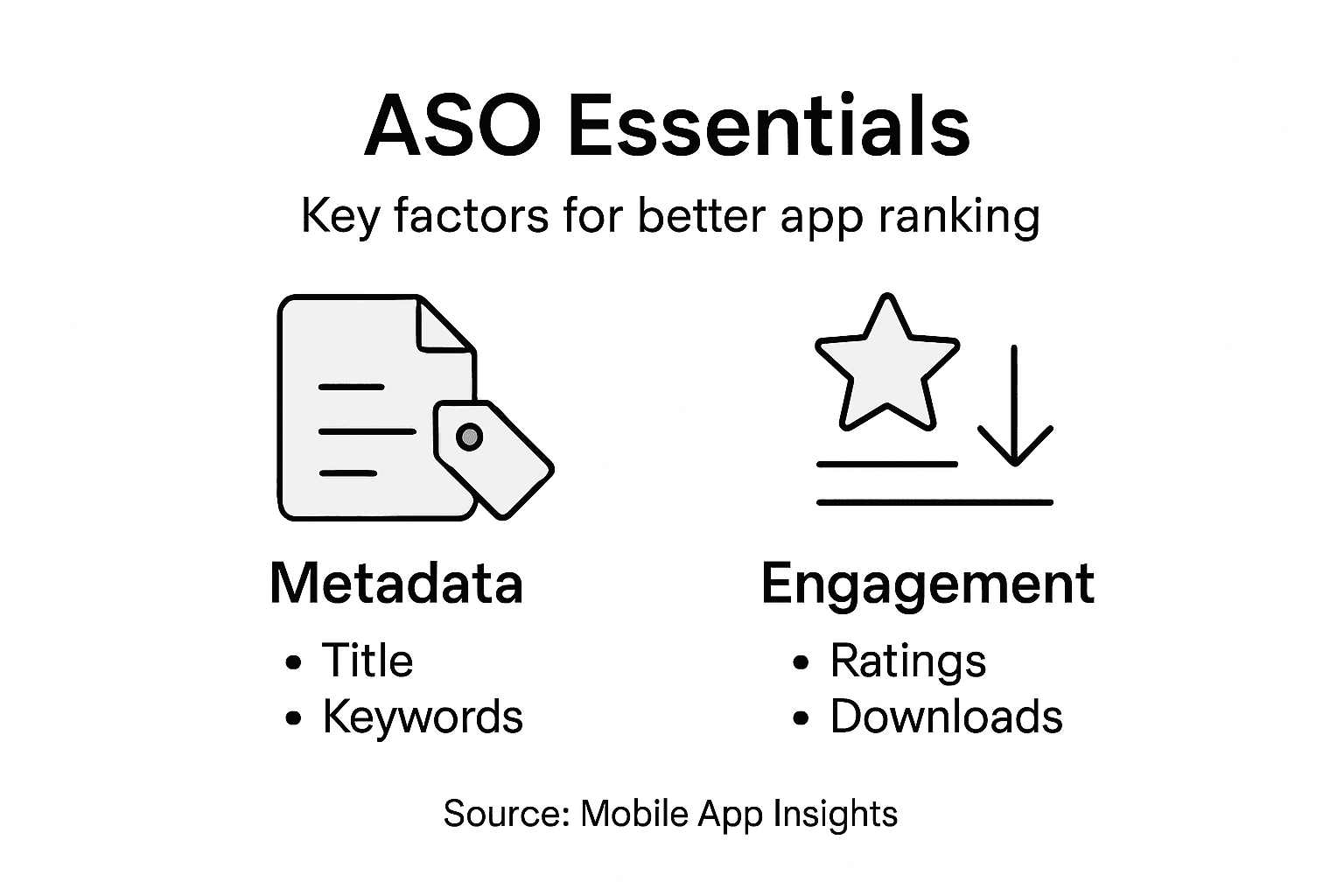
App Store Optimization (ASO) strategies are fundamentally divided into two critical categories that work synergistically to improve mobile app visibility and performance. Metadata and engagement factors represent the dual pillars of effective app store optimization, each playing a unique role in determining an app’s discoverability and success.
Metadata Factors are the developer-controlled elements that directly influence search visibility and initial user perception:
- App title and keywords
- Subtitle and description
- App icon and visual assets
- Category and genre selection
- Localization of content
These on-metadata elements provide the foundational framework for how app stores understand and categorize an application. Developers have direct control over these components, allowing strategic optimization to improve search rankings and initial user attraction.
Engagement Factors represent the dynamic, user-driven metrics that app stores use to evaluate long-term app quality and relevance:
- Download volume and velocity
- User ratings and reviews
- Retention and active user rates
- Session duration
- In-app user interactions
Advanced ASO strategies emphasize integrating both metadata and engagement optimization to create a comprehensive approach. While metadata provides the initial entry point, engagement factors determine the app’s sustained visibility and ranking potential.
Pro tip: Implement a quarterly review process that simultaneously analyzes both metadata performance and user engagement metrics to create a holistic optimization strategy.
Here is a summary of how Metadata and Engagement Factors work together in App Store Optimization:
| Factor Type | Controlled By | Primary Influence | Typical Impact Timeline |
|---|---|---|---|
| Metadata Factors | Developers | Boosts search visibility | Immediate |
| Engagement Factors | Users (behavior) | Sustains rankings and retention | Long-term |
Key Elements for App Store Ranking
App Store Ranking involves a complex interplay of factors that determine an app’s visibility and success in digital marketplaces. Key ranking elements combine developer-controlled metadata with user-driven performance signals, creating a comprehensive evaluation system that goes beyond simple numerical metrics.

The primary ranking factors can be categorized into several critical components:
Quantitative Performance Metrics:
- Total number of downloads
- Download velocity and growth rate
- User retention and active installation rates
- Conversion rates from app store page visits
Qualitative User Engagement Signals:
- User ratings and review quality
- Average rating score
- Review frequency and recency
- User interaction depth and session duration
Developers must understand that app store algorithms use sophisticated scoring mechanisms that weight these elements differently. The most successful mobile games demonstrate consistent performance across multiple dimensions, showing not just initial download potential but sustained user interest and engagement.
Optimization strategies require continuous monitoring and adaptive approaches. Keywords, visual assets, and user experience play interconnected roles in determining an app’s discoverability and ranking potential. Regular updates, responsive customer interaction, and maintaining high-quality app performance are essential for long-term app store success.
Pro tip: Create a monthly tracking dashboard that monitors your app’s performance across key ranking metrics to identify optimization opportunities and trends.
Common Pitfalls and Costly ASO Mistakes
App Store Optimization requires strategic precision, and many mobile game developers inadvertently undermine their app’s visibility through common yet critical mistakes. User acquisition strategies demand meticulous attention to avoid performance-killing errors that can dramatically reduce an app’s discoverability and download potential.
The most frequent ASO mistakes include:
Keyword and Metadata Errors:
- Overcrowding app titles with irrelevant keywords
- Using generic or highly competitive search terms
- Neglecting local language and regional keyword variations
- Failing to update keywords based on market trends
- Ignoring long-tail keyword opportunities
Visual and Presentation Mistakes:
- Low-quality or outdated app screenshots
- Inconsistent branding across app store visuals
- Unclear or cluttered app icon design
- Misaligned preview video content
- Neglecting localized visual assets for different markets
Mobile game developers often underestimate the nuanced nature of app store algorithms. Performance is not just about initial downloads but sustained user engagement. Each mistake can compound, creating a cascading effect that reduces organic discovery and user acquisition potential.
Successful optimization requires a holistic approach that balances technical metadata requirements with compelling user experience design. Continuous monitoring, A/B testing of visual assets, and responsive keyword strategy are essential for maintaining competitive app store rankings.
Pro tip: Conduct a comprehensive ASO audit every quarter, systematically reviewing and updating your app’s metadata, keywords, and visual assets to stay ahead of marketplace dynamics.
Below is a table showing the business impact of addressing common ASO mistakes:
| Mistake Area | Negative Outcome | Optimization Benefit |
|---|---|---|
| Poor Keyword Selection | Low search ranking | Higher discoverability |
| Weak Visual Assets | Low click-through rate | Greater user attraction |
| Outdated Metadata | Missed growth opportunities | Timely ranking improvements |
| Ignored Localization | Limited market reach | Expanded user base |
Best Practices to Enhance Organic User Acquisition
Organic User Acquisition represents the most cost-effective strategy for mobile game developers seeking sustainable growth. Mobile game marketing strategies demand a sophisticated approach that combines strategic visibility with compelling user experience design.
Key practices for enhancing organic user acquisition include:
Keyword Optimization Techniques:
- Conduct comprehensive keyword research specific to mobile gaming
- Target long-tail keywords with moderate competition
- Use region-specific language variations
- Integrate trending gaming terminology
- Analyze competitor keyword strategies
Content and Visual Strategy:
- Create high-resolution, storytelling screenshots
- Develop engaging preview videos
- Showcase unique gameplay mechanics
- Highlight game’s distinctive features
- Update visual assets quarterly
Successful organic acquisition goes beyond simple keyword stuffing. Mobile game developers must create a holistic narrative that communicates the game’s unique value proposition, engaging potential users through strategic visual storytelling and precise metadata optimization.
Dynamic user engagement remains the cornerstone of organic growth. This means continuously monitoring user feedback, rapidly implementing improvements, and maintaining an active community connection that transforms initial downloads into long-term player retention.
Pro tip: Implement a monthly performance review tracking organic download trends, user retention rates, and keyword ranking changes to proactively adjust your acquisition strategy.
Master App Store Optimization with Expert Guidance
Understanding the complexities of App Store Optimization is just the first step toward boosting your mobile game’s visibility and downloads. The challenges of balancing metadata and engagement factors can often feel overwhelming, especially when every detail from keywords to user ratings impacts your app’s success. If you are struggling to pinpoint the right strategies or avoid costly ASO mistakes, you are not alone.
At Ramiz Trtovac, we specialize in transforming ASO challenges into growth opportunities. With extensive experience leading user acquisition initiatives for top studios, our consulting and educational resources are tailored to help you optimize your app titles, keywords, visual assets, and user engagement metrics effectively. Improve your organic user acquisition and sustain high store rankings through proven tactics and ongoing performance insights.

Ready to elevate your app’s discoverability and downloads now? Explore practical strategies and expert advice on ramiztrtovac.com. Connect with a seasoned mobile game performance marketer who can guide your UA campaigns and ASO efforts toward profitable growth. Don’t let your app get lost in the crowd. Take action today and unlock your game’s full potential.
Frequently Asked Questions
What is App Store Optimization (ASO)?
App Store Optimization (ASO) is the process of improving an app’s visibility and ranking in app store search results to increase downloads and user engagement. It involves optimizing various app elements such as titles, keywords, descriptions, and visual assets.
Why is ASO important for mobile apps?
ASO is crucial because it directly impacts an app’s discoverability in competitive app marketplaces. Effective ASO strategies can lead to higher download rates, improved user engagement, and ultimately greater revenue potential for mobile app developers.
What are the key components of ASO?
The key components of ASO include metadata factors like app titles, keywords, and descriptions, as well as engagement factors like user ratings, reviews, and download metrics. Both components work together to improve an app’s visibility and ranking in the app store.
How often should I review my ASO strategy?
It is recommended to conduct a comprehensive ASO audit every quarter. Regularly reviewing and updating your app’s metadata, keywords, and visual assets helps maintain competitiveness and adapts to changing market dynamics.
Recommended
- The Importance of User Acquisition in Mobile Gaming: A Simplified Guide – Ramiz Trtovac
- What Is User Acquisition and Why It Drives Mobile Game Growth
- 7 Key Types of User Acquisition Strategies for Mobile Games
- Top 5 Mobile Game Marketing Strategies for 2024
- Why Optimize Ecommerce Websites for Higher Revenue
- What Is Amazon SEO? Complete Guide for eCommerce
- Why Optimize Ad Campaigns: Boost ROI and Results