
Many founders believe audience expansion means casting a wider net to anyone who might play their game. That’s wrong. Real audience expansion in mobile game user acquisition targets lookalike audiences based on your top players’ data, helping you scale installs while maintaining retention and ROAS. This guide explains how audience expansion works, common mistakes to avoid, and practical frameworks to grow your user base profitably.
Table of Contents
- Introduction: Defining Audience Expansion In Mobile Gaming
- How Audience Expansion Works: Mechanisms And Data
- Common Pitfalls And Misconceptions About Audience Expansion
- Channel Diversification And Creative Integration For Audience Expansion
- Practical Frameworks And Case Studies For Effective Audience Expansion
- Measuring And Optimizing Audience Expansion Performance
- Sustaining Audience Expansion Over Time
- Scale User Acquisition With Expert Guidance
Key takeaways
| Point | Details |
|——-|———||
| Audience expansion uses lookalike modeling | Find new users similar to your best players through data-driven targeting to scale efficiently. |
| Integration with funnel and creative optimization is essential | Expanding audiences without adapting your funnel and creatives can reduce ROAS by 30%. |
| Multi-channel strategies balance scale and profitability | Diversifying ad networks and using phased frameworks helps maintain performance while growing. |
| Clear metrics prevent campaign degradation | Track DAU growth, retention, CPI, and ROAS to identify when segments need refreshing. |
| Long-term success requires continuous iteration | Regularly update audience segments and creatives to sustain quality user acquisition. |
Introduction: defining audience expansion in mobile gaming
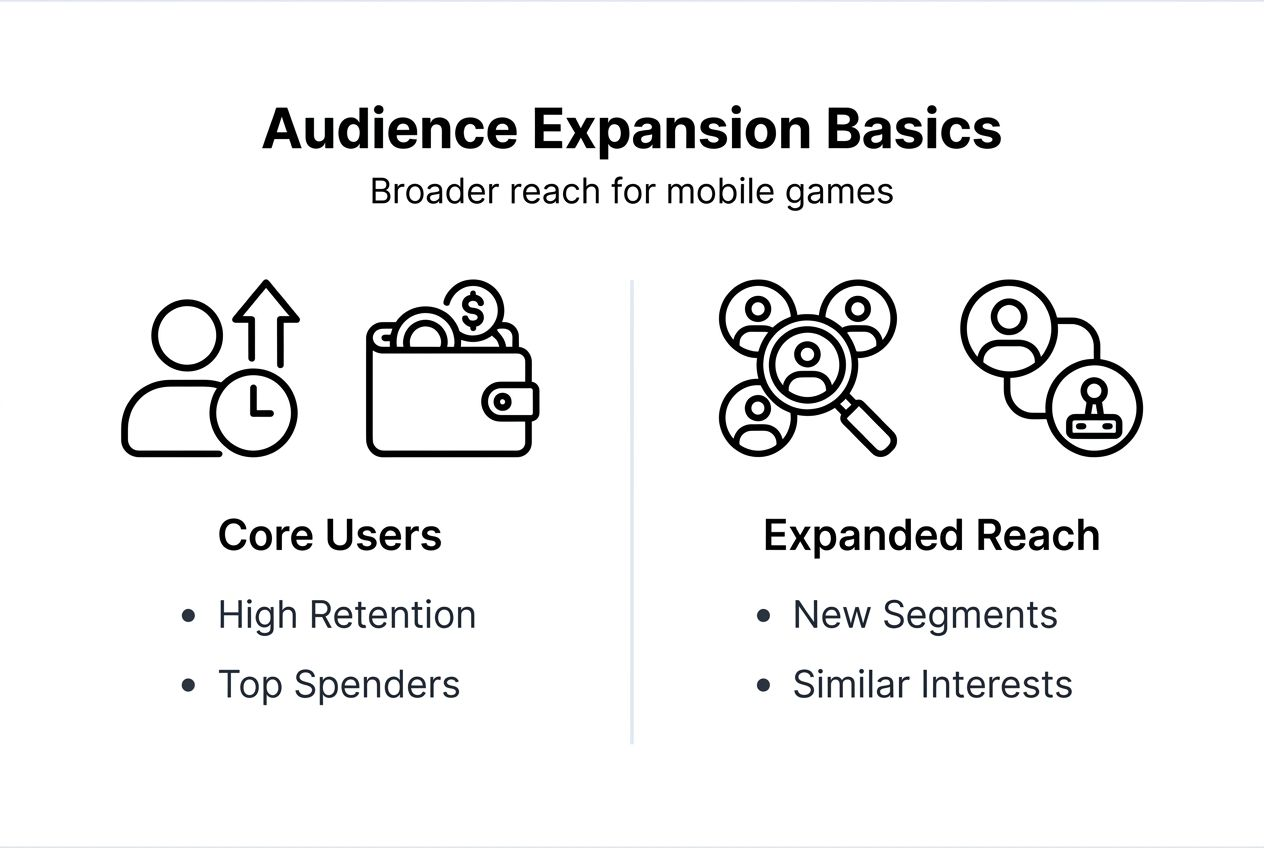
Audience expansion is the strategic process of broadening your user acquisition efforts from core player profiles to similar potential users who share characteristics with your best performers. It’s not about randomly targeting new demographics. Instead, it leverages data to identify players likely to engage deeply and spend money in your game.
In competitive mobile game markets where studios fight for installs with limited budgets, audience expansion is critical for cost-effective user base growth. High market saturation means broad targeting wastes money on low-quality users. Expansion strategies help you compete intelligently by finding quality players efficiently.
Studios typically pursue audience expansion to achieve three goals:
- Scale install volume beyond initial campaigns without sacrificing user quality
- Improve retention rates by targeting players with proven engagement patterns
- Optimize ROAS through precise audience targeting in mobile games that mirrors successful user profiles
Understanding these objectives helps you approach expansion strategically rather than reactively when initial campaigns plateau.
How audience expansion works: mechanisms and data
Lookalike audiences form the technical foundation of modern audience expansion. Ad networks analyze your highest lifetime value players and create targeting models that find new users sharing similar traits, behaviors, and demographics. These models use machine learning to identify patterns invisible to manual targeting.
The data inputs that power lookalike models include:
- Lifetime value (LTV) data from your top spending players
- Behavioral patterns like session length, feature usage, and progression speed
- Demographic information such as age, location, and device type
- Engagement metrics including retention rates and in-app purchase frequency
Maintaining similarity to your core users keeps acquisition ROAS and retention higher because you’re finding players predisposed to enjoy your game. Lookalike-based expansions outperform broad demographic expansions by 25% in retention.
Here’s how lookalike targeting compares to broad demographic approaches:
| Metric | Lookalike Targeting | Broad Demographic |
|---|---|---|
| Day 7 Retention | 42% | 28% |
| Average CPI | $2.40 | $1.80 |
| Day 30 ROAS | 145% | 95% |
| User Quality Score | 8.2/10 | 5.6/10 |
Pro Tip: When selecting your seed audience for lookalike modeling, use players who have reached meaningful milestones like completing tutorial levels or making their first purchase. This creates models focused on engagement, not just installs.
The key is matching new users to behaviors that predict long-term value, not surface-level demographics.

Common pitfalls and misconceptions about audience expansion
Many studios misunderstand audience expansion as permission to target everyone who fits broad categories like “mobile gamers aged 18 to 35.” This approach burns budgets on users with no genuine interest in your game’s mechanics or theme. True expansion maintains connection to proven player profiles.
Another critical mistake is neglecting funnel and creative optimization during expansion. Your onboarding flow and ad creatives worked for initial audiences, but new segments may need different messaging or tutorial pacing. Ignoring these adjustments leads to high install costs with poor retention.
Privacy regulations like iOS App Tracking Transparency have changed how studios collect and use player data for audience modeling. Some founders assume expansion is impossible without granular tracking. Smart studios adapt by using aggregated signals, first-party data, and probabilistic modeling to maintain expansion effectiveness despite privacy constraints.
The most damaging oversight is launching expansion campaigns without clear success metrics. Over 45% of UA campaigns fail due to lack of defined audience expansion success criteria. Without benchmarks for acceptable CPI increases or minimum retention thresholds, you can’t determine if expansion actually improves business outcomes.
Key misconceptions to avoid:
- Expansion means abandoning your core audience understanding
- Lookalike models automatically maintain performance without monitoring
- Privacy changes make data-driven expansion impossible
- Any install growth justifies expansion regardless of user quality
Recognizing these pitfalls helps you approach expansion strategically rather than reactively when initial growth slows.
Channel diversification and creative integration for audience expansion
Relying on a single ad network for audience expansion creates vulnerability to algorithm changes, rising costs, and limited reach. Diversifying across multiple channels like Facebook, Google, Unity, ironSource, and TikTok reduces risk while accessing different user pools. Each network’s lookalike algorithms identify slightly different audiences, expanding your total addressable market.
Creative variants tailored to new audience segments dramatically improve conversion rates. Your original ads resonated with core players, but expanded audiences may respond better to different messaging, visual styles, or value propositions. Testing creative concepts that highlight features appealing to adjacent player types sustains performance as you scale.
Funnel adjustments must accompany audience expansion. New users may need different onboarding experiences, tutorial pacing, or initial incentives. Expanding audience without updating funnel can slash ROAS by up to 30%. Integration between acquisition strategy and product experience determines whether expanded audiences convert into valuable long-term players.
Effective channel and creative strategies include:
- Running parallel campaigns across 3 to 5 ad networks to compare performance
- Creating at least 5 creative variants per audience segment for testing
- A/B testing onboarding flows customized for expanded audience behaviors
- Coordinating mobile user acquisition workflow across teams to align creative, funnel, and targeting
Pro Tip: Analyze which game features your expanded audiences engage with most in their first 72 hours, then create ads highlighting those specific elements. This alignment between ad messaging and actual gameplay experience improves both conversion and retention.
The synergy between diversified channels, tailored creatives, and optimized funnels transforms audience expansion from a scaling tactic into a sustainable growth system.
Practical frameworks and case studies for effective audience expansion
A phased approach to audience expansion reduces risk while building knowledge about what works for your specific game. Start with narrow lookalike audiences (1% to 2% similarity), validate performance, then gradually expand to broader segments (3% to 5%) as data confirms quality remains acceptable.
Phased expansion framework:
- Define your seed audience from top 10% LTV players with strong retention
- Launch 1% lookalike campaigns on two ad networks with existing creative assets
- Monitor for two weeks, measuring Day 7 retention and Day 30 ROAS against benchmarks
- Expand to 2% to 3% lookalikes if metrics remain within 15% of core audience performance
- Test new creative variants specifically for expanded segments
- Scale budgets gradually, increasing by 25% weekly while maintaining ROAS thresholds
- Refresh seed audiences monthly with updated player data
Here’s how strategic timing affects expansion outcomes:
| Expansion Phase | Recommended Timing | Expected DAU Growth | ROAS Target |
|---|---|---|---|
| Initial Testing | Months 1 to 2 | 15% to 25% | Maintain baseline |
| Validated Scaling | Months 3 to 4 | 40% to 60% | Within 10% of baseline |
| Mature Optimization | Months 5+ | 80%+ sustained | Optimize continuously |
A mid-sized puzzle game studio applied this framework after plateauing at 50,000 DAU. By implementing phased audience expansion leading to measurable DAU growth, they reached 95,000 DAU within five months while improving Day 7 retention from 38% to 41%. Their ROAS remained stable at 135% because they continuously refined creatives and onboarding for expanded segments.
The key lesson is balancing growth ambition with data validation at each phase, ensuring expanded audiences maintain the user quality that makes campaigns profitable.
Measuring and optimizing audience expansion performance
Selecting the right KPIs determines whether you can identify problems before they damage profitability. Track DAU growth as your primary scale metric, but never in isolation. Pair it with retention rates to ensure new users engage beyond installation. Monitor CPI trends across audience segments to catch rising costs early.
ROAS measurement becomes more complex during expansion because new audiences often take longer to monetize. Calculate ROAS at Day 30, Day 60, and Day 90 windows rather than relying solely on early indicators. This longitudinal view reveals whether expanded audiences eventually match core user value or consistently underperform.
Key metrics for audience expansion:
- DAU growth rate week over week and month over month
- Day 1, Day 7, and Day 30 retention segmented by audience type
- CPI by audience segment, ad network, and creative variant
- ROAS at multiple time windows (Day 30, 60, 90) by cohort
- Install-to-purchase conversion rate for monetization assessment
Tracking audience segment performance over time exposes degradation before it destroys campaign economics. Create dashboards comparing each segment’s metrics to your baseline core audience. When an expanded segment’s Day 7 retention drops more than 15% below benchmark or CPI rises more than 20%, pause and investigate rather than continuing to spend.
Optimization strategies to sustain performance:
- Refresh underperforming audience segments with updated seed data monthly
- Iterate creative concepts every two to three weeks based on performance data
- Rebalance channel budgets toward networks delivering best segment-specific ROAS
- Test tighter lookalike percentages when broader segments show quality decline
Following the mobile user acquisition workflow ensures you systematically measure and optimize rather than reacting emotionally to temporary fluctuations. Consistent analysis reveals patterns that guide strategic decisions about when to expand further, maintain current scale, or pull back.
Sustaining audience expansion over time
Audience segments degrade as user behaviors evolve, competitors target similar profiles, and ad networks exhaust reach within specific lookalike definitions. Studios that ignore this natural decay watch performance slowly erode without understanding why. Proactive segment refresh every four to six weeks maintains efficiency by incorporating fresh data about which players currently deliver highest value.
Continuous data analysis identifies early warning signs like gradually declining retention or rising CPIs. Set automated alerts when metrics drift beyond acceptable ranges. This allows quick investigation and adjustment before small problems compound into major performance collapses.
Balancing short-term growth ambitions with sustainable ROAS requires discipline. It’s tempting to chase DAU targets by expanding into lower-quality audiences when growth slows. Resist this temptation. Protecting long-term profitability means accepting slower growth that maintains user quality over rapid expansion that destroys unit economics.
Best practices for long-term sustainability:
- Schedule monthly audience strategy reviews analyzing trends across all segments
- Maintain a pipeline of creative concepts ready to test as performance indicators change
- Document learnings from each expansion phase to inform future decisions
- Build financial models that account for gradual CPI increases during sustained growth
- Cultivate relationships with ad network representatives who can provide expansion guidance
Successful audience expansion is not a one-time campaign launch but an ongoing optimization process. Studios that treat it as continuous improvement rather than set-and-forget strategy achieve sustainable growth while maintaining the profitability that funds further investment in their games.
Scale user acquisition with expert guidance
Audience expansion transforms from overwhelming challenge to systematic growth process when you understand the mechanisms, avoid common mistakes, and apply proven frameworks. You’ve learned how lookalike modeling works, which metrics matter, and how to balance scale with profitability.
If you’re ready to implement these strategies but need expert guidance tailored to your specific game, I can help. My experience running large-scale UA campaigns across multiple ad networks has helped studios grow from thousands to hundreds of thousands of daily active users while maintaining strong ROAS. Visit ramiztrtovac.com to explore detailed guides, case studies, and consulting options that accelerate your user acquisition success.
FAQ
What is audience expansion in mobile game user acquisition?
Audience expansion means targeting new potential users similar to your best players through data-driven lookalike models to scale installs effectively. It helps studios grow while maintaining campaign performance and user quality metrics.
How do lookalike audiences improve user acquisition campaigns?
Lookalike audiences target users sharing traits with high-value players, improving retention and ROAS compared to broad demographic targeting. They help efficiently find quality users beyond existing segments by leveraging machine learning pattern recognition.
What mistakes should studios avoid in audience expansion?
Avoid expanding too broadly without data support, neglecting funnel and creative updates, and ignoring privacy constraints that affect tracking. Set clear success metrics from the start to measure whether expansion actually improves business outcomes.
How can studios sustain audience expansion performance over time?
Regularly refresh audience segments and creatives every four to six weeks to prevent performance drops from natural degradation. Balance growth goals with long-term ROAS by maintaining discipline around user quality thresholds even when pursuing scale.
Recommended
- Master Mobile User Acquisition Workflow for Growth
- What Is User Acquisition and Why It Drives Mobile Game Growth
- Audience Targeting: Maximizing Mobile UA Profitability
- What is User Acquisition for Mobile Games? – Ramiz Trtovac