
Rising user acquisition costs are testing the limits of many mobile game studios that want real, profitable growth. For founders and UA managers, clear acquisition goals and meaningful KPIs are not optional—they are the backbone of decisions that can either drive scalable success or drain resources. Grounded in key metrics like Customer Acquisition Cost and Conversion Rate, this guide delivers a proven framework for tracking, analyzing, and refining workflows so your team can confidently scale your user base while protecting margins.
Table of Contents
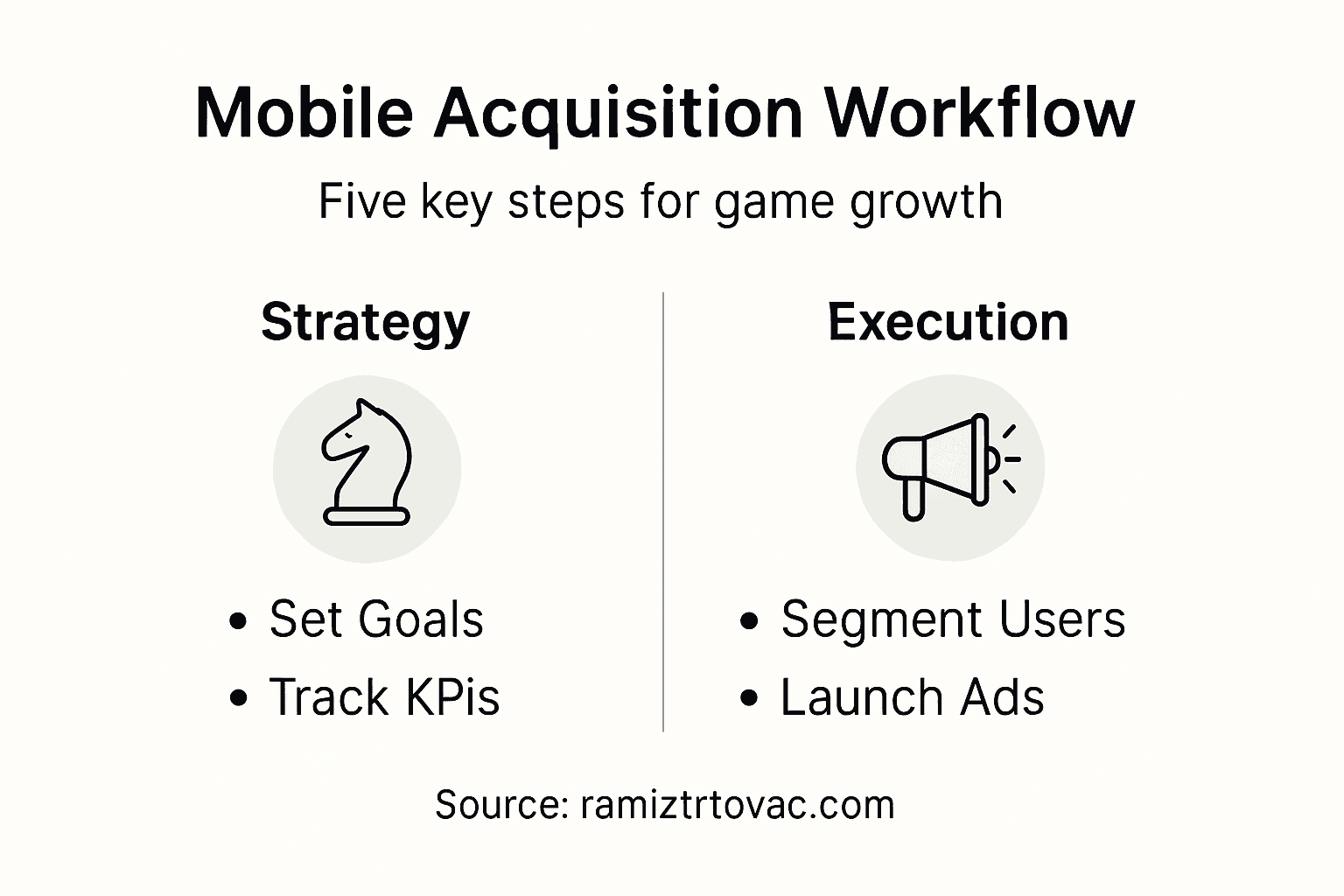
- Step 1: Define Acquisition Goals And KPIs
- Step 2: Set Up Tracking And Analytics Systems
- Step 3: Segment Audiences And Allocate Budgets
- Step 4: Launch Campaigns Across Ad Networks
- Step 5: Analyze Data And Refine Strategies
Quick Summary
| Key Point | Explanation |
|---|---|
| 1. Set Clear Acquisition Goals | Define user acquisition goals that align with your business strategy for effective tracking and optimization. |
| 2. Implement Tracking Systems | Use analytics systems like Firebase to monitor user behavior and campaign effectiveness for informed decision-making. |
| 3. Segment Your Audience | Divide potential players into demographic, behavioral, and technical groups to target marketing efforts effectively. |
| 4. Launch Multi-Network Campaigns | Strategically deploy campaigns across various platforms to maximize visibility and user acquisition opportunities. |
| 5. Analyze and Refine Strategies | Continuously analyze performance data to identify trends and refine user acquisition strategies for better results. |
Step 1: Define acquisition goals and KPIs
Successfully launching a mobile game requires crystal-clear user acquisition goals and measurable key performance indicators (KPIs) that align with your overall business strategy. In this step, you will establish a robust framework for tracking and optimizing your mobile game’s growth potential.
Defining effective acquisition goals starts with understanding your core metrics. User acquisition metrics provide critical insights into your game’s performance and potential scalability. Key metrics you should focus on include:
- Customer Acquisition Cost (CAC): The total expense of acquiring a single new user
- User Growth Rate: The percentage increase in your total user base over a specific timeframe
- Conversion Rate: The proportion of users who complete a desired action (like in-app purchase)
- Channel Attribution: Understanding which marketing channels deliver the most valuable users
To develop meaningful KPIs, you need a strategic approach. KPI development requires articulating clear objectives and selecting indicators that directly reflect your game’s growth potential. Focus on creating KPIs that are:

Here’s how core user acquisition metrics influence mobile game growth:
| Metric | What It Measures | Strategic Business Impact |
|---|---|---|
| Customer Acquisition Cost | Cost per new user acquired | Determines marketing efficiency |
| User Growth Rate | Increase in user base over time | Flags product-market fit and momentum |
| Conversion Rate | Users completing key actions | Indicates onboarding effectiveness |
| Channel Attribution | Value by marketing source | Guides budget allocation and scaling |
- Measurable and quantifiable
- Consistent across reporting periods
- Aligned with your overall game strategy
- Actionable and specific
Your acquisition goals should translate high-level strategic vision into concrete, trackable metrics that guide your user acquisition efforts.
Consider establishing both short-term and long-term acquisition goals. Short-term goals might focus on initial user onboarding and retention, while long-term goals could emphasize lifetime user value and sustainable growth channels.
Pro tip: Create a living document that tracks your KPIs monthly, allowing for continuous refinement and strategic pivots based on actual performance data.
Step 2: Set up tracking and analytics systems
Establishing robust tracking and analytics systems is crucial for understanding and optimizing your mobile game’s user acquisition performance. In this step, you’ll create a comprehensive analytics infrastructure that provides deep insights into user behavior and campaign effectiveness.
Firebase Analytics offers a powerful solution for real-time mobile app tracking. The setup process involves several key steps to ensure comprehensive data collection:
- Create a Firebase project in the Google Firebase console
- Register your mobile game application
- Integrate the Firebase SDK into your game’s codebase
- Configure event tracking for critical user interactions
To establish a robust tracking system, focus on implementing these essential analytics components:
- User acquisition tracking: Monitor where and how users discover your game
- Engagement metrics: Track player interactions, session lengths, and retention rates
- Conversion tracking: Measure key actions like tutorial completion or first purchase
- Performance monitoring: Analyze technical performance and user experience
A well-designed analytics system transforms raw data into actionable insights that drive strategic user acquisition decisions.
For advanced tracking capabilities, consider implementing a comprehensive tracking server that enables centralized data management and collaborative analysis across your team.
Pro tip: Configure custom events and user properties early in your development process to capture nuanced insights that standard tracking might miss.
Step 3: Segment audiences and allocate budgets
Optimizing your mobile game’s user acquisition strategy requires precise audience segmentation and strategic budget allocation. In this critical step, you’ll learn how to divide your potential player base into targeted groups and distribute your marketing resources for maximum impact.
Audience segmentation enables you to create highly focused marketing approaches by dividing potential players into distinct groups. Your segmentation strategy should consider multiple dimensions:
- Demographic segments: Age, gender, location, income level
- Behavioral segments: Gaming preferences, spending habits, play frequency
- Psychographic segments: Player motivations, lifestyle interests
- Technical segments: Device type, operating system, network conditions
When allocating budgets across these segments, implement a strategic approach:
The table below summarizes the primary audience segmentation types and their marketing advantages:
| Segmentation Type | Example Attribute | Marketing Advantage |
|---|---|---|
| Demographic | Age group | Tailors messaging to life stages |
| Behavioral | Spending habits | Identifies high-value users |
| Psychographic | Lifestyle interest | Creates emotional connections |
| Technical | Device type | Optimizes for performance needs |
- Analyze historical performance data from previous campaigns
- Calculate lifetime value (LTV) for each audience segment
- Prioritize high-potential segments with better conversion rates
- Test and iterate budget allocation continuously
Effective audience segmentation transforms generic marketing into precision-targeted user acquisition that maximizes your return on investment.
The goal is to develop a dynamic customer segmentation strategy that adapts to changing market conditions and player behaviors, ensuring your marketing budget delivers optimal results.
Pro tip: Create flexible budget allocation models that allow for rapid reallocation based on real-time performance metrics and emerging audience insights.
Step 4: Launch campaigns across ad networks
Successfully scaling your mobile game requires strategic campaign deployment across multiple advertising platforms. In this critical step, you’ll learn how to orchestrate a comprehensive multi-network user acquisition strategy that maximizes your game’s visibility and player acquisition potential.
Mobile marketing campaigns demand a sophisticated approach to targeting and engagement. Your ad network strategy should encompass diverse channels:
- Social media platforms: Facebook, Instagram, TikTok
- Search engine networks: Google Ads, Apple Search Ads
- Gaming ad networks: Unity Ads, AppLovin, IronSource
- Video advertising platforms: YouTube, Twitch
When launching campaigns, follow these strategic implementation steps:
- Develop platform-specific creative assets
- Set precise targeting parameters
- Establish clear campaign objectives
- Configure budget allocation rules
- Implement robust tracking mechanisms
Successful ad network campaigns require continuous optimization and a data-driven approach to user acquisition.
The key is to understand each platform’s unique advertising campaign dynamics while maintaining consistent messaging and brand identity across all channels.
Pro tip: Create a centralized dashboard that aggregates performance metrics from multiple ad networks, enabling real-time comparative analysis and rapid strategic adjustments.
Step 5: Analyze data and refine strategies
Transforming raw user acquisition data into actionable insights requires a systematic and intelligent approach. In this crucial step, you’ll learn how to dissect performance metrics, uncover hidden patterns, and continuously optimize your mobile game’s growth strategy.
Strategic data analysis enables you to identify barriers and opportunities in your user acquisition workflow. Your analytical approach should focus on key performance dimensions:
- Acquisition channel performance: Comparative metrics across different networks
- User behavior patterns: Engagement rates, retention curves
- Conversion funnel analysis: Drop-off points and optimization opportunities
- Cost efficiency metrics: Customer acquisition cost versus lifetime value
Implement a comprehensive data refinement process through these critical steps:
- Collect comprehensive performance data
- Segment and categorize user interactions
- Identify statistical significance in patterns
- Develop hypotheses for strategic improvements
- Execute targeted experimental modifications
Data-driven refinement transforms user acquisition from a guesswork strategy to a precision-engineered growth mechanism.
Leveraging AI-aided behavioral analysis can help you uncover nuanced insights about user interaction logs and friction points in your mobile game experience.
Pro tip: Create automated dashboards with real-time performance indicators that highlight statistically significant deviations, enabling rapid strategic pivots.
Unlock Your Mobile Game’s Full Growth Potential with Expert Guidance
Mastering the user acquisition workflow is challenging yet critical to scaling your mobile game profitably. The article highlights key hurdles such as defining precise KPIs, setting up robust tracking systems, audience segmentation, and launching cross-network campaigns. If these pain points resonate with you, you are not alone in navigating the complexities of customer acquisition cost, conversion rates, and channel attribution.
Take control of your mobile game’s growth trajectory by partnering with an experienced leader in mobile game performance marketing. At ramiztrtovac.com, you will find proven strategies and tailored consulting that simplify your acquisition goals, optimize budget allocation, and enhance campaign effectiveness. Discover how to turn user data into actionable insights and scale your campaigns confidently just like industry leaders Two Desperados and GameBiz Consulting have.
Visit ramiztrtovac.com today to explore expert resources, practical case studies, and personalized support to elevate your mobile marketing. Don’t wait until data overwhelms you. Start refining your user acquisition strategy now and experience measurable growth.
Frequently Asked Questions
What are the key user acquisition goals for mobile games?
Defining user acquisition goals involves understanding your core metrics, such as Customer Acquisition Cost and User Growth Rate. Establish measurable and actionable goals that reflect your game’s overall growth strategy within a specific timeframe.
How can I set up effective tracking and analytics for my mobile game?
To establish a robust tracking system, create a project in your analytics platform and integrate the necessary software into your game. Focus on monitoring user acquisition sources, engagement metrics, and conversion rates to gather comprehensive insights within the first few weeks of launch.
What is audience segmentation, and why is it important for marketing?
Audience segmentation divides potential players into targeted groups based on demographics, behaviors, and preferences. This helps tailor marketing messages and allocate your budget effectively, improving user acquisition efforts by focusing on high-potential segments.
How do I launch campaigns across multiple ad networks?
Orchestrate your campaigns by developing platform-specific creative assets and defining clear targeting parameters for each ad network. Launch your campaigns systematically, and continually track performance to adjust strategies based on real-time data.
What steps should I take to analyze data after my mobile game launch?
To analyze data effectively, collect comprehensive performance metrics and categorize user interactions to identify patterns. Focus on key areas like acquisition channel efficiency and conversion funnels, enabling you to refine strategies for improved growth.
Recommended
- What Is User Acquisition and Why It Drives Mobile Game Growth
- Master Mobile Game UA Workflow for Profitable Launches
- 7 Key Types of User Acquisition Strategies for Mobile Games
- Mobile Game Marketing: How It Drives Studio Growth