
Every mobile game studio hits a point where raw creativity is not enough to compete. With countless titles vying for the spotlight, understanding the true power of mobile game analytics becomes the difference between scaling quickly and struggling with stagnant growth. Today, founders and UA managers need more than basic metrics—they need strategic intelligence that reveals hidden player patterns, informs smarter acquisition, and maximizes profitability.
Table of Contents
- Defining Mobile Game Analytics and Its Role
- Core Metrics for Mobile Game Performance
- Analytics Tools and Implementation Essentials
- Privacy, Data Quality, and Regulatory Compliance
- Optimizing User Acquisition with Analytics
- Common Pitfalls and Solutions in Mobile Analytics
Key Takeaways
| Point | Details |
|---|---|
| Importance of Mobile Game Analytics | Mobile game analytics transforms data into strategic insights, enhancing player engagement and optimizing game performance. |
| Key Performance Indicators (KPIs) | Tracking KPIs such as user acquisition, retention, and monetization is essential for data-driven decision-making. |
| Implementation Considerations | Choosing the right analytics tools is crucial for effective data collection, privacy compliance, and real-time insights. |
| Addressing Common Pitfalls | Proactively tackling challenges like incomplete data tracking and privacy issues can enhance analytics effectiveness and user trust. |
Defining Mobile Game Analytics and Its Role
Mobile game analytics represents a sophisticated data-driven approach to understanding player interactions and game performance. Game analytics is the systematic process of identifying meaningful patterns within game data to evaluate and improve user engagement strategies.
At its core, mobile game analytics encompasses several critical dimensions:
- Tracking player behaviors and interactions
- Measuring in-game performance metrics
- Understanding user progression patterns
- Evaluating monetization opportunities
- Identifying potential retention strategies
The primary objective of mobile game analytics extends far beyond simple data collection. Actionable insights derived from comprehensive analysis enable game developers and marketers to make strategic decisions that directly impact game performance and user experience.
Mobile game analytics transforms raw data into strategic intelligence, bridging the gap between player behavior and business objectives.
By leveraging advanced analytical technologies, studios can track everything from initial user acquisition through long-term player engagement. Mobile gaming analytics focuses on gathering nuanced data that reveals complex player preferences, helping teams optimize game design, marketing approaches, and monetization strategies.
Pro tip: Implement comprehensive tracking from day one to build a robust dataset that reveals genuine player behavior patterns and supports data-driven decision making.
Core Metrics for Mobile Game Performance
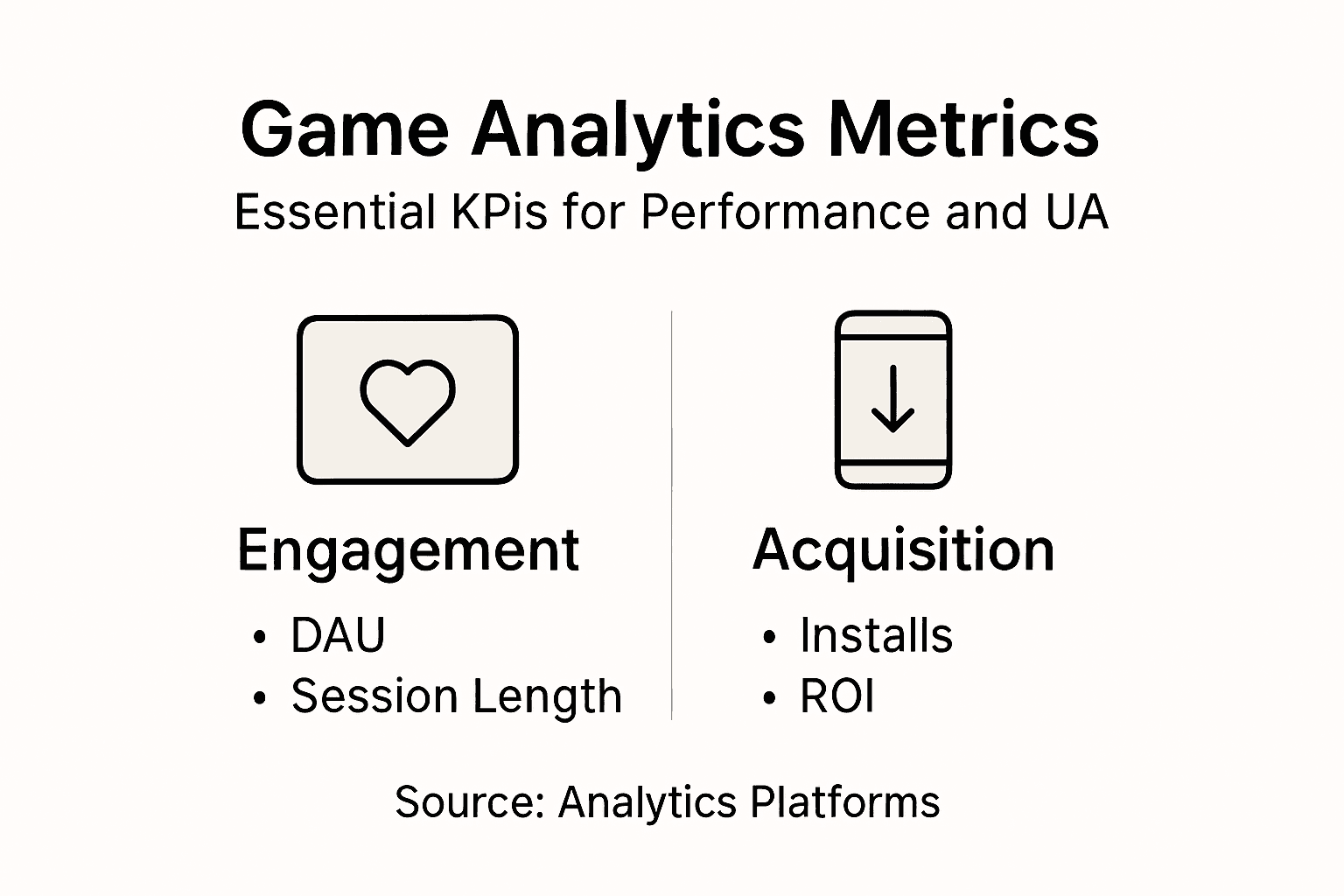
Successful mobile game performance relies on tracking and understanding a comprehensive set of key performance indicators (KPIs) that provide critical insights into game health and user engagement. Performance metrics capture essential data across multiple dimensions of game development and player interaction.
The most critical mobile game performance metrics can be categorized into several fundamental areas:
- User Acquisition Metrics
- Total new users
- Acquisition cost per user
- User source channels
- Retention Metrics
- Day 1, Day 7, and Day 30 retention rates
- Churn rate
- Player lifecycle
- Engagement Metrics
- Average session length
- Session frequency
- In-game interaction rates
- Monetization Metrics
- Average Revenue Per User (ARPU)
- Conversion rate
- In-app purchase frequency
- Technical Performance Metrics
- App crash rates
- Load times
- Server stability
Understanding these metrics provides game developers and marketers with a holistic view of game performance, enabling data-driven decision-making that can significantly improve user experience and revenue potential.

Here’s a reference of how core mobile game metrics align with business goals:
| Metric Category | Key Focus | Common Business Impact |
|---|---|---|
| User Acquisition | New users, cost | Increases player base, controls CAC |
| Retention | Return rates, churn | Boosts lifetime value, reduces churn |
| Engagement | Session length/frequency | Enhances user satisfaction |
| Monetization | Revenue, conversions | Drives in-game purchases, ARPU |
| Technical Performance | Crashes, stability | Improves user experience, prevents loss |
Effective mobile game analytics transforms raw numbers into strategic insights that drive game development and marketing strategies.
By systematically analyzing these performance indicators, studios can identify strengths, address weaknesses, and continuously optimize their mobile game’s overall performance and player satisfaction.
Pro tip: Establish a consistent monitoring dashboard that tracks these key metrics in real-time, allowing for immediate insights and rapid strategic adjustments.
Analytics Tools and Implementation Essentials
Mobile game studios require robust analytics platforms to transform raw player data into meaningful insights. Game analytics implementation involves strategic data collection that captures critical player interactions and game performance metrics.
Key considerations for selecting and implementing analytics tools include:
- Platform Compatibility
- Unity Analytics integration
- Firebase support
- Cross-platform tracking capabilities
- Data Collection Requirements
- Event tracking mechanisms
- User interaction logging
- Performance monitoring
- Privacy and Compliance
- GDPR adherence
- User consent management
- Data anonymization protocols
- Analytical Capabilities
- Cohort analysis tools
- Funnel visualization
- Real-time reporting dashboards
Successful analytics implementation requires a comprehensive approach that balances technical sophistication with strategic objectives. Studios must design event taxonomies that capture meaningful player behaviors while maintaining flexibility for future analysis.
Effective analytics tools are not just data collectors, but strategic partners in understanding player dynamics and optimizing game performance.
Best practices for analytics implementation emphasize selecting platforms that provide deep insights into player retention, engagement, and monetization patterns. This approach enables continuous game optimization and more targeted user acquisition strategies.
Pro tip: Develop a comprehensive analytics implementation plan that prioritizes data quality, privacy compliance, and actionable insights from the initial game development stages.
Privacy, Data Quality, and Regulatory Compliance
Data privacy regulations dramatically impact mobile game analytics strategies, requiring studios to implement robust compliance frameworks that protect user information while maintaining effective data collection practices.
Key privacy and regulatory compliance considerations include:
- Consent Management
- Clear user consent mechanisms
- Transparent data collection policies
- Opt-out options
- Data Protection Requirements
- GDPR compliance protocols
- COPPA child data protection
- International data transfer standards
- Security Protocols
- Encryption of personal data
- Secure data storage practices
- Regular security audits
- User Rights Management
- Right to data access
- Right to data deletion
- Data portability options
Mobile game studios must embed privacy considerations into their core analytics design, treating data protection as a fundamental aspect of their development process rather than an afterthought.
Regulatory compliance is not just a legal requirement, but a critical trust-building mechanism with your player community.
Mobile game analytics demands rigorous data protection strategies that go beyond basic legal compliance. This involves creating comprehensive cybersecurity practices, maintaining transparent data handling protocols, and ensuring that every piece of collected player information serves a clear, justified purpose.
Pro tip: Develop a comprehensive privacy framework that treats user data as a privilege, not a right, by implementing strict consent and protection mechanisms from the initial stages of game development.
Optimizing User Acquisition with Analytics
Scalable user acquisition strategies require a sophisticated approach that leverages deep analytical insights to drive targeted, cost-effective player recruitment. Mobile game studios must transform raw data into precise targeting mechanisms that maximize return on investment across diverse marketing channels.
Key strategies for optimizing user acquisition through analytics include:
- Audience Segmentation
- Demographic targeting
- Behavioral profiling
- Interest-based clustering
- Campaign Performance Tracking
- Cost Per Install (CPI) monitoring
- Return On Ad Spend (ROAS) analysis
- Conversion rate optimization
- Creative Optimization
- A/B testing ad creatives
- Performance-based creative iterations
- Visual and messaging refinement
- Retention-Focused Acquisition
- Identifying high-value player segments
- Predictive lifetime value modeling
- Targeting lookalike audiences
Successful user acquisition demands continuous refinement, with analytics serving as the critical intelligence engine that guides strategic decision-making.
Analytics transforms user acquisition from a guessing game into a precise, data-driven science.
Player segmentation enables targeted marketing that goes beyond traditional demographic boundaries, allowing studios to craft hyper-personalized acquisition strategies that resonate with specific player motivations and behaviors.
Pro tip: Develop a dynamic user acquisition dashboard that tracks real-time performance metrics, enabling immediate strategic pivots and optimization.
Common Pitfalls and Solutions in Mobile Analytics
Mobile game analytics challenges encompass a complex landscape of technical, regulatory, and strategic obstacles that require sophisticated, multifaceted solutions. Studios must navigate rising user acquisition costs, evolving data privacy regulations, and increasingly competitive market dynamics.
Key pitfalls in mobile game analytics include:
- Data Collection Challenges
- Incomplete user tracking
- Fragmented data sources
- Inconsistent measurement standards
- Compliance and Privacy Issues
- GDPR and CCPA restrictions
- User consent management
- Data anonymization requirements
- Performance Measurement Limitations
- Inaccurate attribution models
- Limited cross-platform insights
- Difficulty tracking long-term player value
- Technical Implementation Problems
- Inadequate backend infrastructure
- Poor data integration
- Scalability constraints
Successful analytics strategies require a proactive approach that anticipates and addresses these fundamental challenges through continuous optimization and intelligent design.
Explore practical solutions for common mobile game analytics pitfalls:
| Pitfall Type | Typical Risk | Targeted Solution |
|---|---|---|
| Incomplete Tracking | Data gaps, missed behaviors | Use unified event taxonomy |
| Privacy Compliance | Fines, lost trust | Integrate consent management |
| Poor Data Integration | Fragmented insights | Centralize analytics platforms |
| Inaccurate Attribution | Wrong marketing spend | Implement advanced attribution |
Analytics success depends not just on collecting data, but on transforming complexity into actionable intelligence.
Mobile game development demands robust analytics that go beyond surface-level metrics, requiring deep integration of technical capabilities, user experience insights, and strategic thinking.
Pro tip: Implement a comprehensive analytics framework that prioritizes data quality, privacy compliance, and continuous learning from user interactions.
Unlock Profitable User Acquisition with Expert Mobile Game Analytics Guidance
The challenge of transforming vast mobile game analytics data into actionable strategies for user acquisition profit is critical for studios looking to scale. This article highlights the complexities of tracking key performance indicators such as retention, engagement, and monetization while navigating privacy compliance and data quality pitfalls. If you struggle with converting deep analytical insights into targeted, cost-effective UA campaigns and sustainable growth, you are not alone.
At ramiztrtovac.com, Ramiz Trtovac offers unparalleled consulting and educational support designed to bridge these gaps. Drawing from extensive experience leading large-scale campaign initiatives and pioneering data-driven mobile game marketing strategies, Ramiz equips studios with proven frameworks to optimize user acquisition and maximize lifetime value. Whether it is mastering cohort analysis, building effective dashboards, or developing compliant, privacy-conscious analytics frameworks, expert guidance is crucial now more than ever.

Take control of your mobile game’s growth trajectory today with personalized consulting that unlocks the full potential of mobile game analytics. Visit ramiztrtovac.com to explore comprehensive resources, gain insights from hands-on talks, and start scaling user acquisition profitably right away.
Frequently Asked Questions
What is mobile game analytics?
Mobile game analytics is a data-driven approach that helps developers understand player interactions and game performance. It involves tracking player behavior, measuring performance metrics, and gaining insights to improve user engagement.
How can mobile game analytics improve user acquisition strategies?
Mobile game analytics enables studios to segment audiences, track campaign performance, and optimize creative materials. This data helps in targeting specific player segments, resulting in more cost-effective user acquisition campaigns.
What are key performance indicators (KPIs) for mobile game performance?
Key performance indicators for mobile games include user acquisition metrics, retention rates, engagement metrics, monetization statistics, and technical performance measurements. These KPIs help developers gauge the health and success of their games.
Why is data privacy important in mobile game analytics?
Data privacy is crucial because it involves protecting user information while collecting data for analytics. Compliance with regulations like GDPR helps build trust with players and ensures the proper handling of personal data.
Recommended
- Master Mobile Game UA Workflow for Profitable Launches
- Mobile Game Marketing: How It Drives Studio Growth
- Audience Targeting: Maximizing Mobile UA Profitability
- What Is User Acquisition and Why It Drives Mobile Game Growth
- Level Up Your Loyalty: The Ultimate Guide to Gamification | BonusQR
- How Mobile Fitness Apps Gamify Weight Loss Workouts? – LeanAndFit