
Mobile game studio founders across Europe know the challenge of capturing user attention in a saturated market. Delivering the right advertising experience is key, and playable ads offer a unique solution by letting users actively try a game before committing to download. Despite persistent myths about technical barriers or costs, modern tools have made playables widely accessible. Discover how breaking through outdated misconceptions can unlock more engaged users and make mobile game marketing significantly more profitable.
Table of Contents
- Playable Ads Explained And Common Myths
- Playable Ad Types And Core Distinctions
- Mechanics And Features Of Playable Ads
- Measuring Impact On Ua And Retention
- Risks, Costs, And Common Pitfalls
Key Takeaways
| Point | Details |
|---|---|
| Playable Ads Enhance Engagement | These interactive ads allow users to experience a game directly, leading to higher conversion rates compared to traditional formats. |
| Debunking Myths | Common misconceptions, such as playable ads only being for mobile games and being too costly, are unfounded due to democratized creation tools. |
| Optimize User Experience | Implementing clear interfaces and highlighting core mechanics are essential for creating effective playable ads. |
| Track Performance Metrics | Key indicators like conversion rate and retention should be monitored to assess the success of playable ad campaigns. |
Playable ads explained and common myths
Playable ads represent a powerful interactive advertising format that enables potential users to experience a game or app directly within an advertisement. Unlike traditional static or video ads, these dynamic experiences allow users to engage with a miniature version of the product before downloading. Interactive digital advertising techniques have transformed how mobile game studios attract and convert new players.
Several common misconceptions persist about playable ads that prevent many developers from fully leveraging their potential:
- Playable ads are only for mobile games
- They require advanced coding skills to create
- Interactive ads are too expensive to produce
- These ads do not genuinely improve user acquisition
In reality, modern playable ad creation tools have democratized the process, making them accessible to developers with varying technical backgrounds. Advanced ad creation platforms now offer drag-and-drop interfaces that eliminate complex programming requirements.
Playable ads work by providing users a short interactive preview that demonstrates a game’s core mechanics and entertainment value. This approach generates higher engagement compared to passive video advertisements because potential users can immediately understand the app’s appeal. By allowing users to experience gameplay directly, studios can:
- Reduce install friction
- Increase user intent
- Lower customer acquisition costs
- Improve overall conversion rates
Key Performance Metrics for playable ads typically demonstrate significant improvements over traditional advertising formats. Studios frequently report conversion rates 2-3 times higher than standard mobile game advertisements.
Pro tip: Start with a simple, compelling 15-30 second playable experience that highlights your game’s most enjoyable core mechanic.
Playable ad types and core distinctions
Playable ads represent a sophisticated digital advertising strategy with multiple distinct formats designed to engage potential users. Interactive advertising formats have evolved to provide increasingly nuanced approaches for mobile game marketing.
Two primary categories of playable ads dominate the current landscape:
- HTML5 Playable Ads: Complex, fully interactive experiences
- Interactive Video Ads: Hybrid formats blending video and gameplay elements
- Clickable End Card Ads: Simplified interactive experiences
HTML5 Playable Ads offer the most immersive user experience, allowing potential players to engage directly with a miniature version of the game. Advanced interactive ad platforms enable developers to create sophisticated, code-based experiences that closely mirror actual gameplay.

Interactive video ads represent a more accessible alternative, integrating short gameplay segments within traditional video advertisement frameworks. These hybrid formats provide a compromise between full HTML5 experiences and standard video advertisements, making them particularly attractive for studios with limited development resources.
Key distinguishing factors between playable ad types include:
Here’s a side-by-side comparison of the main playable ad formats:
| Ad Format | Technical Complexity | Immersion Level | Typical Use Case |
|---|---|---|---|
| HTML5 Playable Ads | High | Most immersive | Full gameplay simulation |
| Interactive Video Ads | Moderate | Moderate immersion | Blending video & action |
| Clickable End Card Ads | Low | Limited interactivity | Simple feature preview |
- Technical complexity
- Development cost
- User engagement potential
- Representation of actual gameplay
- Production time requirements
Performance Metrics consistently demonstrate that more interactive ad formats generate higher user intent and lower acquisition costs compared to traditional advertising approaches.
Pro tip: Select a playable ad format that authentically represents your game’s core mechanics while remaining technically feasible for your development team.
Mechanics and features of playable ads
Playable ads transform mobile game marketing by offering interactive experiences that go beyond traditional advertising. Interactive ad mechanics enable potential users to directly experience game functionality through engaging user interfaces.
The core mechanics of playable ads typically involve several key interaction types:
- Tap Interactions: Simple touch-based gameplay
- Swipe Mechanics: Directional user input
- Drag-and-Drop Functions: More complex interaction models
- Timing-Based Challenges: Skill-testing gameplay segments
These interaction methods are strategically designed to showcase a game’s most compelling core gameplay loop. By providing a miniature, time-limited experience (usually 15-30 seconds), playable ads effectively communicate a game’s unique value proposition and entertainment potential.
Successful playable ads focus on several critical design principles:
- Highlight the most engaging game mechanic
- Maintain a clear, intuitive user interface
- Provide immediate feedback for user actions
- Include a prominent call-to-action button
- Limit complexity to prevent user frustration
The technical implementation of these ads requires careful consideration of user experience, performance optimization, and precise game asset selection. Developers must create a condensed version of their game that feels authentic yet quickly demonstrates the core entertainment value.
Performance Characteristics reveal that well-designed playable ads can significantly improve user acquisition metrics, with some studios reporting conversion rate increases of 30-50% compared to traditional video advertisements.
Pro tip: Design your playable ad to demonstrate your game’s most unique and enjoyable mechanic within the first 10 seconds of interaction.
Measuring impact on UA and retention
User acquisition metrics provide critical insights into the effectiveness of playable ad campaigns. Quantitative performance analysis reveals that interactive advertising formats can dramatically improve conversion rates and user engagement.
Key performance indicators for measuring playable ad impact include:
- Install conversion rates
- User engagement duration
- Day 1, Day 7, and Day 30 retention rates
- Return on ad spend (ROAS)
- Cost per quality install
Comprehensive Testing Strategies are essential for accurately assessing playable ad performance. Iterative testing methodologies help developers optimize their ad experiences by systematically evaluating different creative approaches and audience segments.
Most successful mobile game studios implement a multi-dimensional analysis approach that goes beyond traditional metrics. They track:
- Initial interaction time within the playable ad
- Completion rates of the mini-gameplay experience
- Post-install user behavior patterns
- Long-term lifetime value (LTV) of acquired users
Statistical evidence suggests that well-designed playable ads can reduce uninstall rates by up to 40% and improve user satisfaction through more authentic pre-installation experiences.
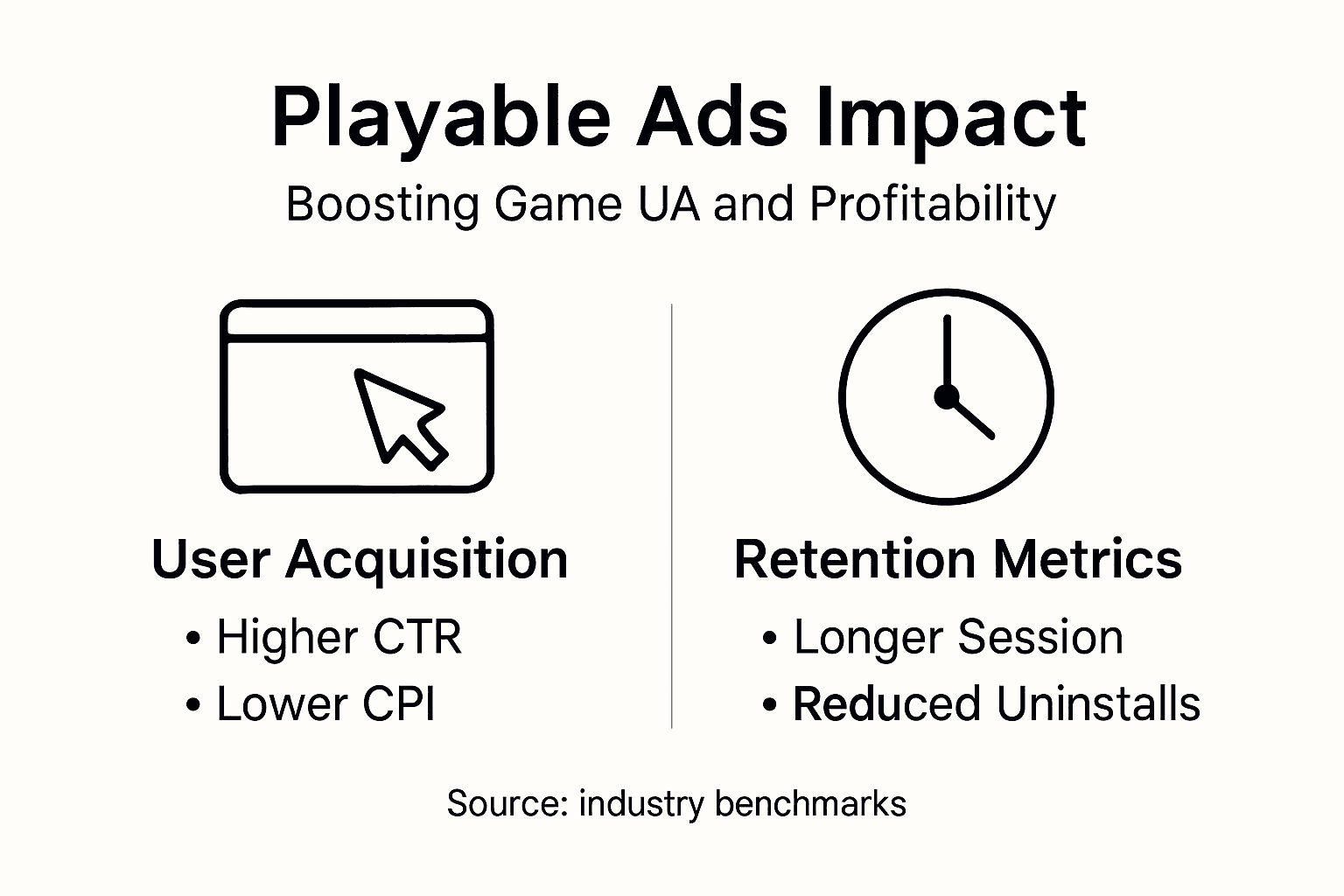
Below is a summary of key metrics for evaluating playable ad campaign success:
| Metric | What It Measures | Typical Impact of Playable Ads |
|---|---|---|
| Conversion Rate | Users installing post-click | 2-3x higher than video ads |
| Retention Rate | User retention over time | Up to 40% lower uninstalls |
| Cost Per Quality Install | Cost for high-value user | Often reduced due to engagement |
| Engagement Duration | Time spent in the ad | 15-30 seconds recommended |
Advanced tracking technologies enable studios to create granular user segments, allowing for increasingly precise targeting and performance optimization.
Pro tip: Implement A/B testing for your playable ads, comparing different interaction mechanics, visual styles, and call-to-action placements to identify the most effective combination.
Risks, costs, and common pitfalls
Playable ad development involves several significant challenges that mobile game studios must carefully navigate. Common pitfalls in interactive advertising can quickly undermine the effectiveness of user acquisition strategies.
Primary risks and challenges include:
- High development complexity
- Substantial upfront production costs
- Technical implementation barriers
- Potential user experience inconsistencies
- Risk of ad platform rejection
Development Complexity represents one of the most significant obstacles for game studios. Creating a compelling mini-gameplay experience requires sophisticated technical skills and creative design expertise. Playable ad optimization strategies highlight the critical importance of balancing technical execution with creative clarity.
Most studios encounter specific challenges during playable ad creation:
- Condensing game mechanics into a 15-30 second experience
- Maintaining visual and interactive quality
- Creating intuitive user interfaces
- Preventing user confusion
- Controlling production expenses
Financial considerations can be particularly challenging. Developing high-quality playable ads typically requires significant investment, with production costs ranging from $2,000 to $15,000 depending on game complexity and design requirements.
Performance Metrics suggest that despite these challenges, well-executed playable ads can generate substantially higher conversion rates compared to traditional advertising formats.
Pro tip: Start with a minimum viable playable ad prototype, focusing on your game’s most engaging core mechanic to minimize initial development costs.
Elevate Your User Acquisition with Expert Playable Ad Strategies
Playable ads offer an incredible opportunity to boost mobile game user acquisition by engaging potential players with interactive previews. However, the challenges of high development costs and technical complexity can hold studios back from unlocking their full potential. If you want to reduce install friction, increase conversion rates, and lower acquisition costs while mastering effective playable ad mechanics, expert guidance is key.
Discover how Ramiz Trtovac can help you navigate the complexities of playable ads and optimize campaign performance. Leverage proven strategies from industry campaigns and cutting-edge user acquisition insights to scale your game profitably. Don’t let common pitfalls slow your growth. Visit ramiztrtovac.com today and take the first step toward transformative UA success with actionable consulting and tailored educational resources.
Frequently Asked Questions
What are playable ads?
Playable ads are interactive advertisements that allow potential users to experience a game or app within the ad itself, providing a miniature version of the product for engagement before downloading.
How do playable ads improve user acquisition?
Playable ads enhance user acquisition by generating higher engagement and interest, reducing install friction, increasing user intent, and ultimately leading to lower customer acquisition costs and improved conversion rates.
What types of playable ads are available?
The main types of playable ads include HTML5 playable ads, interactive video ads, and clickable end card ads. Each format varies in technical complexity, immersion level, and typical use cases.
What key performance metrics should be evaluated for playable ads?
Important metrics to evaluate include install conversion rates, user engagement duration, retention rates for Day 1, Day 7, and Day 30, return on ad spend (ROAS), and cost per quality install.
Recommended
- Master Mobile Game UA Workflow for Profitable Launches
- What Is User Acquisition and Why It Drives Mobile Game Growth
- Crafting Engaging Ad Creatives for Hyper-Casual Games
- Audience Targeting: Maximizing Mobile UA Profitability