
Staying profitable in the crowded mobile gaming industry means tackling the challenge of turning user engagement into sustainable income without pushing players away. With consumer spending on mobile apps projected to reach 233 billion dollars by 2026, the pressure is on for studios worldwide to adapt fast. This guide explores the essentials of in-app monetization, highlighting innovative models and actionable strategies designed to help game founders and UA managers maximize revenue while keeping players loyal.
Table of Contents
- Defining In-App Monetization And Its Role
- Most Common Monetization Models In 2026
- How In-App Monetization Works In Games
- Balancing Revenue, User Experience, And Retention
- Risks, Legal Issues, And Common Pitfalls
Key Takeaways
| Point | Details |
|---|---|
| In-App Monetization Definition | In-app monetization is the process of generating revenue within mobile applications, allowing developers to create ongoing income streams through various methods. |
| Importance of User Experience | Successful monetization strategies must balance revenue generation with user experience to enhance engagement without disruption. |
| Emerging Monetization Models | As the market evolves, models like rewarded video ads, subscription tiers, and premium content unlocks are becoming increasingly prominent. |
| Legal and Ethical Considerations | Developers must navigate legal risks related to data privacy and ensure transparent pricing to maintain user trust and compliance. |
Defining In-App Monetization and Its Role
In-app monetization represents the strategic process of generating revenue within mobile applications by converting user engagement into financial value. Unlike traditional one-time purchase models, in-app monetization allows developers to create sustainable income streams through multiple mechanisms embedded directly within the application experience.
The core purpose of in-app monetization involves transforming free or freemium mobile applications into profitable platforms by implementing intelligent revenue generation strategies. Digital platform economics research demonstrates that effective monetization significantly influences user participation and market dynamics.
Key characteristics of in-app monetization include:
- Generating revenue without disrupting user experience
- Offering multiple potential income streams
- Providing flexible payment options
- Enabling direct value exchange between users and developers
Mobile game developers specifically leverage various monetization techniques to create sustainable business models. These strategies transform user interactions into measurable economic value, allowing studios to invest in continued game development and improvement.
The fundamental monetization approaches include:
- Microtransactions for virtual goods
- Premium feature unlocks
- Subscription models
- In-game advertising
- Virtual currency systems
Pro tip: Successful in-app monetization requires balancing user value with revenue generation, ensuring that monetary strategies enhance rather than interrupt the core application experience.
Most Common Monetization Models in 2026
The mobile app monetization landscape continues to evolve, with multiple sophisticated strategies emerging to help developers generate sustainable revenue. Global app monetization trends project consumer spending will exceed $233 billion by 2026, highlighting the critical importance of diverse revenue streams for mobile game studios.
Mobile game developers are increasingly adopting complex monetization models that balance user experience with strategic revenue generation. These approaches go beyond traditional advertising, incorporating more nuanced and user-friendly methods of creating financial value.
Key Monetization Models in 2026 Include:
- Rewarded Video Ads: Users receive in-game benefits for watching advertisements
- Subscription Tiers: Multiple access levels with incrementally valuable features
- Microtransactions: Small, targeted purchases for virtual goods
- Battle Passes: Time-limited progression systems with exclusive rewards
- Premium Content Unlocks: One-time purchases for permanent game enhancements
These models represent a sophisticated approach to generating revenue that respects user engagement and provides tangible value. Successful implementation requires understanding player psychology and creating monetization strategies that feel like natural extensions of the gaming experience.
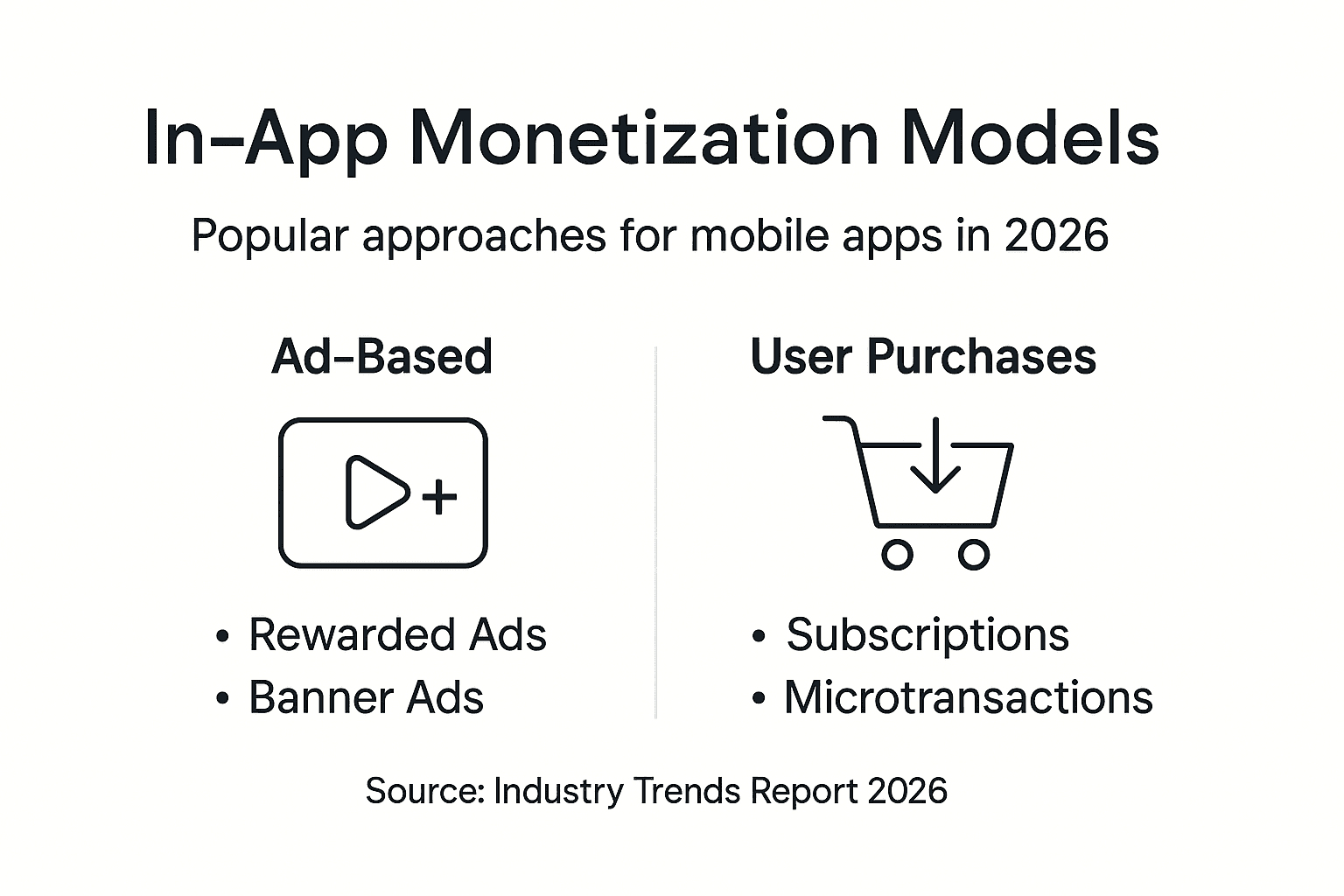
Here’s a comparison of leading in-app monetization models in 2026, highlighting their benefits and challenges:
| Model | Key Benefit | Primary Challenge |
|---|---|---|
| Rewarded Video Ads | Enhances retention with incentives | Ad fatigue risk |
| Subscription Tiers | Predictable recurring revenue | Requires frequent content updates |
| Microtransactions | High volume of small purchases | Potential for user overspending |
| Battle Passes | Boosts long-term engagement | Needs regular new content |
| Premium Content Unlocks | Increases upfront value perception | Limits for non-paying users |
The Most Promising Monetization Approaches Ranked:
- Hybrid models combining multiple revenue streams
- User-centric microtransaction design
- Personalized premium content offerings
- Dynamic pricing strategies
- Community-driven monetization mechanisms
Pro tip: Design monetization strategies that add value to the user experience rather than interrupting gameplay, ensuring players feel they are receiving meaningful benefits for their investment.
How In-App Monetization Works in Games
In-app monetization represents a sophisticated ecosystem where game developers strategically transform player interactions into revenue streams. Game monetization research reveals complex psychological mechanisms that enable developers to generate income while maintaining engaging player experiences.

The fundamental process involves creating value propositions that motivate players to make voluntary purchases within the game environment. These purchases can range from cosmetic items and character upgrades to time-saving mechanisms and exclusive content that enhance the overall gaming experience.
Core Monetization Mechanics Include:
- Virtual currency systems
- Microtransaction design
- Tiered access levels
- Limited-time offers
- Progression-based unlock strategies
Successful monetization requires a delicate balance between generating revenue and preserving player satisfaction. Developers must design systems that feel rewarding rather than predatory, ensuring that purchases add genuine value to the player’s experience.
Key Implementation Strategies:
- Create transparent purchase options
- Offer meaningful content upgrades
- Design non-intrusive purchasing interfaces
- Provide multiple price point options
- Implement fair progression systems
Pro tip: Develop monetization strategies that feel like optional enhancements rather than mandatory paywalls, prioritizing player enjoyment over aggressive revenue extraction.
Balancing Revenue, User Experience, and Retention
Mobile game developers face a complex challenge of generating revenue without compromising player engagement. Systematic literature reviews demonstrate that excessive monetization strategies can dramatically reduce user retention, making thoughtful implementation crucial for long-term success.
The key to successful monetization lies in creating value-driven experiences that feel organic and rewarding to players. This means designing monetization mechanisms that enhance rather than interrupt gameplay, providing meaningful options that players voluntarily choose to purchase.
Critical Balance Points:
- Transparent pricing models
- Optional purchasing pathways
- Meaningful content upgrades
- Non-intrusive monetization interfaces
- Fair progression systems
Successful monetization strategies recognize that player trust is more valuable than short-term revenue gains. Developers must carefully craft experiences where monetary transactions feel like natural extensions of gameplay, not forced interruptions.
Retention-Focused Monetization Strategies:
- Implement gradual, optional progression paths
- Create perceived value in purchases
- Use time-limited, attractive offers
- Maintain gameplay balance
- Provide clear purchase value propositions
Pro tip: Design monetization strategies that feel like player-initiated choices, not mandatory expenses, by focusing on delivering genuine value and maintaining gameplay integrity.
Risks, Legal Issues, and Common Pitfalls
In-app monetization strategies carry substantial legal and ethical risks that developers must carefully navigate. Regulatory compliance research highlights the complex landscape of legal challenges surrounding mobile app monetization, emphasizing the critical need for transparent and ethical approaches.
The primary risks stem from potential violations of data privacy regulations, aggressive monetization tactics, and lack of user consent. Mobile game developers must understand that legal complications can result in significant financial penalties, reputational damage, and potential loss of user trust.
Key Legal and Ethical Risks Include:
- Unauthorized data collection
- Non-transparent pricing models
- Predatory monetization practices
- Inadequate user consent mechanisms
- Violation of regional consumer protection laws
Navigating the monetization landscape requires a comprehensive understanding of evolving regulatory frameworks. Different regions have unique requirements, making it essential for developers to implement flexible, adaptable monetization strategies that prioritize user protection and legal compliance.
This summary outlines essential strategies for legally compliant in-app monetization:
| Risk Area | Mitigation Strategy | Business Benefit |
|---|---|---|
| Data Privacy | Transparent usage policies | Avoids regulatory violations |
| User Consent | Explicit opt-in for purchases | Builds trust with users |
| Transparent Pricing | Clear cost communication | Reduces refund disputes |
| Ethical Monetization | Value-driven purchases | Boosts positive brand reputation |
| Compliance Audits | Regular legal reviews | Minimizes risk of penalties |
Critical Risk Mitigation Strategies:
- Implement transparent data usage policies
- Obtain explicit user consent
- Provide clear pricing information
- Design ethical monetization mechanisms
- Regularly audit compliance practices
Pro tip: Consult legal experts specializing in digital privacy and consumer protection to develop robust monetization frameworks that protect both your business and your users.
Unlock the True Potential of Your Mobile Game with Expert In-App Monetization Guidance
Understanding how to balance revenue, user experience, and retention is vital for successful in-app monetization. This article highlights the challenges mobile game developers face in creating transparent, value-driven purchase options that avoid alienating players. If you struggle to develop sophisticated monetization models like microtransactions, subscription tiers, and rewarded video ads while navigating legal risks and player psychology, you are not alone.
Take control of your game’s monetization strategy today by partnering with Ramiz Trtovac. With proven expertise in mobile game performance marketing and user acquisition, Ramiz offers tailored consulting to help your studio build flexible, ethical, and profitable revenue streams. Explore practical resources, case studies, and large-scale campaign strategies on ramiztrtovac.com to start maximizing your game’s lifetime value without sacrificing player trust. Don’t let monetization pitfalls hold your game back. Visit Ramiz Trtovac’s main site and learn how to launch and scale profitably now.
Frequently Asked Questions
What is in-app monetization?
In-app monetization is the process of generating revenue within mobile applications by converting user engagement into financial value, often through multiple mechanisms such as microtransactions, subscriptions, and in-game advertising.
Why is in-app monetization important for mobile game developers?
In-app monetization is crucial as it allows developers to create sustainable income streams and fund ongoing development, thereby improving the overall gaming experience while maintaining user engagement.
What are the common monetization models used in mobile games?
Common monetization models include rewarded video ads, subscription tiers, microtransactions for virtual goods, battle passes, and premium content unlocks, each designed to enhance user experience while generating revenue.
How can developers balance user experience with revenue generation in in-app monetization?
Developers can balance user experience with revenue by implementing transparent pricing, offering meaningful content upgrades, and designing non-intrusive purchasing interfaces that enhance the gameplay rather than disrupt it.
Recommended
- 7 Key Types of User Acquisition Strategies for Mobile Games
- What Is User Acquisition and Why It Drives Mobile Game Growth
- What Is MMP in Gaming: Impact on UA Success
- Mobile Game Marketing: How It Drives Studio Growth
- Creative Incentive Marketing Strategies That Work | BonusQR