Scaling user acquisition is never straightforward for small studios seeking profitable growth. Retargeting delivers a precision-driven edge, helping developers reconnect with players who already know their game while increasing conversion rates and retention. By harnessing data-driven marketing techniques and personalizing ad experiences, founders and UA managers can turn past interactions into future engagement. This guide maps out proven retargeting strategies, creative personalization methods, and advanced AI-powered approaches designed to optimize campaigns and maximize profitability for mobile game studios worldwide.
Table of Contents
- What Retargeting Means for Mobile UA
- Retargeting Methods and Segmentation Models
- Personalizing Creative for User Re-Engagement
- AI and Automation in 2026 Retargeting
- Privacy Regulations and Ethical Retargeting
- Common Pitfalls and How to Avoid Them
Key Takeaways
| Point | Details |
|---|---|
| Retargeting Boosts User Engagement | Retargeting effectively re-engages users who have interacted with a mobile app, increasing conversion rates and user retention. |
| Segment for Precision Targeting | Implement multi-dimensional segmentation models to classify users and tailor marketing messages based on behavior and preferences. |
| Personalize Creative Content | Utilize dynamic and personalized ad creatives to enhance user experience and elevate re-engagement efforts. |
| Embrace AI and Automation | Invest in AI-driven systems to optimize campaigns in real-time, predicting user behavior and efficiently managing retargeting efforts. |
What Retargeting Means for Mobile UA
Retargeting represents a strategic approach in mobile user acquisition where developers re-engage users who have previously interacted with their game or mobile application. Unlike standard advertising strategies, retargeting focuses on rekindling interest among users who are already familiar with the product, making it a precision-driven technique for increasing conversion rates and user retention.
The core mechanics of retargeting in mobile user acquisition involve tracking user behavior and delivering personalized ad experiences that reignite potential players’ interest. Digital marketing retargeting techniques enable mobile game studios to create highly targeted campaigns that speak directly to users’ previous interactions and preferences.
Key aspects of mobile UA retargeting include:
- Identifying users who have downloaded but not actively played the game
- Tracking in-app behavior and engagement patterns
- Creating segmented ad campaigns based on specific user interactions
- Utilizing time-sensitive and contextually relevant advertising messaging
Successful retargeting strategies recognize that not all users follow a linear path to conversion. Consumer purchasing behaviors demonstrate that repeated, strategically timed advertisements can significantly influence user decisions, especially when those ads provide compelling value propositions tailored to individual user segments.
Pro tip: Segment your retargeting audiences based on specific in-app behaviors to create more personalized and effective re-engagement campaigns.
Retargeting Methods and Segmentation Models
Mobile user acquisition retargeting requires sophisticated segmentation models that divide potential players into granular, actionable groups. These models help mobile game developers craft precisely targeted campaigns that speak directly to users’ specific behaviors, preferences, and engagement levels.
Effective retargeting segmentation typically involves breaking down user populations across multiple dimensions:
- Behavioral Segments: Users categorized by specific in-app actions
- Demographic Segments: Players grouped by age, location, and device type
- Engagement Segments: Users classified by activity level and interaction frequency
- Value-Based Segments: Players divided by potential monetization potential
The most advanced retargeting approaches utilize machine learning algorithms to dynamically adjust audience segments in real-time. These intelligent systems can analyze complex user interaction patterns and predict the most effective re-engagement strategies for each micro-segment.

Successful segmentation models go beyond simple categorization. They create nuanced user profiles that enable hyper-personalized messaging, allowing developers to craft communication strategies that feel individually tailored. By understanding each segment’s unique motivations and barriers, mobile game studios can design targeted campaigns that dramatically improve user retention and conversion rates.
Pro tip: Implement a multi-dimensional segmentation strategy that combines at least three different user characteristics to create more precise and responsive retargeting campaigns.
Here’s a comparison of basic vs. advanced retargeting approaches in mobile user acquisition:
| Aspect | Basic Retargeting | Advanced Retargeting |
|---|---|---|
| Audience Targeting | Broad segments | Dynamic micro-segments |
| Creative Personalization | Static ads | AI-driven real-time personalization |
| Optimization Frequency | Manual, periodic | Automated, continuous |
| User Data Use | Limited signals | Multidimensional behavioral analysis |
| Campaign Results | Moderate improvement | Higher retention and ROI |
Personalizing Creative for User Re-Engagement
Personalizing creative content is a critical strategy for re-engaging mobile game users, transforming generic advertisements into compelling, individual experiences that speak directly to each player’s unique journey. Creative personalization goes beyond simple demographic targeting, diving deep into user behavior, preferences, and past interactions to craft messaging that feels intimately relevant.
Key components of effective personalized retargeting creatives include:
- Dynamically generated visuals matching user’s previous game interactions
- Contextual messaging that reflects specific player achievements
- Tailored incentives based on individual engagement history
- Customized game feature highlights aligned with user preferences
AI-powered personalization strategies enable developers to create sophisticated, real-time content adaptations that anticipate user needs before they even recognize them. These intelligent systems analyze granular interaction data to predict which creative elements will most effectively reactivate dormant players or encourage deeper engagement from casual users.
Successful personalization requires a multilayered approach that combines data analysis, creative design, and psychological understanding. By treating each user as a unique individual with specific motivations and barriers, mobile game studios can design retargeting creatives that feel less like advertisements and more like personalized invitations to an experience tailored precisely to their interests.
Pro tip: Create at least three distinct creative variations for each user segment, allowing for dynamic rotation and continuous performance optimization.
AI and Automation in 2026 Retargeting
Artificial intelligence is set to revolutionize mobile game retargeting strategies, transforming how developers approach user acquisition and re-engagement. By 2026, AI-driven systems will move beyond traditional targeting methods, creating hyper-intelligent platforms that anticipate user behaviors with unprecedented precision and adaptability.
Key technological advancements in AI-powered retargeting will include:
- Predictive user behavior modeling
- Real-time campaign optimization
- Automated creative generation
- Dynamic audience segmentation
- Micro-moment targeting capabilities
Machine learning technologies will enable mobile game studios to create sophisticated retargeting ecosystems that continuously learn and adapt. These intelligent systems will analyze hundreds of behavioral signals simultaneously, adjusting campaign parameters in milliseconds to maximize user acquisition efficiency and return on investment.
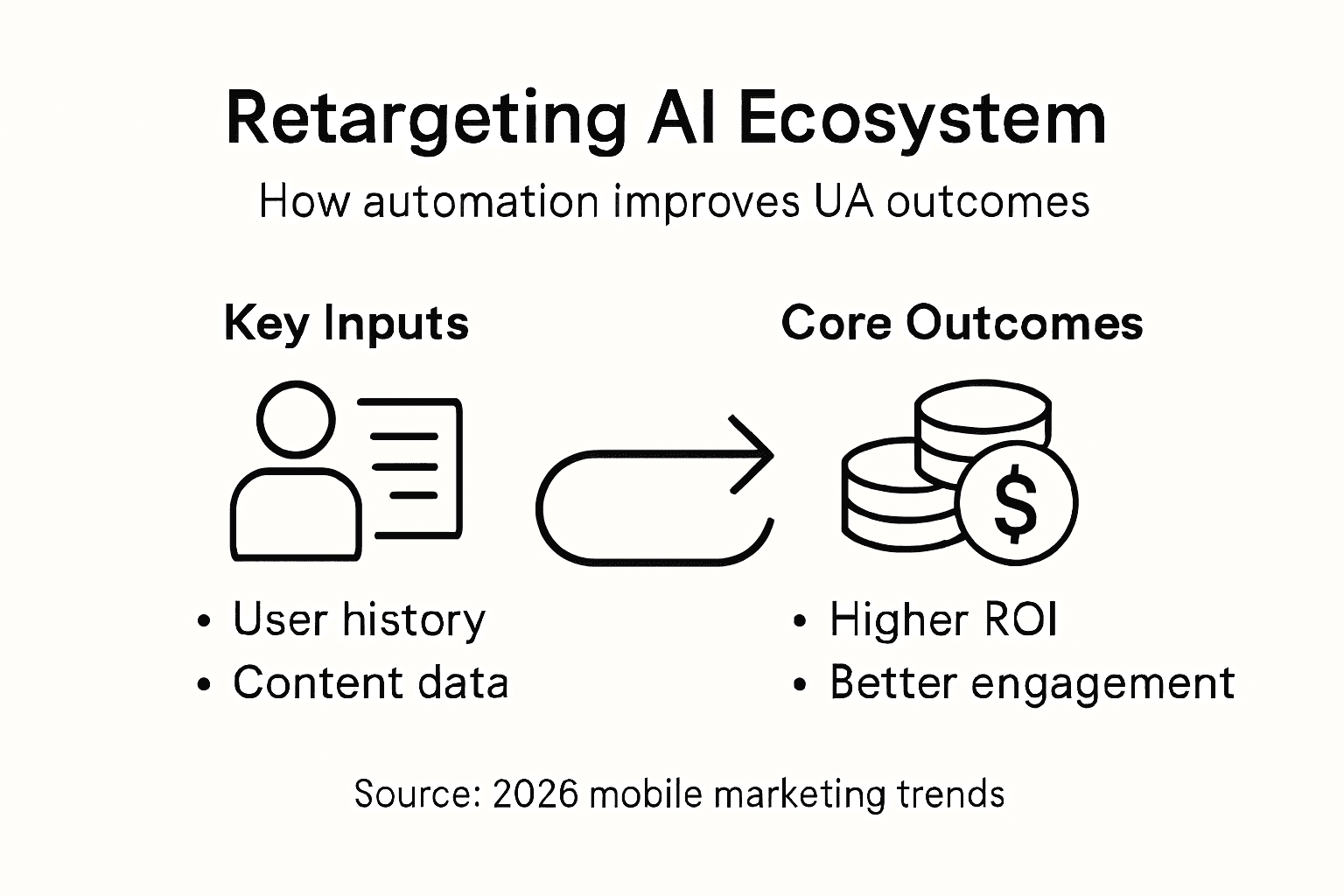
The most advanced AI retargeting platforms will integrate multiple data streams, combining user interaction history, contextual signals, and predictive analytics to create truly personalized re-engagement experiences. Mobile game developers who embrace these technologies will gain significant competitive advantages, transforming their user acquisition strategies from reactive approaches to proactive, intelligence-driven campaigns that anticipate and fulfill user needs before they are explicitly expressed.
Pro tip: Invest in machine learning infrastructure now to build foundational data pipelines that will support advanced AI retargeting capabilities in 2026.
Privacy Regulations and Ethical Retargeting
Privacy compliance has become a critical consideration for mobile game developers implementing retargeting strategies, transforming how user data is collected, processed, and utilized in marketing campaigns. The landscape of digital advertising is rapidly evolving, with stringent regulations demanding unprecedented transparency and user consent in data management practices.
Key privacy considerations for ethical retargeting include:
- Obtaining explicit user consent for data tracking
- Providing clear opt-out mechanisms
- Implementing data minimization principles
- Ensuring secure and encrypted data storage
- Maintaining transparent data usage policies
Data sharing restrictions have fundamentally reshaped mobile advertising strategies, compelling developers to balance personalization with user privacy protection. The introduction of frameworks like Apple’s App Tracking Transparency (ATT) has forced mobile game studios to develop more nuanced, consent-driven approaches to user acquisition and retargeting.
Ethical retargeting requires a comprehensive approach that goes beyond mere legal compliance. Mobile game developers must cultivate a culture of respect for user privacy, viewing data protection not as a regulatory burden but as a fundamental aspect of building trust with their player base. This means creating robust consent mechanisms, providing clear communication about data usage, and implementing sophisticated privacy-preserving technologies that maintain the effectiveness of retargeting campaigns.
Pro tip: Develop a comprehensive privacy policy that is written in plain language and clearly communicates how user data will be collected, used, and protected.
Common Pitfalls and How to Avoid Them
Retargeting campaigns often fail due to predictable strategic missteps that can dramatically reduce user acquisition effectiveness. Understanding these common pitfalls is crucial for mobile game developers seeking to maximize their return on investment and create meaningful user re-engagement experiences.
Most frequent retargeting mistakes include:
- Over-targeting and creating user fatigue
- Failing to segment audiences effectively
- Using generic, non-personalized ad creatives
- Ignoring frequency capping
- Neglecting performance tracking and optimization
- Misaligning messaging with user intent
User acquisition strategies require nuanced approaches that balance precision targeting with user experience considerations. Developers must recognize that retargeting is not about bombarding users with repetitive advertisements, but creating contextually relevant, timely interactions that genuinely add value to the user’s experience.
Successful retargeting demands continuous learning and adaptation. Mobile game studios need robust analytics frameworks that enable real-time campaign adjustments, allowing them to quickly identify and mitigate underperforming strategies. This means implementing sophisticated tracking mechanisms, maintaining flexible campaign structures, and developing a culture of data-driven decision making that prioritizes user experience alongside conversion metrics.
Below is a summary of the most common retargeting pitfalls and how to avoid them:
| Pitfall | Description | How to Avoid |
|---|---|---|
| User Fatigue | Too many ads cause annoyance | Set ad frequency caps |
| Poor Segmentation | Targeting the wrong users | Use multi-factor segmentation models |
| Generic Messaging | Ads lack relevance | Personalize creative content |
| No Performance Tracking | Lack of data-driven decisions | Implement robust analytics tools |
| Misaligned Messaging | Ads don’t match user intent | Align offers with user behaviors |
Pro tip: Implement a rigorous A/B testing framework that allows you to systematically evaluate and refine your retargeting approaches across different audience segments.
Elevate Your Mobile UA with Precision Retargeting Strategies
Retargeting is a powerful way to reconnect with users who already know your game but need that extra nudge to engage or convert. If your challenge is overcoming user fatigue, poor segmentation, or generic messaging, our expertise can help you master hyper-personalized campaigns that boost retention and maximize ROI. By focusing on AI-driven audience segmentation, creative personalization, and ethical data usage, we turn complex retargeting concepts into actionable strategies that deliver real results.
Ready to overcome retargeting pitfalls and embrace cutting-edge AI tools for mobile user acquisition success? Explore proven user acquisition practices and deep-dive resources that prepare you for 2026 and beyond at Ramiz Trtovac. Unlock personalized consulting and educational solutions crafted specifically for mobile game studios aiming to scale profitably. Take control of your retargeting performance now and connect with our team to start transforming your campaigns today.
Learn more about mobile game marketing growth and discover key user acquisition strategies tailored to your game on our site.
Frequently Asked Questions
What is retargeting in mobile user acquisition?
Retargeting in mobile user acquisition involves re-engaging users who have previously interacted with a mobile game or application, aiming to rekindle their interest and improve conversion rates and retention.
How can I effectively segment audiences for retargeting campaigns?
Effective audience segmentation can be achieved by categorizing users based on behavioral actions, demographics, engagement levels, and monetization potential. Advanced modeling techniques like machine learning can dynamically adjust segments in real-time.
What methods can I use to personalize ad creatives for retargeting?
Personalize ad creatives by dynamically generating visuals based on past user interactions, using contextual messaging that reflects player achievements, and tailoring incentives according to individual engagement histories.
How can I avoid common pitfalls in retargeting campaigns?
To avoid pitfalls like user fatigue and poor segmentation, implement frequency caps on ad delivery, use multi-factor segmentation models, personalize your messaging, and ensure robust performance tracking through analytics.
Recommended
- Master Mobile Game UA Workflow for Profitable Launches
- Mobile Game Marketing: How It Drives Studio Growth
- 7 Key Types of User Acquisition Strategies for Mobile Games
- What Is MMP in Gaming: Impact on UA Success
- Hoe werkt retargeting: waarom het B2B echt werkt
- B2B vs. B2C Conversion Rate Optimization: Key Differences Explained
- Maximizing Your Marketing Return on Investment: A Step-by-Step Guide