
Launching a mobile game without real-world testing can feel like risking everything on a single roll of the dice. For founders and UA managers, the stakes are high and the margin for error is slim. A soft launch gives your studio a controlled way to evaluate core gameplay, technical performance, and user monetization before committing to a worldwide rollout. You will discover how strategic market selection and iterative testing transform early player insights into meaningful growth and sustained profitability.
Table of Contents
- Defining Soft Launch In Mobile Gaming
- Types Of Soft Launch Strategies Used
- Key Performance Metrics And Testing Stages
- User Acquisition And Market Insights
- Risks, Costs, And Common Pitfalls
- Comparing Soft Launch With Global Launch
Key Takeaways
| Point | Details |
|---|---|
| Soft Launch Definition | A soft launch is a pre-global release phase that allows developers to test game elements in targeted markets before a full worldwide rollout. |
| Strategic Objectives | The main goals of a soft launch include assessing technical performance, user engagement, monetization testing, and market validation. |
| Risk Management | Soft launches help minimize financial and reputational risks by addressing potential issues in a controlled environment. |
| Incremental Improvement | By analyzing performance metrics during the soft launch, studios can make informed adjustments to improve user experience before the global launch. |
Defining Soft Launch in Mobile Gaming
In mobile game development, a soft launch represents a strategic pre-global release phase where studios introduce their game to a limited, targeted market. This calculated approach allows developers to test critical game elements and performance metrics before a full worldwide rollout. Soft launch strategies help studios minimize potential risks while gathering crucial player insights.
The primary objectives of a soft launch typically encompass several key areas:
- Technical Performance: Identify and resolve potential bugs or technical issues
- User Engagement: Measure player retention and interaction rates
- Monetization Testing: Validate in-game purchase mechanisms and revenue potential
- Market Validation: Assess game appeal within specific demographic segments
Studio teams carefully select soft launch markets that closely mirror their target audience’s characteristics. These markets often share similar technological infrastructure, player behaviors, and cultural gaming preferences with the intended global market. By choosing strategically comparable regions, developers can obtain more accurate and transferable insights.
Typical Soft Launch Duration: Most mobile game soft launches range from 2-6 months, providing sufficient time to collect comprehensive data and make meaningful adjustments before the global release.
Pro tip: Select soft launch markets that represent your game’s core target demographic to maximize the relevance and accuracy of your performance metrics.
Types of Soft Launch Strategies Used
Mobile game developers employ multiple sophisticated soft launch strategies to validate different aspects of their game before a global release. Strategic soft launch approaches help studios systematically test and refine their game’s potential across multiple dimensions.
These strategies typically encompass several key testing phases:
- Closed Beta Testing: Limited user group testing to identify technical bugs and assess device compatibility
- Geographic Market Testing: Releasing the game in select regions to evaluate market response
- Gameplay Mechanics Iteration: Continuous refinement of core game interactions and user experience
- Monetization Model Validation: Testing pricing strategies and in-app purchase mechanisms
The soft launch process often follows a structured progression. Early alpha stages focus on core gameplay technologies, while later beta phases dive deeper into server scalability, marketing acquisition channels, and comprehensive monetization strategies. This phased approach allows developers to make incremental improvements and gather targeted feedback at each stage.
Each testing strategy serves a unique purpose in the game development lifecycle. Technical testing uncovers potential performance issues, user engagement metrics reveal gameplay strengths and weaknesses, and market testing provides insights into cultural and demographic receptiveness.

Here’s a summary of how soft launch strategies align with business goals in mobile gaming:
| Strategy Type | Primary Purpose | Business Impact |
|---|---|---|
| Closed Beta Testing | Find technical and device issues | Improves product quality early |
| Geographic Market Testing | Evaluate market interest | Refines targeting, boosts ROI |
| Mechanics Iteration | Enhance gameplay and balance | Raises engagement and retention |
| Monetization Model Validation | Test pricing and revenue features | Maximizes earning potential |
Pro tip: Design your soft launch strategy as a progressive funnel, starting with technical validation and gradually expanding to broader market and monetization testing.
Key Performance Metrics and Testing Stages
Understanding critical performance metrics is essential for mobile game developers during the soft launch process. Key metrics drive data-driven decision making throughout the game development lifecycle, providing insights that guide strategic improvements.
The most crucial performance metrics for mobile game soft launches include:
- User Retention Rates: Measuring how long players continue engaging with the game
- Conversion Rates: Tracking the percentage of users who become paying players
- Average Revenue Per Paying User (ARPPU): Evaluating monetary value generated by active players
- Daily Active Users (DAU): Monitoring consistent player engagement
- Lifetime Value (LTV): Calculating total projected revenue from an average player
Soft launch testing typically progresses through structured stages, each designed to validate different aspects of game performance. The initial alpha stage focuses on core technical functionality, identifying and resolving fundamental gameplay and technical issues. Subsequent beta stages dive deeper, examining gameplay balance, user experience, and monetization potential.
Successful soft launches transform raw data into actionable insights, enabling developers to refine their game before global release.
By systematically analyzing these metrics across different testing stages, studios can make informed decisions about game mechanics, pricing strategies, and overall player experience. This data-driven approach minimizes risks and increases the likelihood of a successful global launch.
Pro tip: Establish clear benchmarks for each key performance metric before starting your soft launch, allowing for objective and precise evaluation of game potential.
User Acquisition and Market Insights
User acquisition represents a critical strategic component of mobile game soft launches, offering developers a nuanced window into potential market performance. Soft launch testing provides invaluable acquisition insights by enabling targeted campaign evaluation in select geographic regions before full-scale deployment.
Key user acquisition strategies during soft launch include:
- Targeted Geographic Testing: Identifying high-potential markets
- Campaign Performance Tracking: Measuring cost per install and engagement rates
- Channel Scalability Assessment: Evaluating marketing platform effectiveness
- Audience Behavior Analysis: Understanding regional user interaction patterns
Analytics help detect critical user acquisition challenges by providing granular insights into user behavior, spending habits, and engagement potential. Studios can rapidly adjust marketing spend, refine targeting strategies, and optimize user experience based on real-world data collected during limited market releases.
Effective soft launches transform user acquisition from a speculative process into a data-driven, strategic initiative.
The soft launch approach allows developers to understand nuanced regional differences in player preferences, technological infrastructure, and spending patterns. By carefully selecting test markets that closely mirror the intended global audience, studios can create more precise, effective user acquisition strategies that minimize financial risk and maximize potential game success.
Pro tip: Select soft launch markets that closely represent your game’s target demographic to generate the most actionable and transferable user acquisition insights.
Risks, Costs, and Common Pitfalls
Mobile game soft launches involve complex financial and strategic risks that developers must carefully navigate. While these preliminary releases offer valuable insights, they also present potential challenges that can significantly impact a game’s ultimate success and market reception.
The most critical risks and potential pitfalls include:
- Budget Overruns: Unexpected marketing and testing expenses
- Market Misalignment: Incorrect audience targeting
- Technical Performance Issues: Unforeseen bugs or compatibility problems
- Competitive Exposure: Revealing game mechanics to potential competitors
- Reputation Damage: Negative early user experiences
Financial considerations are particularly significant during soft launches. Studios must allocate resources strategically, balancing testing expenses against potential return on investment. Small to mid-sized game developers face unique challenges, as their limited budgets require precise resource allocation and risk management.
Successful soft launches require a delicate balance between comprehensive testing and financial prudence.
Psychological factors also play a crucial role in managing soft launch risks. Development teams must maintain realistic expectations, understanding that not every metric will align perfectly with initial projections. Flexibility and rapid adaptation are key to transforming potential setbacks into strategic opportunities for game improvement.
Pro tip: Create a comprehensive risk mitigation budget that includes contingency funds for unexpected soft launch challenges, ensuring financial flexibility throughout the testing process.
Comparing Soft Launch with Global Launch
Global and soft launches represent two distinct strategic approaches in mobile game deployment, each with unique characteristics, objectives, and potential outcomes. While a global launch aims for immediate widespread market penetration, a soft launch focuses on strategic validation and incremental improvement.
Key differences between soft and global launches include:
- Market Scale: – Soft Launch: Limited, targeted geographic regions
- Global Launch: Worldwide, comprehensive market coverage
- Risk Exposure: – Soft Launch: Minimal financial and reputational risk
- Global Launch: Maximum potential risk and investment
- Performance Insights:
- Soft Launch: Granular, iterative feedback
- Global Launch: Aggregate, less nuanced user data
- Marketing Approach:
- Soft Launch: Controlled, strategic campaign testing
- Global Launch: Full-scale, high-budget marketing push
The strategic approach of a soft launch allows developers to mitigate potential risks before committing to a full global release. By testing in controlled environments, studios can identify and address technical issues, validate gameplay mechanics, and refine monetization strategies with minimal financial exposure.
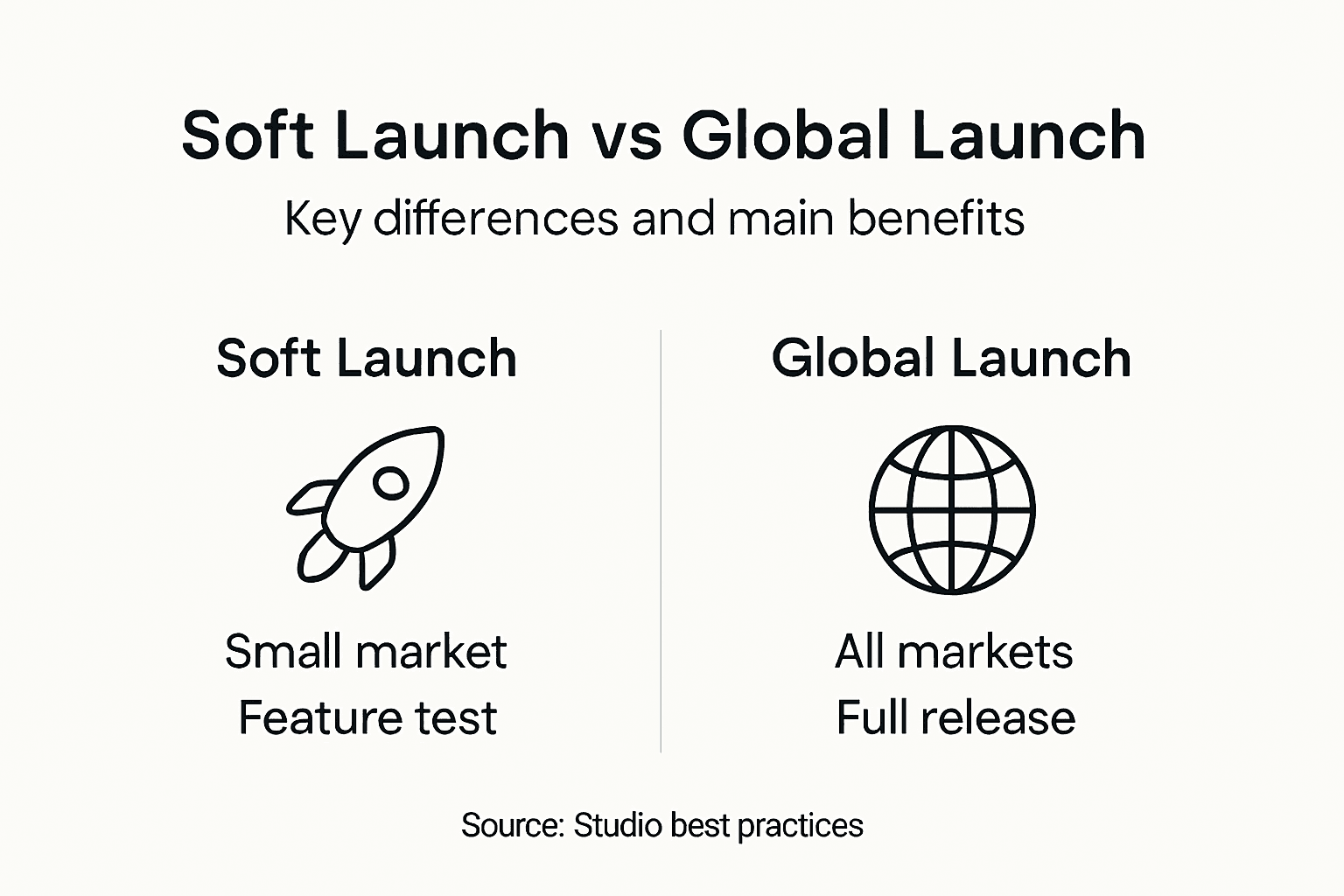
To provide a clear overview, here’s a comparison of soft launch versus global launch approaches:
| Aspect | Soft Launch | Global Launch |
|---|---|---|
| Scope | Limited regional markets | Worldwide release |
| Data Granularity | Detailed user feedback | Broad aggregate metrics |
| Risk Level | Lower, controlled exposure | High, full market risk |
| Adjustability | Easy to refine before scaling | Hard to adjust post-release |
A successful soft launch transforms uncertainty into a calculated, data-driven global launch strategy.
Psychologically, the transition from soft to global launch requires a significant mindset shift for development teams. The controlled, analytical approach of a soft launch must evolve into a confident, comprehensive market engagement strategy that leverages insights gained during preliminary testing.
Pro tip: Develop a clear transition framework that systematically translates soft launch insights into global launch tactics, ensuring a seamless and informed market entry.
Take Control of Your Mobile Game Soft Launch Success
Soft launching a mobile game comes with challenges like managing user acquisition, optimizing monetization models, and reducing costly risks. If you want to turn those critical performance metrics and market insights into actionable strategies that boost retention and revenue you need expert guidance tailored to your studio’s goals. The article highlights the importance of selecting the right test markets and progressive testing phases to avoid budget overruns and technical pitfalls — areas where proven consulting makes all the difference.

Discover how Ramiz Trtovac’s consulting and educational resources at ramiztrtovac.com help studios like yours master user acquisition campaigns and maximize soft launch effectiveness. Whether you’re refining gameplay mechanics or validating monetization during your soft launch, access insights from extensive experience working with top studios. Take the next step to reduce risk and launch with confidence by exploring Ramiz’s expertise today and see how a data-driven approach transforms your mobile game performance marketing.
Frequently Asked Questions
What is a soft launch in mobile gaming?
A soft launch is a pre-global release phase where developers introduce a game to a limited market to test the game’s performance, user engagement, monetization strategies, and gather player insights before a worldwide rollout.
Why is a soft launch important for game studios?
A soft launch helps studios minimize risks by identifying technical issues, assessing user engagement, and validating monetization models, leading to informed decisions before a full global launch.
How long does a typical soft launch last?
Most mobile game soft launches last between 2 to 6 months, allowing developers enough time to gather substantial data and make necessary adjustments based on player feedback.
What are the key performance metrics to evaluate during a soft launch?
Critical performance metrics include user retention rates, conversion rates, average revenue per paying user (ARPPU), daily active users (DAU), and lifetime value (LTV), which provide essential insights into the game’s potential success.
Recommended
- Playable Ads: Boosting Game UA and Profitability
- Crafting Engaging Ad Creatives for Hyper-Casual Games
- Top 5 Mobile Game Marketing Strategies for 2024
- The Importance of User Acquisition in Mobile Gaming: A Simplified Guide – Ramiz Trtovac