What makes successful ad monetization more than simply placing ads in a game? For mobile game studio founders and UA managers, understanding the complex dynamics between revenue generation and user satisfaction is vital to lasting growth. Research shows that traditional assumptions about monetization and innovation do not always hold true, so relying on old myths can undermine profitability. This guide clarifies how to approach ad monetization strategically, challenging misconceptions and introducing practical solutions to achieve both scale and strong financial performance.
Table of Contents
- Ad Monetization Defined And Common Myths
- Types Of Ad Monetization In Mobile Games
- How Ad Monetization Ecosystems Work
- Critical Metrics And Optimization Strategies
- Balancing User Experience And Revenue
- Pitfalls, Risks, And Common Mistakes
Key Takeaways
| Point | Details |
|---|---|
| Ad Monetization Requires Strategy | Developers must combine revenue generation techniques with user experience to optimize ad placement and frequency. |
| Varied Ad Formats Have Different Impacts | Understanding the characteristics of each ad type is crucial to balance player engagement and revenue. |
| Data-Driven Optimization Is Essential | Continuous monitoring of key performance metrics enables developers to refine their ad strategies effectively. |
| Avoid Common Pitfalls for Success | Careful attention to audience preferences and avoiding oversaturation can significantly improve player retention and satisfaction. |
Ad Monetization Defined and Common Myths
Ad monetization represents a strategic revenue generation method for mobile game developers, where advertising platforms pay studios to display ads within their gaming applications. By integrating targeted advertisements, game studios can transform user engagement into direct financial opportunities.
To truly understand ad monetization, developers must recognize its core mechanisms:
- Revenue sharing between game developers and ad networks
- Dynamic ad placement strategies
- Performance-based compensation models
- User experience optimization
Understanding these fundamentals helps combat prevalent misconceptions. Digital service monetization research indicates that ad revenue models are far more nuanced than most developers assume. Contrary to popular belief, monetization does not automatically guarantee technological innovation or sustained growth.
Common myths about ad monetization include:
- All ads generate equal revenue
- More ads always mean higher earnings
- Ad integration doesn’t impact user retention
- Monetization is a one-size-fits-all strategy
Successful ad monetization requires strategic thinking, understanding user preferences, and maintaining a delicate balance between revenue generation and user experience. Developers must carefully select ad formats, placement, and frequency to maximize earnings without compromising gameplay enjoyment.
Pro tip: Continuously A/B test your ad placements and monitor user engagement metrics to optimize your monetization strategy effectively.
Types of Ad Monetization in Mobile Games
Mobile game developers have multiple strategies for video game monetization through advertising, each designed to generate revenue while maintaining player engagement. These ad types represent sophisticated approaches to transforming user interactions into financial opportunities.
The primary types of ad monetization in mobile games include:
- Banner Ads: Static or animated advertisements displayed at screen edges
- Interstitial Ads: Full-screen advertisements appearing during natural game breaks
- Rewarded Video Ads: Optional video ads offering in-game rewards for player participation
- Playable Ads: Interactive mini-game advertisements allowing direct product experience
- Native Ads: Advertisements seamlessly integrated into game design and user interface
Each ad type carries unique characteristics and potential revenue streams. Mobile game monetization strategies demonstrate that successful implementation depends on understanding player psychology and maintaining a delicate balance between revenue generation and user experience.

Here’s a comparison of popular ad formats in mobile games and their typical business impact:
| Ad Format | User Experience Effect | Revenue Potential | Implementation Complexity |
|---|---|---|---|
| Banner Ads | Minimal disruption, often ignored | Low to moderate | Simple |
| Interstitial Ads | Can interrupt gameplay | Moderate to high | Moderate |
| Rewarded Video Ads | Creates value for user | High | Moderate |
| Playable Ads | Highly engaging, memorable | High | Complex |
| Native Ads | Seamless integration | Moderate | Requires customization |
Developers must carefully consider the following factors when selecting ad monetization approaches:
- Player retention rates
- Potential revenue per user
- User experience impact
- Technical implementation complexity
- Target audience preferences
Successful ad monetization requires strategic placement, frequency management, and continuous performance analysis. Game studios must experiment with different ad formats to determine the most effective approach for their specific game genre and target audience.
Pro tip: Implement a dynamic ad rotation strategy that allows for real-time adjustment of ad types and frequencies based on player engagement metrics.
How Ad Monetization Ecosystems Work
The ad monetization ecosystem is a complex network of interconnected participants, each playing a critical role in transforming digital interactions into revenue. Digital content platform interactions reveal the intricate balance required between content creators, platforms, and advertisers to generate sustainable financial models.
Key participants in the ad monetization ecosystem include:
- Game Developers: Content creators designing interactive experiences
- Ad Networks: Intermediary platforms connecting advertisers and publishers
- Advertisers: Brands seeking targeted user engagement
- Mobile Measurement Partners (MMPs): Analytics providers tracking ad performance
- User Base: Consumers who interact with advertisements
The ecosystem operates through a sophisticated video game monetization framework that involves multiple revenue-sharing mechanisms. Platforms negotiate complex agreements determining how advertising revenues are distributed among participants, ensuring each stakeholder receives appropriate compensation for their contribution.
Successful ad monetization ecosystems depend on several critical factors:
- Transparent revenue sharing models
- Advanced targeting capabilities
- Robust performance tracking
- Minimal user experience disruption
- Continuous optimization strategies
Technology plays a pivotal role in connecting these ecosystem components, enabling real-time bidding, precise audience segmentation, and dynamic ad placement. Game developers must continuously adapt their monetization strategies to maintain a delicate balance between generating revenue and preserving user engagement.
Pro tip: Develop comprehensive integration protocols with multiple ad networks to maximize revenue potential and reduce dependency on a single platform.
Critical Metrics and Optimization Strategies
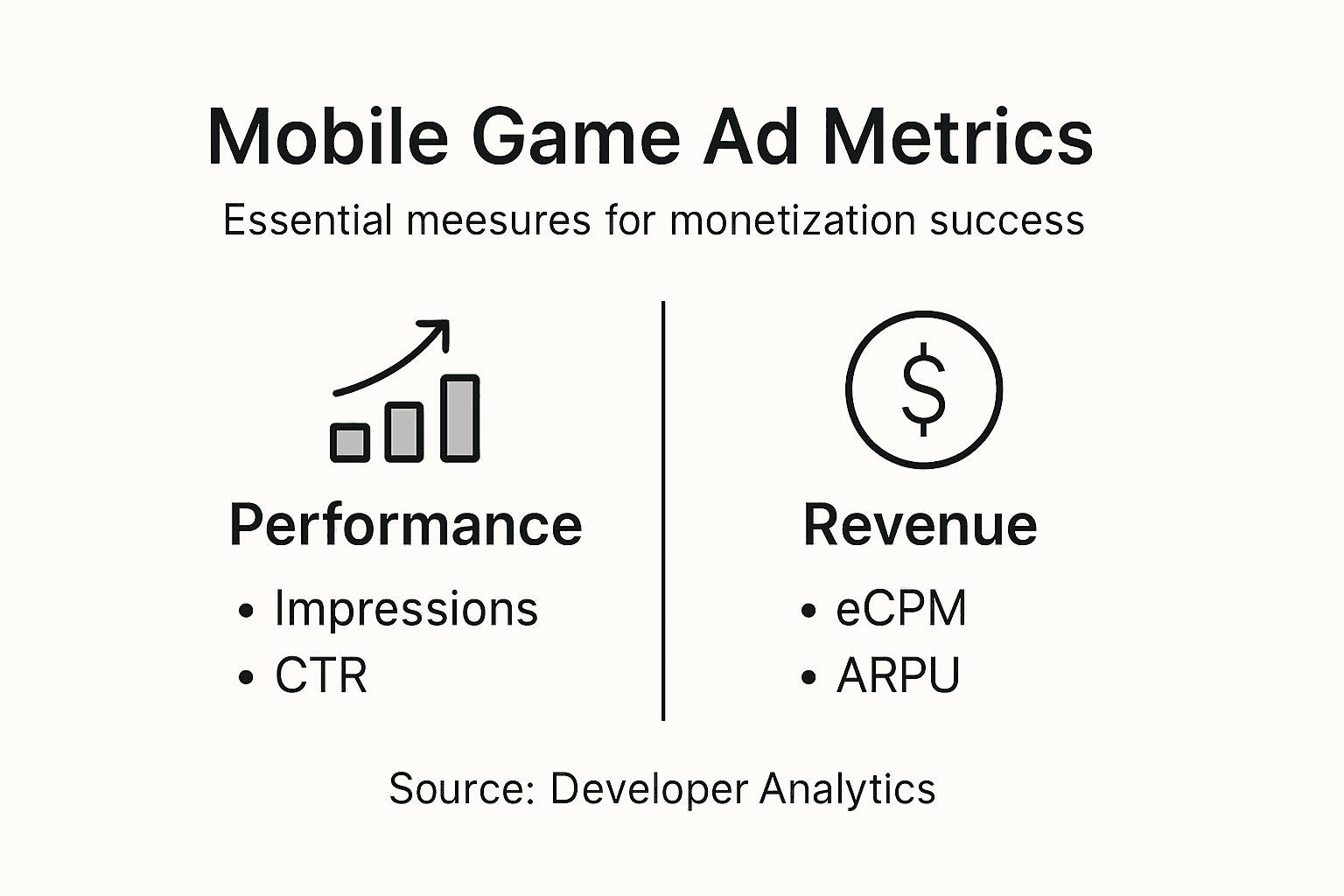
Player engagement metrics represent the cornerstone of successful ad monetization strategies in mobile games. Game developers must understand and track sophisticated performance indicators that go beyond traditional revenue measurements to capture the nuanced interactions between advertisements and player experience.
Key performance metrics for ad monetization include:
- Impressions: Total number of ad views
- Click-Through Rate (CTR): Percentage of users who click on ads
- Conversion Rate: Proportion of ad interactions resulting in desired actions
- Revenue Per Mille (RPM): Earnings per thousand ad impressions
- Retention Rate: User retention correlated with ad experience
Optimization strategies require a comprehensive approach that balances monetization with user experience. Monetization uncertainties suggest that overly aggressive ad placement can negatively impact game performance and user engagement.
Developers should focus on strategic optimization through:
- Precise audience segmentation
- Dynamic ad placement algorithms
- Contextual ad relevance
- Frequency capping
- Continuous performance monitoring
Successful ad monetization demands a data-driven methodology that considers multiple variables simultaneously. Advanced analytics tools can help developers understand intricate relationships between ad interactions, player behavior, and revenue generation.
Pro tip: Implement machine learning algorithms to dynamically adjust ad frequency and placement based on individual user engagement patterns and preferences.
Balancing User Experience and Revenue
Digital platform monetization strategies reveal the delicate art of maintaining user engagement while generating sustainable revenue in mobile games. Successful developers understand that ad monetization is not about maximizing interruptions, but creating seamless, value-added experiences that players actually appreciate.
Key strategies for balancing user experience and revenue include:
- Contextual Ad Placement: Integrating ads during natural gameplay breaks
- Reward-Based Advertising: Offering in-game benefits for ad interactions
- Personalized Ad Targeting: Delivering relevant advertisements to specific player segments
- Frequency Management: Limiting ad displays to prevent user frustration
- Transparent User Consent: Providing clear opt-in/opt-out mechanisms
Mobile game developers must recognize that ad monetization statistics demonstrate a clear correlation between user satisfaction and revenue generation. Approximately 65% of mobile games successfully employ ad monetization techniques that enhance rather than disrupt the player experience.
Optimization approaches for balancing revenue and user experience include:
- Implementing dynamic ad frequency algorithms
- Developing sophisticated audience segmentation
- Creating non-intrusive ad integration methods
- Monitoring player feedback and engagement metrics
- Continuously refining ad placement strategies
The most successful mobile game studios treat advertisements as a potential value-add rather than an intrusive revenue stream. They understand that player trust and engagement are ultimately more valuable than short-term monetary gains.
Pro tip: Design ad experiences that feel like natural extensions of gameplay, transforming advertisements from interruptions into potentially enjoyable interactions.
Pitfalls, Risks, and Common Mistakes
Digital advertising attention costs reveal significant risks that can undermine mobile game monetization strategies. Game developers must navigate a complex landscape where seemingly minor mistakes can dramatically impact revenue and user engagement.
Common pitfalls in ad monetization include:
- Oversaturation: Displaying too many advertisements
- Irrelevant Ad Targeting: Showing unrelated content to players
- Disruptive Placement: Interrupting critical gameplay moments
- Inconsistent Ad Quality: Using low-resolution or poorly designed ads
- Ignoring User Feedback: Failing to adapt to player preferences
The most critical risks stem from misaligned economic incentives. Prediction market research highlights how mispricing ad inventory and ignoring consumer information preferences can lead to suboptimal outcomes for all stakeholders.
Developers should be particularly wary of these strategic mistakes:
- Prioritizing short-term revenue over long-term user retention
- Implementing inflexible ad monetization models
- Neglecting comprehensive performance analytics
- Failing to segment audience preferences
- Overlooking cross-platform user experience consistency
Successful mobile game studios recognize that ad monetization is a delicate balance between generating revenue and maintaining player trust. Each advertisement represents a potential point of friction that can either enhance or diminish the overall gaming experience.
For a quick overview, here are common ad monetization mistakes and their long-term consequences:
| Mistake | Immediate Effect | Long-Term Risk |
|---|---|---|
| Oversaturation | User frustration, abandonment | Falling retention rates |
| Irrelevant targeting | Low engagement, wasted impressions | Reduced ad revenue |
| Disruptive placement | Gameplay interruption, complaints | Negative reviews |
| Neglecting analytics | Missed optimization opportunities | Suboptimal revenue growth |
| Inflexible monetization | Limited adaptability | Loss of competitive edge |
Pro tip: Create a dedicated user feedback mechanism specifically for ad experiences, allowing players to provide real-time insights into their monetization preferences.
Unlock the Full Potential of Ad Monetization in Your Mobile Game
Ad monetization is a powerful yet delicate strategy that demands careful balance between maximizing revenue and preserving user experience. The challenges outlined in the article, from optimizing ad formats like rewarded video ads and interstitials to avoiding pitfalls like oversaturation and irrelevant targeting, are common hurdles many mobile game developers face. If you want to transform these challenges into growth opportunities and harness advanced strategies such as dynamic ad placement, user segmentation, and real-time performance tracking, expert guidance is essential.

Discover how Ramiz Trtovac leverages years of experience leading user acquisition and monetization campaigns for studios like Two Desperados and GameBiz Consulting. By visiting Ramiz Trtovac’s consulting and educational platform, you gain access to proven insights, tailored solutions, and actionable resources designed to optimize your mobile game’s ad monetization without compromising player retention. Don’t let common mistakes drain your revenue potential—take the next step now and collaborate with a trusted expert to scale your mobile game profitably.
Frequently Asked Questions
What is ad monetization in mobile games?
Ad monetization in mobile games refers to a revenue generation strategy where game developers earn money by displaying ads within their applications, transforming user engagement into financial opportunities through various ad formats and networks.
How do ad placements affect user experience in mobile games?
Ad placements can have a significant impact on user experience. Strategic ad integration during natural gameplay breaks enhances player engagement, while disruptive ad placements can frustrate users and lead to decreased retention rates.
What are the common types of ad formats used in mobile games for monetization?
Common ad formats in mobile games include banner ads, interstitial ads, rewarded video ads, playable ads, and native ads. Each format offers different user experiences and revenue potentials, and developers choose based on game design and audience preferences.
What metrics should developers track to optimize ad monetization?
Developers should focus on key performance metrics such as impressions, click-through rate (CTR), conversion rate, revenue per mille (RPM), and user retention rate. Tracking these metrics helps assess the effectiveness of ad placements and overall monetization strategies.
Recommended
- What Is In-App Monetization and Why It Matters
- Mobile Game Marketing: How It Drives Studio Growth
- Playable Ads: Boosting Game UA and Profitability
- What Is User Acquisition and Why It Drives Mobile Game Growth