Competitive user acquisition can feel like an endless cycle of chasing metrics that never quite translate to profitability. For studios aiming to scale, the challenge is more than just growing download numbers or finding the next big creative twist—it is about building a system where every marketing decision is rooted in clear goals and actionable data. By defining SMART marketing objectives and understanding which performance indicators drive actual business outcomes, you position your studio for success in even the toughest global markets.
Table of Contents
- Step 1: Define Success Metrics And Set Marketing Objectives
- Step 2: Research Target Audience And Benchmark Competitors
- Step 3: Develop Multi-Channel User Acquisition Strategies
- Step 4: Launch Campaigns And Monitor Performance Kpis
- Step 5: Optimize Tactics And Validate Profitability Outcomes
Quick Summary
| Key Point | Explanation |
|---|---|
| 1. Define SMART objectives | Establish clear, specific, measurable, actionable, relevant, and time-bound marketing goals that support business outcomes. |
| 2. Understand your audience | Build a detailed profile of your target audience with demographics and spending habits to guide your marketing strategy. |
| 3. Diversify acquisition channels | Use multiple marketing platforms to reach different audience segments, reducing reliance on any single channel for user acquisition. |
| 4. Monitor performance closely | Track real-time campaign metrics to spot issues early, allowing for quick adjustments to optimize spending and improve ROI. |
| 5. Validate profitability regularly | Continuously analyze campaign data to ensure spending leads to profitable outcomes, adjusting strategies based on performance metrics. |
Step 1: Define success metrics and set marketing objectives
Success in user acquisition doesn’t happen by accident. Before you launch campaigns or analyze data, you need to define what winning actually looks like for your studio. This step establishes the foundation for every decision you’ll make going forward.
Start by connecting your marketing goals to your business mission. Your studio exists to create revenue, grow its player base, or both. Your marketing objectives need to directly support these outcomes. A common mistake is setting vague targets like “increase downloads” without defining the specific, measurable outcomes you need.
SMART marketing objectives give you a framework to work with. Your goals should be:
- Specific: Define exactly what you want to achieve, not just “grow UA.”
- Measurable: Choose metrics you can track in real-time through analytics.
- Actionable: Set targets your team can actually influence through strategy and optimization.
- Relevant: Align objectives with your business goals and studio capacity.
- Time-bound: Set clear deadlines for reaching each target.
Now identify your core success metrics. For most mobile game studios, these fall into a few categories. Cost per install (CPI) tracks your efficiency. Return on ad spend (ROAS) or lifetime value to customer acquisition cost (LTV:CAC) ratio measures profitability. Day 1, Day 7, and Day 30 retention show player quality. And daily active users (DAU) growth tracks momentum.
Different studios prioritize differently. A free-to-play game might obsess over LTV:CAC ratios and unit economics. A premium title might focus on download velocity and retention. Choose metrics that directly control profitability for your model.
Clear, measurable marketing objectives guide your team’s focus and enable you to track performance against defined targets within specific timeframes.
Document your targets in writing. If your goal is “reach 100,000 DAU by month 6 at a CAC of $1.50 or less,” that’s concrete. Your team knows exactly what to optimize for.
Here’s a comparison of key user acquisition metrics and their impact on mobile game studios:
| Metric | What It Measures | Why It Matters for Studios |
|---|---|---|
| Cost Per Install (CPI) | Efficiency of ad spend | Directly impacts acquisition budget |
| Return on Ad Spend (ROAS) | Revenue generated per dollar spent | Indicates overall campaign profitability |
| Lifetime Value to CAC (LTV:CAC) | User value vs acquisition cost | Signals long-term sustainability |
| Retention Rate (D1/D7/D30) | Player engagement over time | Reflects game quality and satisfaction |
| Daily Active Users (DAU) | Number of active players daily | Measures game momentum and growth |
Pro tip: Set slightly aggressive targets to push your team toward excellence, but avoid impossible ones that kill morale. A 20-30% improvement over your current baseline often hits the sweet spot between challenging and achievable.
Step 2: Research target audience and benchmark competitors
You can’t build a profitable UA strategy without understanding who you’re trying to reach and what competitors are doing to reach them. This step transforms assumptions into data-driven insights that shape every campaign decision.
Start by profiling your target audience with concrete details. Don’t just say “casual mobile gamers.” Instead, define age range, device type, geography, gaming habits, and spending patterns. Are you targeting Android users in Southeast Asia who play for 15 minutes daily? Or iOS players in North America spending $10 monthly? The specificity matters because it determines which networks, creatives, and messaging work.
Gather audience data from multiple sources. App analytics show who currently plays your game and how they behave. Ad network dashboards reveal who engages with your test campaigns. Third-party research platforms like Sensor Tower or App Annie provide demographic breakdowns of competing games. Survey your existing players directly—their feedback about why they installed your game is gold.
Combining qualitative and quantitative research methods helps you build a complete audience profile. Numbers tell you what happened; interviews and feedback explain why it happened.
Now benchmark your competitors. Identify 5-10 games with similar mechanics, monetization, or target markets. Document their:
- Install velocity and estimated DAU from tools like App Annie or Mobile Action
- Ad networks and creative themes by running ads yourself or using spy tools like AppFigures
- Pricing strategy and in-app purchase structure
- Retention rates estimated from reviews and community sentiment
- Marketing spend approximated through ad spend estimation tools
You’re looking for gaps and opportunities. If competitors all use casual aesthetics and target casual players, maybe a hardcore angle exists for your game. If everyone targets ages 25-45, maybe younger players are underserved.
Understanding what competitors are spending and how audiences respond reveals where you can compete more efficiently and profitably.
Create a competitive positioning matrix. Plot competitors on axes like “cost-per-install” versus “player retention” or “ad spend” versus “download volume.” This visual shows where your game should position itself for maximum competitive advantage.
Pro tip: Spend 2-3 hours monthly updating your competitive benchmark. Markets shift fast, and new competitors emerge constantly. Fresh data prevents you from chasing outdated strategies while better opportunities exist.
Step 3: Develop multi-channel user acquisition strategies
No single ad network or marketing channel will fuel profitable growth at scale. Successful studios diversify across multiple platforms to reach different audience segments, reduce dependency on any one channel, and maintain flexibility as market conditions shift.

Start by mapping out the channels where your target audience spends time. Mobile games reach players through app store ads, social media platforms like Facebook and TikTok, Google App Campaigns, programmatic display networks, and emerging platforms like Discord or Twitch. Each channel has different audience demographics, cost structures, and creative requirements.
Begin with 2-3 channels that align with your audience and budget. If you’re targeting casual players aged 35-55, Facebook and Instagram make sense. If you want hardcore gamers, consider Google App Campaigns and Discord communities. Understanding the key types of user acquisition strategies helps you choose channels that match your studio’s capabilities and player profile.
Allocate your budget strategically across channels:
- Tier 1 channels receive 50-60% of budget. These are proven performers with solid ROAS and reliable scaling.
- Tier 2 channels get 25-35% of budget. These show promise but need optimization or have higher volatility.
- Tier 3 channels receive 10-15% of budget. These are experimental or emerging opportunities worth testing.
Run parallel campaigns on each channel with similar messaging and creative but tailored to platform norms. A Facebook video ad looks different from a TikTok ad, even when promoting the same game.
Multi-channel diversification protects your growth from single-platform algorithm changes and policy shifts while maximizing your reach across different player segments.
Track performance metrics separately for each channel. Cost per install, click-through rate, conversion rate, and retention should be measured independently. This data shows which channels deserve budget increases and which need optimization or pausing.
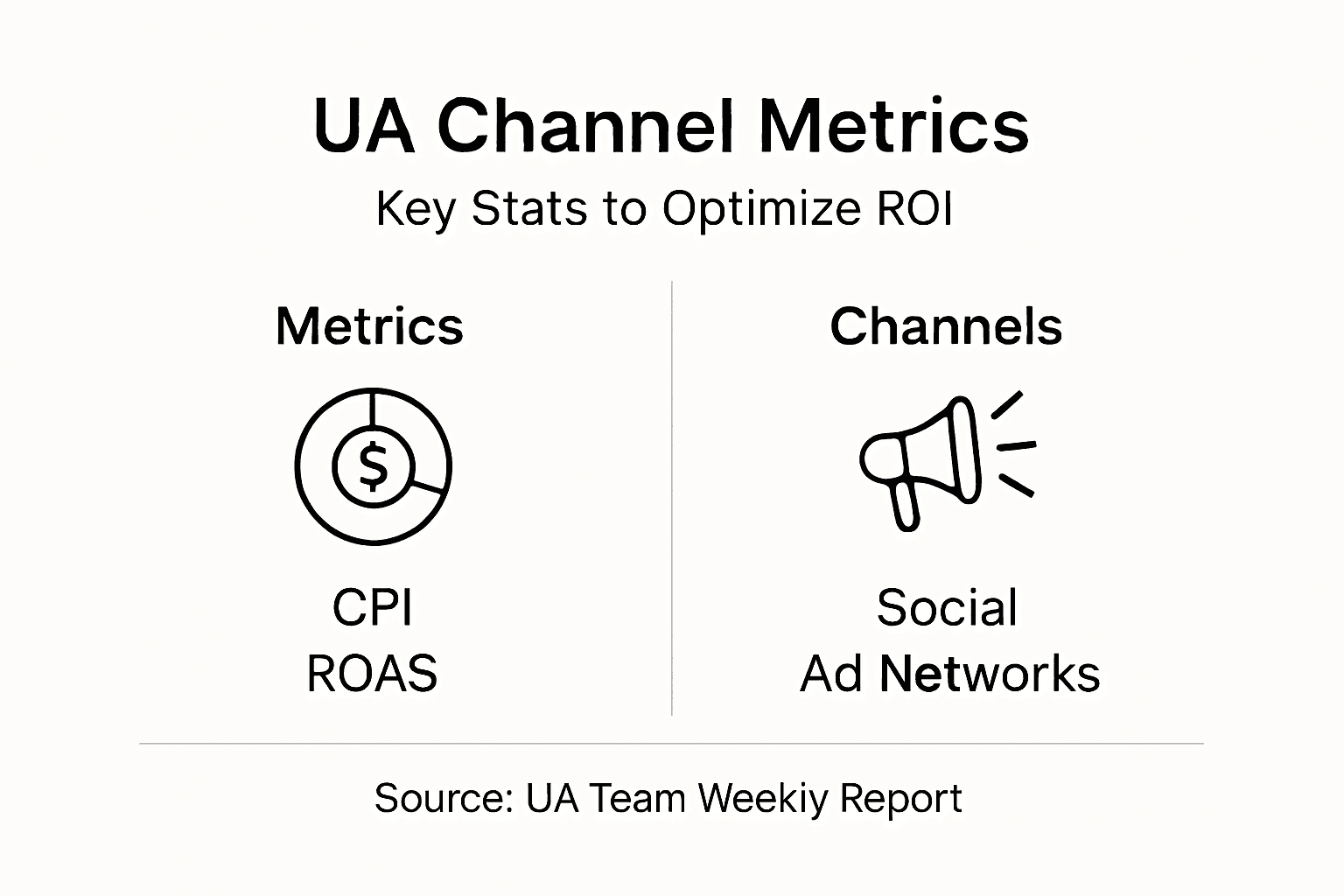
Rebalance quarterly. If one channel’s ROAS drops 30%, cut budget there and redirect to better performers. If a new channel hits your target metrics consistently, increase allocation. Markets move fast, and your strategy needs to move with them.
Pro tip: Don’t chase every new platform hoping it’s the next goldmine. Test conservatively with 5-10% of budget first, and only scale channels that hit your baseline profitability targets within 2-3 weeks of testing.
The table below summarizes common channels for mobile game user acquisition:
| Channel Type | Main Audience Example | Cost Structure | Creative Format |
|---|---|---|---|
| Social Media (e.g. Facebook) | Ages 25-50, casual gamers | Auction-based CPM | Video, carousel |
| App Store Ads | All mobile users | Bid per tap/install | Banner, search ads |
| Programmatic Display | Broad, global | CPM/CPA | Static, video |
| Influencer/Community | Niche, engaged fans | Fixed or CPM | Sponsored content |
| Emerging Platforms (e.g. Discord, Twitch) | Core/hardcore gamers | Varies | Streams, chat plug-ins |
Step 4: Launch campaigns and monitor performance KPIs
Launching campaigns is not a “set and forget” moment. The first 72 hours determine whether your campaigns survive or crash. Your job is to monitor real-time data, spot problems early, and optimize aggressively before you waste significant budget.
Start with a soft launch on one channel with a small budget. Spend $500-$2,000 to gather initial performance data before scaling. Monitor these core KPIs from hour one:
- Cost per install (CPI) should land within 10-20% of your target
- Click-through rate (CTR) reveals creative performance
- Conversion rate shows how many clicks become installs
- Day 1 retention (D1) indicates whether players stick around
- Day 7 retention (D7) proves long-term appeal
Use a analytics dashboard to watch performance live. Defining relevant KPIs and monitoring them in real-time enables quick campaign adjustments and better ROI during volatile market conditions.
Run campaigns for at least 7-14 days before major decisions. Early data is noisy. One bad day doesn’t mean failure, and one great day doesn’t guarantee success. You need enough volume to spot real trends versus random fluctuations.
Pause underperforming creatives after 2-3 days of poor data. If a video has 0.8% CTR when your target is 2%, kill it and test another. If CPI is 40% above target after 1,000 installs, pause and pivot.
Real-time monitoring and rapid optimization separate profitable campaigns from money-losing ones. The teams that adjust within hours, not days, win.
Create weekly performance reports showing trends, not just snapshots. Plot CPI, ROAS, and D7 retention over time. This reveals whether campaigns improve as they optimize or deteriorate toward death.
Scale slowly. If a campaign hits your profitability targets consistently, increase budget by 20-30% weekly. If performance drops during scaling, pull back immediately. Some campaigns plateau at $5,000 daily spend; others scale to $50,000. Find your channel’s natural ceiling.
Pro tip: Set automated alerts in your dashboard for KPI deviations. If CPI jumps 30% or D1 retention drops below threshold, you get notified immediately instead of discovering problems in tomorrow’s report.
Step 5: Optimize tactics and validate profitability outcomes
Optimization separates studios that grow sustainably from those that burn cash. After campaigns launch, your focus shifts to systematic testing, data analysis, and ruthless validation that every dollar spent generates returns.
Start with A/B testing your creative assets. Run two versions of an ad simultaneously to identical audiences. Change one variable at a time: headline, video thumbnail, call-to-action, or audience demographic. After 500-1,000 installs per variant, declare a winner and pause the loser. This iterative process compounds over weeks.
Test these high-impact variables first:
- Creative hook: Does the first 3 seconds grab attention?
- Messaging angle: Does one value proposition outperform others?
- Audience targeting: Which demographic segment converts cheapest?
- Bid strategy: Does automated bidding beat manual optimization?
- Platform placement: Which ad format (banner, video, interstitial) converts best?
Using iterative testing and data-driven adjustments refines campaign tactics while ensuring sustainable growth through continuous profitability validation.
Measure profitability with brutal honesty. Calculate your blended ROI across all campaigns combined. If you spend $10,000 and earn $12,000 in gross revenue, that’s 1.2x ROI. But factor in operational costs, server infrastructure, and payment processing. Your true profitability is often 30-40% lower than gross ROI suggests.
Track cohort analysis to understand which users generate the most lifetime value. Players from Facebook might have lower D1 retention but higher Day 30 spending. Android users might cost more to acquire but retain longer. These insights guide future budget allocation and channel strategy.
Profitability validation isn’t a one-time checkpoint. Build it into your weekly review process and adjust tactics ruthlessly based on what the data shows.
Create a profitability scorecard showing LTV, CAC, and LTV:CAC ratio by channel, creative, and audience. Update it weekly. If a channel’s ratio drops below 3:1, it’s unsustainable. Kill it or redesign it completely.
Scale winners, kill losers. Once a tactic proves profitable at 1.5x+ ROI consistently, increase budget aggressively. If something underperforms for 3 weeks straight, stop wasting money and redeploy budget elsewhere.
Pro tip: Don’t optimize everything simultaneously. Focus on one variable per testing cycle, wait for statistical significance (usually 3-7 days), then move to the next. Changing multiple variables at once masks which change actually drove improvement.
Propel Your Mobile Game Marketing with Expert Guidance
Defining clear success metrics and crafting multi-channel user acquisition strategies are crucial steps for studios aiming to launch and scale their games profitably. If you found value in mastering concepts like CPI, ROAS, and retention benchmarking from this game marketing roadmap, imagine accelerating your growth with hands-on expertise tailored to your studio’s unique challenges. Ramiz Trtovac brings deep experience leading large-scale UA campaigns and optimizing profitability across diverse ad networks.
Explore practical consulting and educational solutions designed precisely for mobile game performance marketing. Whether you need to refine your campaign KPIs, benchmark competitors effectively, or scale multi-channel campaigns with confidence, visit Ramiz Trtovac’s website to access rich resources and partnership opportunities. Take the next step to move from strategy to action and start scaling your user acquisition profitably today with proven, data-driven insights. Discover how at ramiztrtovac.com and unlock your studio’s growth potential now.
Frequently Asked Questions
How can I define success metrics for my game marketing campaigns?
Defining success metrics involves setting specific, measurable, actionable, relevant, and time-bound (SMART) marketing objectives. Start by connecting your goals to your business mission, like achieving a cost per install (CPI) below a certain threshold within six months.
What audience research methods should I use for user acquisition?
To research your target audience effectively, combine qualitative and quantitative methods. Use app analytics for behavior insights, conduct surveys for player feedback, and analyze competitor data to refine your audience profile.
How do I allocate my budget across different marketing channels?
Allocate your budget strategically by categorizing channels into tiers. For proven performers, allocate 50-60% of your budget; for promising but less established channels, set aside 25-35%; and reserve 10-15% for experimental opportunities.
What key performance indicators should I monitor during campaign launches?
Monitor essential metrics like cost per install (CPI), click-through rate (CTR), and day one retention (D1) during initial campaign launches. Start analyzing these KPIs within the first 72 hours to identify any issues early and make quick adjustments.
How can I optimize my marketing tactics after launching campaigns?
After launching, use A/B testing to systematically evaluate different creative assets and audience targeting. Focus on one variable at a time, and once you gather enough data, declare a winner and adjust your campaigns accordingly.
When should I scale my winning campaigns?
Scale your winning campaigns gradually, increasing the budget by 20-30% weekly if the campaign consistently meets profitability targets. If performance declines during scaling, reduce the budget and reassess your strategy.
Recommended
- Master Mobile Monetization Workflow for Game Scalability
- Master Mobile User Acquisition Workflow for Growth
- Master Mobile Game UA Workflow for Profitable Launches
- 7 Steps for an Effective Mobile Game Launch Checklist