Scaling a mobile game often feels like chasing moving targets across spending patterns, player engagement, and real profitability. For American and Canadian studio founders, understanding which monetization strategies actually drive sustainable growth makes the difference between a short-lived hit and lasting success. This guide offers actionable steps, starting with a deep dive into game monetization potential and proven tactics that build revenue without losing player trust or engagement.
Table of Contents
- Step 1: Assess Game Monetization Potential
- Step 2: Integrate High-Impact Monetization Tools
- Step 3: Optimize User Acquisition and Ad Placement
- Step 4: Analyze and Refine Monetization Performance
Quick Overview
| Main Takeaway | Summary Explanation |
|---|---|
| 1. Assess monetization potential | Analyze current metrics like ARPU and LTV to identify gaps in revenue. This helps improve your game’s earnings. |
| 2. Implement effective monetization tools | Choose tools that enhance player experience while generating income, focusing on transparency to maintain trust. |
| 3. Optimize ad placement and user acquisition | Place ads at natural breaks in gameplay and tailor user acquisition strategies to align with your monetization model. |
| 4. Continuously analyze performance metrics | Regularly track key metrics and player feedback to refine your monetization strategy for better results. |
Step 1: Assess game monetization potential
Before scaling your mobile game, you need a clear picture of what your current monetization setup actually generates. This step involves analyzing your game’s earning capacity, understanding player behavior, and identifying gaps between what you’re currently making and what you could be making.
Start by measuring your baseline metrics. Track your average revenue per user (ARPU), lifetime value (LTV), and the percentage of players who spend money. These numbers tell you whether your monetization model is resonating with your audience or leaving money on the table.
Next, examine your player spending patterns across different segments. Are whales spending significantly more than casual players? Are new users spending more or less than veterans? This segmentation reveals which player types drive revenue and which ones need different monetization approaches.
The balance between engagement and monetization matters more than you might think. Research on dynamic difficulty adjustment’s impact on spending shows that easier game difficulty can actually increase long-term player spending by boosting retention, even if it decreases immediate purchases. This highlights why understanding your monetization potential requires looking beyond immediate conversion rates.
Create a simple audit by listing your current monetization streams:
- In-app purchases (cosmetics, battle pass, premium currency)
- Ad revenue (banner, interstitial, rewarded)
- Subscriptions (premium tiers, season passes)
- Battle pass or seasonal offers
For each stream, calculate what percentage of your user base engages with it and the average revenue generated. This baseline becomes your reference point for measuring improvement.
Here’s how different monetization streams impact both revenue and player experience:
| Monetization Stream | Revenue Potential | Player Sentiment | Best Use Case |
|---|---|---|---|
| In-app purchases | High for engaged users | Positive if non-intrusive | Custom items, power-ups |
| Ad revenue | Moderate, scalable | Neutral to negative | Casual players, free progression |
| Subscriptions | Steady, long-term | Positive if value is clear | Hardcore or loyal players |
| Battle pass/seasonal | High during events | Positive with fair rewards | Retention boosts, special events |
Next, research your competitors in your specific niche. What monetization models do similar games use? What are their price points? Understanding the market landscape helps you position your game competitively while identifying opportunities your competitors may have missed.
Assess whether your current monetization strategy aligns with player expectations. A hardcore strategy game may support higher prices and more aggressive monetization, while a casual puzzle game needs gentler monetization to maintain broad appeal.
Your monetization potential isn’t fixed at launch—it evolves as you optimize player experience and refine your strategy.
Pro tip: Use analytics cohorts to compare monetization performance across different player acquisition sources and time periods, revealing which channels drive higher-value users and which offer the best scaling potential.
Step 2: Integrate high-impact monetization tools
Now that you understand your monetization baseline, it’s time to select and implement tools that will actually drive revenue without damaging player trust. The right monetization tools create multiple income streams while keeping your game enjoyable for all player types.

Start by categorizing monetization tools by impact and player perception. You’ll want a mix of high-frequency tools that engage most players and premium options that appeal to spenders. The key is avoiding aggressive tactics that alienate your player base.
Consider these proven monetization tools:
- Cosmetic items and cosmetic passes (skins, emotes, character customizations)
- Battle passes with seasonal content and exclusive rewards
- Premium currency with transparent pricing and clear value propositions
- Limited-time offers that create urgency without manipulation
- Ad-supported progression for players who prefer not to spend
Transparency matters significantly when implementing monetization. Research on ethical monetization approaches shows that simpler, more transparent tools like cosmetic add-ons and DLC content promote long-term player retention while maintaining profitability. Players are willing to spend when they understand exactly what they’re buying.
Implement your tools strategically across player funnels. New players should experience your game’s core value before encountering monetization prompts. Mid-tier players respond well to seasonal passes and cosmetics. Whales engage with exclusive bundles and early access to premium content.
Test your monetization tools carefully. Roll out one or two new tools at a time, measure their impact on ARPU and churn, then adjust accordingly. Aggressive monetization that works for hardcore games can destroy retention in casual titles.
Ensure your monetization tools align with how ad monetization impacts your game. If you’re running ads, premium currency purchases shouldn’t feel redundant with ad rewards. Players need clear reasons to choose spending over watching advertisements.
The best monetization tools feel like optional enhancements, not necessary purchases to progress fairly.
Pro tip: Start with cosmetic items and battle passes before introducing more aggressive monetization like loot boxes, since they generate strong revenue with minimal player friction and significantly lower churn rates.
Step 3: Optimize user acquisition and ad placement
Scaling your game requires bringing in quality players while maximizing ad revenue without destroying the experience. This step focuses on aligning your user acquisition strategy with thoughtful ad placement that keeps players engaged rather than frustrated.
Start by identifying where ads currently exist in your game. Map every ad placement: rewarded video locations, interstitial triggers, banner placements, and any native ad integrations. This audit reveals whether you’re saturating players with ads or leaving money on the table.
Evaluate each ad placement by these criteria:
- Placement timing: Does the ad appear at natural game pauses or jarring moments?
- Player level: Are new players seeing fewer ads than veterans who expect them?
- Frequency capping: Are players hitting ad limits that frustrate them without maximizing impressions?
- Relevance: Are your ads contextual to the game or completely random?
- Opt-in rates: What percentage of players voluntarily watch rewarded ads?
Optimizing user acquisition strategies means attracting players who actually tolerate your monetization model. A player acquired through a hardcore gaming network expects different ad density than someone from a casual network. Match your acquisition sources to player segments that align with your ad placement strategy.
Research shows that ethical ad placement combined with strategic acquisition fosters genuine player engagement and long-term sustainability. Players accept ads when they feel rewarded for watching them or when placements feel natural within the game flow.
Test ad placement changes methodically. Move one interstitial placement or adjust frequency caps, then measure impact on retention and ad revenue over at least one week. Some placements generate more impressions but tank retention. Find your equilibrium.
Segment your players by monetization preference. Whales need fewer ads. Free players who watch ads should see better progression. Premium subscribers should see no ads. This tiered approach maximizes lifetime value across all player types.
This table summarizes how player segments respond to common monetization approaches:
| Player Segment | Preferred Monetization | Churn Risk with Aggressive Tactics | Key Motivation |
|---|---|---|---|
| Whales | Exclusive content, bundles | High | Early access, prestige |
| Casual Users | Rewarded ads, cosmetics | Very high | Progression support |
| Mid-tier | Seasonal passes, value offers | Moderate | Steady engagement |
| Premium Subs | Ad-free, VIP perks | Low | Consistent rewards |
The highest-revenue games aren’t the ones with the most ads. They’re the ones that optimize ad placement to match player expectations and game flow.
Pro tip: Place your highest-value interstitial ads (those with best fill rates and CPMs) at moments where players naturally pause, like between match results or level completions, rather than interrupting active gameplay.
Step 4: Analyze and refine monetization performance
You’ve implemented monetization tools and optimized ad placement. Now it’s time to measure what’s actually working and adjust based on real player behavior and revenue data. This step separates guessing from knowing.
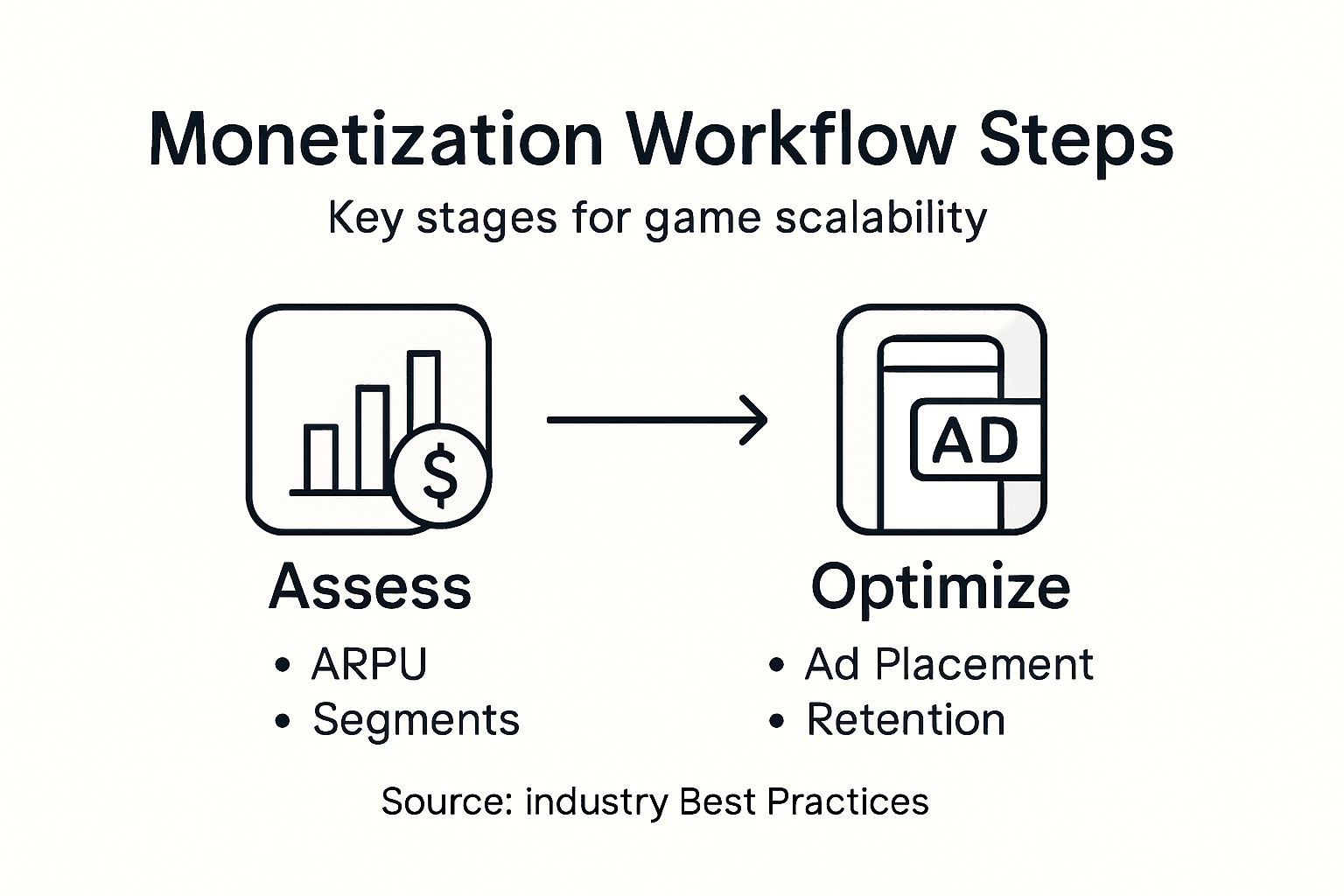
Start by establishing your performance baseline across key metrics. Document your current ARPU, lifetime value by player segment, conversion rates for each monetization tool, and churn rates. These numbers become your reference point for measuring improvement.
Track these monetization metrics weekly:
- Average revenue per user (ARPU) and median revenue per user (MRPU)
- Conversion rates for in-app purchases, battle passes, and premium currency
- Ad impression rates and revenue per thousand impressions (RPM)
- Player retention at day 1, day 7, and day 30 by monetization segment
- Churn rate for players exposed to different monetization intensities
Analyze performance by player cohort. Players acquired in January behave differently than those acquired in March. Players from organic channels spend differently than those from paid ads. Continuous data analysis helps identify which segments are monetizing healthily and which ones are being pressured too aggressively.
Correlate monetization changes with retention outcomes. When you reduce ad frequency, does retention improve enough to offset lower ad revenue? When you raise battle pass prices, how many players stop engaging? These trade-offs reveal your monetization ceiling.
Collect qualitative feedback through player surveys and app store reviews. Numbers tell you what happened, but player feedback tells you why. Players frustrated by aggressive monetization will say so in reviews before they churn.
Run A/B tests on monetization changes before rolling out globally. Test new price points, different ad placements, or alternative battle pass structures with 10 percent of your player base. Measure impact over 2 weeks before deciding whether to scale.
The best monetization strategy is the one you actually measure and refine continuously, not the one that sounded good in theory.
Pro tip: Create a monthly monetization report that tracks ARPU, LTV, conversion rates, and retention side by side, making it instantly clear which changes improved profitability without harming player experience.
Unlock Your Mobile Game’s True Monetization Potential Today
Scaling your mobile game profitably starts with mastering the very challenges this article highlights: understanding your monetization baseline, integrating effective tools, and optimizing user acquisition while protecting player experience. If you are struggling to balance high revenue with player retention or feeling unsure about how to strategically implement battle passes and ad placements, you are not alone. These common hurdles require expert guidance tailored to your game’s unique player segments and monetization model.
Discover how Ramiz Trtovac can help you transform these monetization concepts into real, actionable growth. With proven experience leading large-scale user acquisition campaigns and deep insights into mobile game performance marketing, Ramiz offers consulting and educational resources designed specifically to solve your toughest monetization problems and scale your game sustainably.
Take the next step toward supercharging your game’s revenue and keeping players engaged. Dive deeper into strategies that work by exploring Ramiz Trtovac’s consulting expertise, check out insightful blog articles and talks that complement your monetization workflow, and connect now to start building a scalable, profitable future for your game.
Frequently Asked Questions
How can I assess my mobile game’s monetization potential?
Before scaling your mobile game, analyze your current monetization setup. Measure key metrics like Average Revenue Per User (ARPU) and Lifetime Value (LTV) to identify gaps and opportunities for improvement.
What monetization tools should I integrate for my game?
Focus on high-impact monetization tools like cosmetic items, battle passes, and premium currency. Start integrating these tools gradually to identify what enhances player experience while driving revenues.
How should I optimize ad placements in my game?
Evaluate where ads are currently placed and ensure they appear during natural pauses in gameplay. Aim to test ad placements methodically, adjusting one factor at a time to measure how changes affect player retention and ad revenue.
What metrics should I track to analyze my monetization performance?
Track key metrics weekly, including ARPU, conversion rates for in-app purchases, and churn rates by player segment. Document these metrics consistently to measure the impact of your monetization strategies over time.
How can I improve player retention while monetizing?
Align monetization tactics with player preferences to minimize frustration. Test different strategies and gather feedback regularly to ensure that you maintain a balance between engagement and revenue generation.
What actions can I take to refine my monetization strategy?
Continuously analyze player behavior and revenue data to adjust your monetization tools. Implement A/B testing for price changes or new offerings, measuring the impact to find the optimal balance between profitability and player satisfaction.
Recommended
- What Is In-App Monetization and Why It Matters
- What Is Ad Monetization and Its Impact on Mobile Games
- Mobile Game Marketing: How It Drives Studio Growth
- Master Mobile User Acquisition Workflow for Growth