
Rising user acquisition costs and privacy restrictions have transformed mobile game marketing in 2026. Founders and UA managers face a critical challenge: targeting precise audiences without relying on granular data that’s no longer available. This guide reveals proven strategies to segment users effectively, optimize creative assets, and align campaigns early to reduce costs by 20% or more while improving engagement and retention.
Table of Contents
- Introduction To Game Audience Targeting In Mobile Ua
- Prerequisites: What You Need Before Starting Audience Targeting
- Step 1: Data-Driven Audience Segmentation And Analysis
- Step 2: Creative Testing And Optimization For Segmented Audiences
- Step 3: Align Early Ua Campaign Planning With Game Development
- Common Mistakes And Troubleshooting In Game Audience Targeting
- Expected Results And Metrics For Successful Audience Targeting
- Boost Your Game’s Ua Success With Expert Strategies
- Frequently Asked Questions
Key takeaways
| Point | Details |
|---|---|
| Behavioral and psychographic data improve UA efficiency by 30% | Targeting based on user motivations and actions outperforms demographic-only approaches significantly. |
| Early UA planning prevents up to 40% higher acquisition costs | Starting campaign strategy before alpha stage secures scale windows and optimizes spend efficiency. |
| Regular creative refresh reduces ad fatigue and boosts engagement | Monthly creative iterations maintain user interest and prevent performance decline from stale assets. |
| Combining data-driven segmentation with creative testing lowers UA cost by 20% | Integrated approach to audience targeting and asset optimization delivers measurable cost reductions. |
| Integrating ASO and paid UA improves install conversion 20-30% | Coordinated organic and paid strategies maximize discovery and conversion across channels. |
Introduction to game audience targeting in mobile UA
Precise audience targeting in mobile UA has become essential for profitable mobile game user acquisition in 2026. Studios can no longer afford to chase install volume alone. Success requires identifying and acquiring engaged, high-quality users who generate revenue and stick around.
Market concentration among top publishers and evolving privacy regulations have fundamentally changed the targeting landscape. Privacy restrictions since 2024 have reduced access to granular user data by over 50%, requiring UA strategies to shift towards aggregate behavioral insights and no-code creative iterations. This reduction forces studios to develop new approaches that don’t depend on individual user tracking.
High user acquisition costs create intense pressure for efficiency. Small and mid-size studios must extract maximum value from every dollar spent. The solution lies in combining behavioral segmentation, rapid creative testing, and early campaign planning to target motivated users who convert and retain at higher rates.
Key challenges facing mobile game studios in 2026 include:
- Limited access to granular user data due to privacy laws
- Rising cost per install across all major ad networks
- Increased competition for player attention in saturated markets
- Difficulty scaling campaigns profitably without sophisticated targeting
- Need for faster creative iteration to combat ad fatigue
Addressing these challenges requires a systematic approach to audience targeting that balances data-driven insights with creative experimentation and cross-functional collaboration.
Prerequisites: What you need before starting audience targeting
Successful audience targeting campaigns require solid groundwork before launch. Studios must establish data infrastructure, creative resources, tooling, and team alignment to execute effectively.
Access to behavioral, demographic, and psychographic user data forms the foundation. Your analytics infrastructure for UA should track user actions within your game, identify patterns in engagement and spending, and segment audiences based on motivations and preferences. Even aggregate data provides valuable targeting signals in the privacy-first environment of 2026.
Your creative asset library should include segmented variations ready for rapid testing. Prepare multiple ad formats, messaging angles, and visual styles tailored to different audience segments. Having assets ready accelerates testing cycles and reduces time to optimization.
Essential prerequisites include:
- Analytics platform tracking behavioral metrics, retention cohorts, and revenue attribution
- Creative production capability or partnerships for rapid asset development
- Ad network accounts configured with proper tracking and attribution
- Cross-functional communication channels between UA, marketing, and game development teams
- Budget allocation for initial testing phases across multiple segments
Pro Tip: Start with three to five broad audience segments based on player motivations (competitive, social, collection-driven, puzzle-solving) rather than demographics. Test which segments respond best to your game’s core loop before expanding.
| Prerequisite Category | Required Elements | Impact on Campaign Success |
|---|---|---|
| Data Infrastructure | Behavioral tracking, cohort analysis, attribution | Enables precise segmentation and performance measurement |
| Creative Assets | Multiple formats, segment-specific messaging, rapid iteration capability | Drives engagement and reduces ad fatigue |
| Tooling & Platforms | Ad networks, analytics, creative production tools | Facilitates execution and optimization |
| Team Alignment | Cross-functional communication, shared goals, launch coordination | Prevents inefficient spend and messaging inconsistency |
Step 1: Data-driven audience segmentation and analysis
Data-driven audience segmentation transforms generic user acquisition into precision targeting. Instead of broad demographics, segment audiences by behavior patterns and psychological motivations to identify users most likely to engage with your game.
Start by analyzing your existing player base. Identify common behaviors among high-value users: session frequency, feature usage, progression speed, social interactions, and spending patterns. Group players who exhibit similar behaviors into segments representing distinct player types.

Psychographic segmentation adds depth by categorizing users based on gaming motivations. Competitive players seek leaderboards and PvP. Social players value guilds and chat features. Collectors aim for completion. Puzzle solvers enjoy strategic challenges. Behavioral and psychographic targeting improves reach efficiency by over 30% compared to demographic-only approaches.
Practical steps for effective segmentation:
- Analyze retention cohorts to identify behavioral patterns of users who stay beyond day 7 and day 30
- Map feature engagement to understand which game elements drive different player types
- Create 3-5 primary segments based on motivation and behavior, not age or gender
- Build lookalike audiences on ad networks using your best-performing segments
- Test segment performance independently before combining strategies
Pro Tip: Focus on behavioral signals you can actually influence with creative messaging. If competitive players respond to leaderboard highlights, feature that prominently in ads targeting similar lookalike audiences.
| Segment Type | Targeting Approach | Expected Efficiency Gain |
|---|---|---|
| Behavioral (session frequency, feature use) | Target users with similar in-game action patterns | 25-30% improvement in engagement |
| Psychographic (motivations, preferences) | Message based on core gaming desires | 30-35% improvement in conversion |
| Combined Behavioral + Psychographic | Align behavior patterns with motivational messaging | 35-40% improvement in overall efficiency |
Step 2: Creative testing and optimization for segmented audiences
Creative testing and optimization bring your audience segments to life. Each segment requires tailored messaging and visual styles that resonate with their specific motivations and preferences.
No-code playable ads reduce production time and costs by up to 50%, enabling faster creative iteration critical for engaging different audience segments. These tools allow UA teams to test multiple creative variations quickly without lengthy development cycles or expensive agency partnerships.
Implement structured testing frameworks:
- Design 3-5 creative concepts per audience segment highlighting different game features
- Launch initial tests with modest budgets to gather performance data quickly
- Measure engagement metrics (click-through rate, install rate, early retention) for each creative
- Scale winning creatives while iterating on underperformers
- Refresh creative assets monthly to prevent ad fatigue
Rapid creative iteration, with refresh cycles averaging monthly, is critical for reducing ad fatigue and maintaining engagement. Even high-performing ads lose effectiveness as audiences see them repeatedly. Plan for continuous production and replacement.
Creative elements to test by segment:
- Competitive players: PvP footage, leaderboard rankings, skill demonstrations
- Social players: Guild interactions, chat features, collaborative gameplay
- Collectors: Unlockable content, completion progress, rare items
- Puzzle solvers: Strategic challenges, problem-solving moments, progression systems
Pro Tip: Test one variable at a time within each segment. If you change both the hook and the gameplay footage simultaneously, you won’t know which element drove performance changes.
Step 3: Align early UA campaign planning with game development
Early UA campaign planning separates successful launches from costly scrambles. Starting user acquisition strategy before alpha stage provides time to refine targeting, test creatives, and secure optimal scale windows.
Launching a well-planned UA campaign before alpha stage can prevent rising CPI and missed scale windows, as late planning requires increased ad spend to compensate for poor conversion rates. Studios that wait until soft launch or global launch face compressed timelines, limited testing data, and inefficient spending.
Coordinate closely between marketing and development teams for aligned messaging. When game features change during development, creative assets and targeting strategies must adapt accordingly. Regular cross-functional meetings ensure everyone understands current priorities and upcoming milestones.
Early planning delivers concrete benefits:
- Secures prime advertising inventory during key launch windows
- Allows iterative creative testing before budget pressure intensifies
- Identifies optimal audience segments with sufficient lead time
- Prevents rushed decisions that lead to wasted spend
- Establishes baseline performance data for scaling decisions
“Coordinating UA planning with game development from the start creates alignment on target audience, messaging strategy, and launch timing. This prevents the common scenario where marketing discovers fundamental game changes weeks before launch, forcing expensive last-minute creative overhauls.”
Establish cross-functional communication systems including weekly syncs, shared roadmaps, and clear decision-making processes. Define who approves creative direction, budget changes, and launch timing to avoid bottlenecks.
Common mistakes and troubleshooting in game audience targeting
Even experienced UA teams make common mistakes in UA targeting that inflate costs and reduce efficiency. Understanding these pitfalls helps you avoid them and implement fixes quickly.
Late UA planning causes the most damage. Ignoring early alignment between marketing and development teams leads to inefficient UA spend and campaign inconsistency, causing CPI increases as much as 40%. When marketing starts planning just weeks before launch, there’s insufficient time for proper testing, creative iteration, and audience validation.
Over-reliance on demographic targeting reduces efficiency in 2026. Age and gender provide limited predictive value for mobile game engagement. Studios that ignore behavioral and psychographic segmentation miss opportunities to connect with motivated players who actually want their game type.
Neglecting creative refresh leads to ad fatigue and engagement drops. Audiences become blind to ads they’ve seen repeatedly. Without monthly creative iterations, even initially successful campaigns experience declining performance and rising costs.
Ignoring privacy changes forces outdated data assumptions. Strategies built on granular user tracking from 2021-2023 no longer work. Studios must adapt to aggregate data and privacy-compliant targeting methods or face diminishing returns.
Common mistakes and fixes:
- Mistake: Starting UA planning at soft launch. Fix: Begin campaign strategy during alpha, allowing 4-6 months of preparation.
- Mistake: Targeting only by demographics. Fix: Shift to behavioral and psychographic segmentation for 30%+ efficiency gains.
- Mistake: Running the same creatives for 2-3 months. Fix: Implement monthly refresh cycles and continuous testing.
- Mistake: Assuming 2023 data strategies still work. Fix: Adopt privacy-compliant aggregate targeting and attribution methods.
- Mistake: Siloed teams with no communication. Fix: Establish weekly cross-functional syncs and shared roadmaps.
For detailed troubleshooting audience targeting issues, analyze performance data at the segment level rather than campaign totals. Identify which specific audiences underperform and adjust targeting parameters, creative messaging, or budget allocation accordingly.
Expected results and metrics for successful audience targeting
Define realistic KPIs to evaluate audience targeting effectiveness. UA success metrics and benchmarks provide objective measures to verify strategy performance and guide optimization decisions.
Data-driven audience segmentation combined with strong creative assets can lower user acquisition cost by an average of 20%, enabling better ROI for mobile games at scale. This reduction comes from eliminating wasted impressions on uninterested users and improving conversion rates among targeted segments.
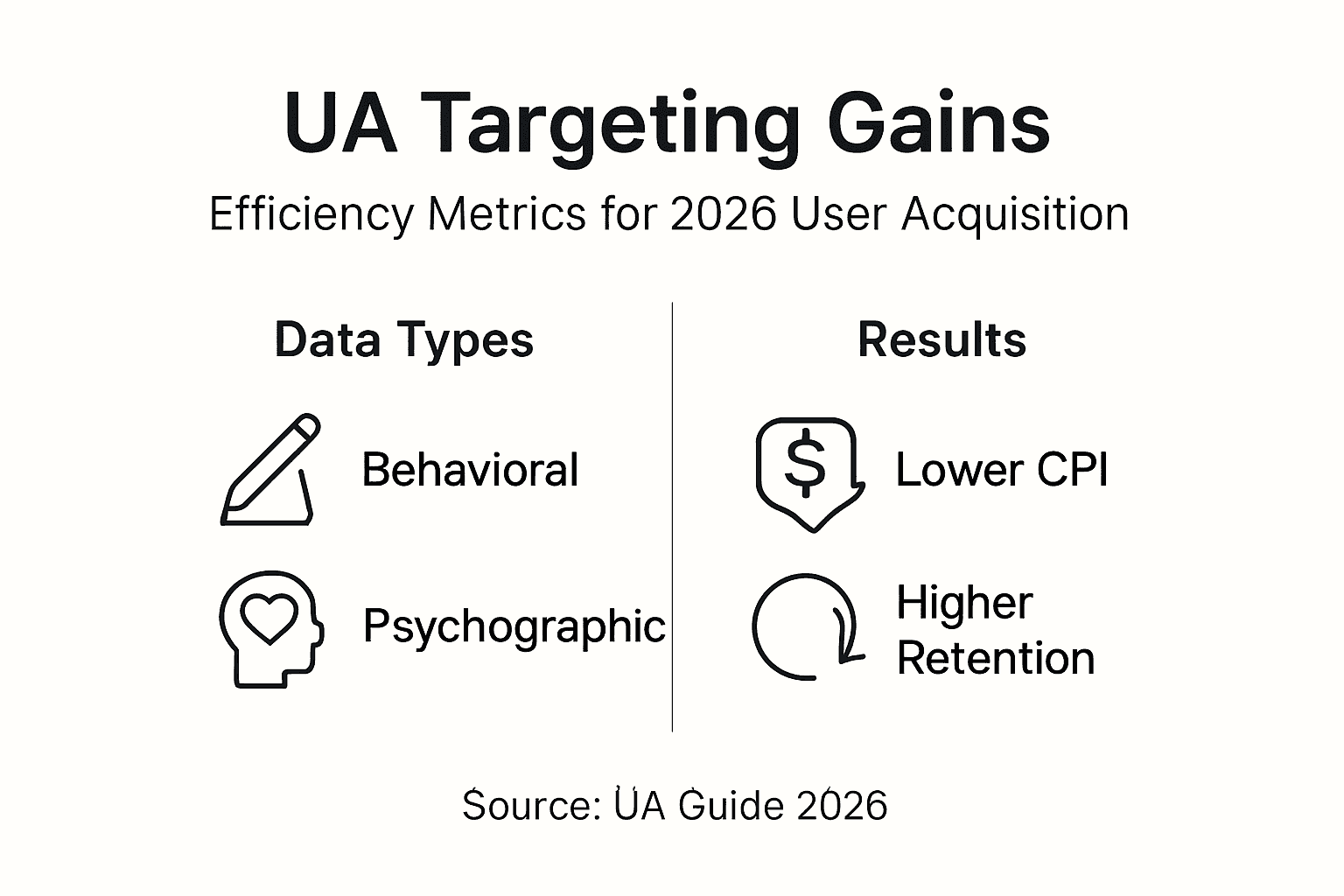
Expect 8-12% uplift in user retention rates over 30 days when targeting precisely matches player motivations to game features. Users acquired through relevant messaging understand what to expect and engage more consistently.
App Store Optimization combined with targeted paid UA campaigns can improve install conversion rates by 20-30%. Coordinated organic and paid strategies create multiple touchpoints that reinforce messaging and increase overall discovery.
Key performance indicators to track:
- Cost per install (CPI) by audience segment
- Day 1, Day 7, and Day 30 retention rates
- Install conversion rate from impression to download
- Return on ad spend (ROAS) at 30, 60, and 90 days
- Creative engagement metrics (click-through rate, video completion rate)
| Metric | Demographic-Only Baseline | Behavioral + Psychographic Target | Improvement Range |
|---|---|---|---|
| Cost Per Install | $2.50 | $2.00 | 15-25% reduction |
| Day 30 Retention | 8% | 9-10% | 8-12% uplift |
| Install Conversion Rate | 18% | 22-24% | 20-30% improvement |
| 60-Day ROAS | 0.85 | 1.05-1.15 | 20-35% improvement |
Benchmark against your own demographic-only campaigns rather than industry averages. Your specific game genre, monetization model, and target markets create unique performance characteristics. Measure improvement relative to your baseline to verify segmentation and creative optimization impact.
Boost your game’s UA success with expert strategies
Precise audience targeting requires both strategic planning and tactical execution. If you need guidance optimizing your mobile game user acquisition campaigns, UA expert Ramiz Trtovac offers specialized consulting to help studios scale profitably.
Explore proven mobile game marketing strategies covering campaign structure, creative optimization, and cross-channel coordination. Access practical insights from years of hands-on experience running large-scale UA campaigns across multiple ad networks and game genres. Whether you’re launching your first title or scaling an established game, expert resources help you avoid costly mistakes and accelerate results. Visit the user acquisition blog posts for detailed guides on segmentation, creative testing, analytics, and profitability optimization.
Frequently asked questions
What are the best data types for segmenting mobile game audiences?
Behavioral and psychographic data outperform demographics for precise audience targeting in mobile games. Focus on in-game actions like session frequency, feature usage, and progression patterns combined with motivational factors such as competitive drive, social preferences, or collection goals. These signals predict engagement and retention far better than age or gender alone.
How often should creatives be refreshed to prevent ad fatigue?
Monthly creative refresh frequency maintains engagement and prevents ad fatigue in 2026 mobile UA campaigns. Even high-performing ads lose effectiveness as audiences see them repeatedly. Plan continuous production cycles to replace or update creatives before performance degrades, ensuring consistent conversion rates and cost efficiency.
What are the biggest mistakes to avoid in game audience targeting?
Late UA planning causes up to 40% higher CPI by forcing rushed decisions and insufficient testing time. Overdependence on demographic-only targeting wastes budget on uninterested users. Neglecting creative testing and refresh allows ad fatigue to erode performance. Ignoring privacy changes leaves strategies dependent on unavailable data. Avoid these common UA targeting mistakes by starting early, segmenting behaviorally, refreshing creatives monthly, and adopting privacy-compliant methods.
Recommended
- Audience Targeting: Maximizing Mobile UA Profitability
- Ad Creatives in Mobile Games: 16% Higher UA Efficiency
- User acquisition strategies 2026: Cut CPI up to 40% with AI
- Master Mobile Game UA Workflow for Profitable Launches