
Playable ads now drive 8.3% of mobile game installs and delivered 16% year-over-year performance gains in 2025, yet many UA managers still underestimate creative quality’s impact on campaign profitability. As user acquisition costs climb, your ad creative becomes the critical first touchpoint shaping install rates, retention, and long-term revenue. This guide explores emerging formats like playables and hybrids, data-driven optimization strategies, and practical scaling methods to help founders and UA teams improve efficiency and cut costs in 2026.
Table of Contents
- Understanding Creative Quality And Performance Metrics
- Emerging Ad Formats And Their Impact On User Acquisition
- Data-Driven Creative Optimization Through Tagging And Metrics
- Scaling Creative Production Without Losing Quality
- Common Misconceptions About Ad Creatives In Mobile Games
- Applying Insights To Your UA Strategy: Practical Tips
- Boost Your Mobile Game UA With Expert Creative Strategies
Key Takeaways
| Point | Details |
|---|---|
| Creative quality drives CTR | Engaging video narratives boost click-through rates 20-30% over static ads. |
| Playable ads deliver measurable ROI | Playables grew 16% in performance year-over-year and now represent 8.3% of creatives. |
| Creative tagging enables precision | Nearly 49% of new creatives use tagging for component-level optimization. |
| Scaling requires modular design | Top studios release hundreds of creatives weekly using asset libraries to prevent fatigue. |
| Misconceptions waste budgets | Generic ads underperform tailored creatives by up to 30% in conversion rates. |
Understanding Creative Quality and Performance Metrics
High-quality ad creatives combine professional visuals, clear messaging, and compelling narratives that resonate with your target audience. These elements translate directly into measurable user acquisition metrics.
Key performance indicators tie creative quality to campaign success. Click-through rate (CTR) measures how effectively your ad captures attention. Install conversion rate shows how many clicks become downloads. Retention metrics reveal whether creatives attract users who stay engaged beyond the first session. Together, these KPIs help you evaluate which creatives drive profitable growth.
Video ads with engaging narratives saw 20-30% higher CTRs than static ads in 2025 UA campaigns. This performance gap stems from storytelling’s ability to communicate gameplay value and emotional hooks within seconds. When users understand what makes your game fun before installing, you attract more qualified players who convert at higher rates.
Quality creatives reduce user acquisition cost by filtering out irrelevant audiences early. A well-crafted ad showing actual gameplay mechanics attracts players genuinely interested in that experience. Generic ads might generate more impressions, but they waste budget on users who install and immediately churn. Focus on mobile game UA KPIs that measure quality over volume.
Components of creative quality:
- Professional art and animation that reflects in-game visuals accurately
- Clear value proposition communicated in the first 3 seconds
- Emotional hooks tied to gameplay rewards or social proof
- Authentic gameplay footage rather than misleading concepts
Pro Tip: Test creatives with small budget allocations first. Monitor day 1 and day 7 retention alongside CTR to identify which creative styles attract valuable long-term players before scaling spend.
Emerging Ad Formats and Their Impact on User Acquisition
Video ads dominate mobile game UA with over 80% market share, but lower interactivity limits their ability to qualify users effectively. Playable ads offer hands-on trial experiences that let potential players interact with core mechanics before installing. Hybrid formats blend storytelling with interactive elements to balance engagement and conversion.

Playable ads accounted for 8.3% of mobile game ad creatives globally in 2024, with 16% year-over-year performance increase in 2025. This growth reflects their unique ability to pre-qualify users through gameplay sampling. Players who complete a playable ad demonstrate genuine interest and understanding, leading to higher retention and better lifetime value.
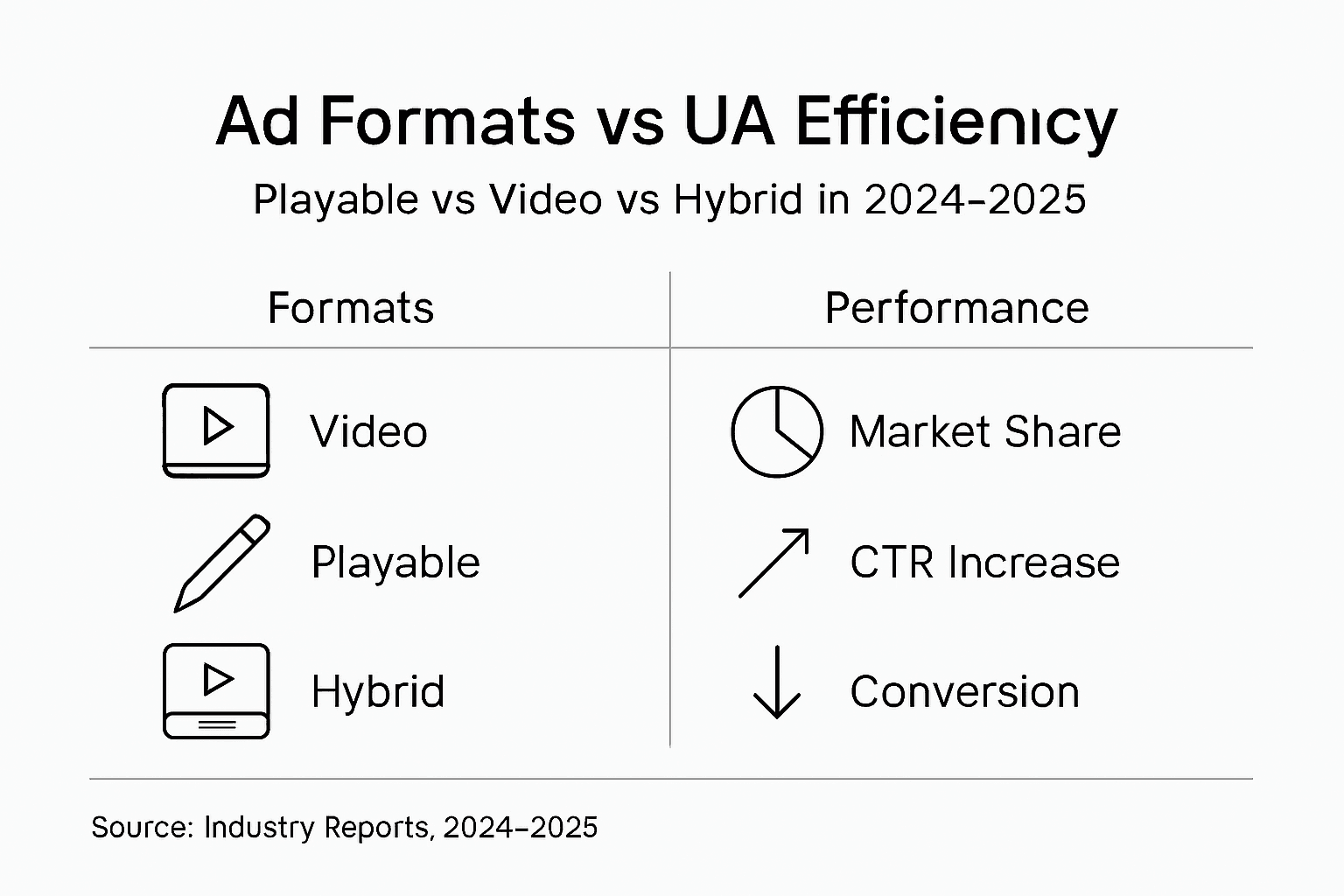
Video ads made up 80.9% of global mobile game ad creatives in Q1-Q3 2025, with playable ads at 5% and hybrids rising steadily. Regional differences affect format efficiency, requiring market-specific strategies. Asian markets show higher playable adoption, while Western audiences still respond strongly to narrative-driven video content.
| Format | Market Share | Best Use Case | Avg CTR | Conversion Strength |
|---|---|---|---|---|
| Video | 80.9% | Brand awareness, storytelling | 3-5% | Moderate |
| Playable | 8.3% | User qualification, pre-install trial | 6-8% | High |
| Hybrid | Growing | Balancing narrative and interaction | 5-7% | High |
Choosing the right format depends on your game genre and target audience. Puzzle and casual games benefit from playable ads for UA profitability because core mechanics are easy to demonstrate in 30 seconds. Strategy and RPG titles often need video storytelling to convey depth and progression systems.
Format selection considerations:
- Match format to gameplay complexity and session length
- Test playables for casual genres with simple, repeatable mechanics
- Use video for narrative-heavy games requiring context
- Experiment with hybrids to combine strengths of both approaches
Explore effective user acquisition strategies and review playable ads performance data and 2025 mobile gaming ad formats data to inform your format decisions.
Data-Driven Creative Optimization Through Tagging and Metrics
Creative tagging labels specific ad components like characters, colors, hooks, or calls-to-action to track granular performance. This practice transforms creative testing from guesswork into analytics-driven optimization.
Nearly 49% of new mobile game creatives were tagged for performance analysis in January 2025. This industry adoption reflects tagging’s proven ability to identify winning elements faster and allocate budget more efficiently. When you know a specific character or visual style drives 40% higher conversion, you can double down on that element across future creatives.
Tagging benefits include precise insights into which creative components resonate most with your audience. You can isolate emotional hooks, visual styles, or messaging frameworks that consistently outperform. This enables targeted optimizations rather than wholesale creative replacements, saving production time and costs.
Steps for implementing creative tagging in your UA workflow:
- Define a consistent taxonomy for creative elements (characters, hooks, colors, formats)
- Tag each new creative with relevant labels before launching campaigns
- Collect performance data across tags using your attribution platform
- Analyze which tagged elements correlate with your key UA metrics
- Iterate by amplifying high-performing elements and testing variations
Pro Tip: Use tagging data to identify emotional hooks or visual styles that resonate most with high-value user segments. Filter performance by cohort quality, not just volume, to optimize for retention and revenue.
“Tagging transforms creative production from art into science. When you measure what works at the component level, every new creative becomes smarter than the last.”
Integrate tagging into your mobile user acquisition workflow to build a feedback loop between creative teams and performance data. Review the importance of creative tagging for deeper implementation guidance.
Scaling Creative Production Without Losing Quality
Creative fatigue increases cost-per-install after 2-3 weeks of showing the same ads to overlapping audiences. As performance declines, you must refresh creatives frequently to maintain efficiency. Top studios release hundreds or thousands of creatives weekly using modular asset design.
Modular production breaks creatives into reusable components like backgrounds, characters, animations, and hooks. Teams mix and match these elements to generate variations quickly without starting from scratch each time. This approach maintains quality while achieving the volume needed to combat fatigue.
Strategies for scaling creative production:
- Build libraries of modular assets that creative teams can combine rapidly
- Use automation tools to render variations from templates at scale
- Run continuous A/B tests comparing new creatives against current champions
- Schedule creative refreshes every 2-3 weeks based on performance decay signals
- Localize top performers for different markets rather than creating region-specific concepts
Pro Tip: Monitor fatigue early via performance metrics like CTR and CPI trends. When you see a 15-20% performance drop over 7 days, schedule your creative refresh proactively rather than waiting for complete decay.
Balancing volume with quality ensures sustained engagement and cost-effective scaling. Avoid the trap of flooding channels with mediocre ads just to hit quantity targets. Each creative should offer a unique angle or hook, even when built from shared asset libraries. Learn more about launching mobile game ads for ROI.
Common Misconceptions About Ad Creatives in Mobile Games
Misconception 1 claims more creatives automatically improve UA results. In reality, launching dozens of low-quality ads creates noise and fatigue without improving conversion. Volume matters only when paired with strategic variation and quality control. Flooding ad networks with similar creatives dilutes performance and wastes creative budgets.
Misconception 2 dismisses playable ads as a fleeting trend or niche format. Data shows playables delivered measurable 16% performance improvements year-over-year, proving their staying power and effectiveness. Studios ignoring playables miss opportunities to pre-qualify users and improve retention.
Misconception 3 suggests generic ads save money compared to tailored creatives. Generic approaches underperform customized ads by up to 30% in CTR and conversion rates. The upfront savings on production get erased by higher acquisition costs and lower-quality installs that churn quickly.
| Misconception | Reality | Evidence |
|---|---|---|
| More ads = better UA | Quality beats quantity; fatigue hurts performance | CPI increases 20-30% after 2-3 weeks with stale creatives |
| Playables are a fad | Proven format with sustained growth | 16% YoY performance increase, 8.3% market share |
| Generic ads save money | Tailored ads convert 30% better | Personalized creatives reduce CPI and improve retention |
Practical takeaways to avoid these pitfalls:
- Prioritize strategic creative variation over sheer volume
- Test playable and hybrid formats even if video dominates your current mix
- Invest in tailored creatives that speak to specific player motivations
- Use data to guide production rather than assumptions about cost savings
Applying Insights to Your UA Strategy: Practical Tips
Translate research into action by following these steps to improve your mobile game user acquisition campaigns immediately.
1. Focus on quality and format relevance first. Choose ad formats that match your game genre and audience preferences. Test playables for casual games and video for narrative-driven titles. Measure results against UA KPIs that prioritize retention and revenue over raw installs.
2. Implement creative tagging across all new ads. Build a taxonomy that captures hooks, visuals, and messaging elements. Track performance at the component level to identify what drives engagement and conversion in your specific audience.
3. Integrate playable and hybrid ads into your mix. Allocate 15-20% of creative budget to testing interactive formats. Monitor how pre-qualified users from playables compare to video installs on day 7 and day 30 retention.
4. Emphasize continuous iteration over volume alone. Launch new creative variations every 2-3 weeks based on performance data. Use modular production to maintain quality while scaling output.
5. Localize creatives for regional relevance. Adapt top performers for different markets by changing language, cultural references, or visual styles. Regional customization can improve conversion rates by 20-40% compared to generic global creatives.
Pro Tip: Use performance benchmarks from your genre and platform to set realistic KPIs. Optimize campaign timing and budget allocation based on when your target audience is most active and receptive. Review strategies to lower UA costs in 2026 and cut CPI while scaling ROAS.
Apply modular production workflows to sustain creative freshness and reduce fatigue. Schedule refreshes proactively based on performance signals rather than waiting for complete decay. This approach maintains efficiency and protects your budget from diminishing returns.
Boost Your Mobile Game UA with Expert Creative Strategies
Applying these creative optimization strategies requires ongoing expertise and data analysis. Ramiz Trtovac specializes in mobile game user acquisition with a proven track record of improving campaign ROI through creative excellence and analytics-driven iteration.
Explore tailored solutions including playable ads boosting UA profitability and mobile game analytics for UA profitability. Access case studies, detailed guides, and personalized consultations designed to help founders and UA managers scale profitably while reducing acquisition costs. Whether you need help implementing creative tagging, scaling production workflows, or optimizing format strategy, expert guidance accelerates results and protects your budget from common pitfalls.
FAQ
What metrics best indicate ad creative success in mobile games?
Click-through rate (CTR), install conversion rate, day 1 and day 7 retention, and cost-per-install (CPI) are primary metrics to track creative success. Analyzing these together reveals which creatives attract high-quality users who engage beyond initial install, enabling continuous optimization and improved ROI.
How do playable ads improve user acquisition compared to video ads?
Playable ads offer interactive trial experiences that pre-qualify users by letting them engage with core gameplay mechanics before installing. They show a 16% yearly performance growth and higher conversion efficiency because players who complete playables demonstrate genuine interest and better understanding of your game.
What is creative fatigue and how can it be prevented?
Creative fatigue occurs when audiences see the same ads repeatedly, causing performance drops and CPI increases of 20-30% after 2-3 weeks. Prevent fatigue by regularly rotating creatives every 2-3 weeks, using modular asset libraries to generate variations, and monitoring performance metrics for early decay signals.
Why is creative tagging important for mobile game UA teams?
Tagging breaks creatives into labeled components to identify exactly which elements drive engagement and conversion. It enables data-driven iterations that improve campaign performance by amplifying winning hooks, visuals, or messaging while eliminating underperforming elements, ultimately reducing acquisition costs and improving user quality.
Recommended
- What Is ROAS in Games? Boost UA Profitability by 1.5x+
- Master Mobile Game UA Workflow for Profitable Launches
- Effective User Acquisition Strategies – Blog posts
- Retargeting Strategies: Maximizing Mobile UA ROI