Launching user acquisition campaigns for mobile games can feel like chasing moving targets when your objectives and audiences remain vague. For mobile game studios across North America, the gap between an average campaign and a profitable one begins with clear goals and razor-sharp audience segmentation. Mastering the SMART framework and building out precise player profiles becomes your foundation for campaigns that drive sustained growth rather than wasted spend.
Table of Contents
- Step 1: Define Ad Objectives And Target Audience
- Step 2: Set Up Tracking And Creative Assets
- Step 3: Deploy Campaigns Across Ad Networks
- Step 4: Optimize Bids And Targeting Strategies
- Step 5: Analyze Results And Improve Campaigns
Quick Summary
| Essential Insight | Clear Explanation |
|---|---|
| 1. Define specific ad objectives | Identify clear goals like downloads or monetization to guide campaign strategies effectively. |
| 2. Narrow down your target audience | Understand player demographics and behaviors to tailor your advertising messages for better engagement. |
| 3. Implement robust tracking measures | Set up tracking tools to monitor key performance indicators for measuring campaign effectiveness continuously. |
| 4. Optimize network deployment strategies | Deploy ads across multiple networks and adjust budget allocations based on performance data to maximize reach. |
| 5. Analyze results for continuous improvement | Regularly review campaign metrics to identify trends and optimize strategies, ensuring sustained campaign success. |
Step 1: Define ad objectives and target audience
Before launching a single ad, you need crystal clear objectives and a specific audience in mind. Without these foundational elements, you’re essentially throwing money at the wall and hoping something sticks. This step separates campaigns that scale profitably from those that drain your budget with mediocre results.
Start by defining what success looks like for your mobile game. Are you chasing raw downloads, building retention among existing players, or driving in-app purchases? These three objectives require completely different campaign strategies. A download-focused campaign might prioritize reach and cost-per-install, while a monetization campaign targets high-value segments willing to spend within your game.
Use the SMART framework to structure your goals:
- Specific: “Acquire 50,000 new players” beats “get more downloads”
- Measurable: Track install numbers, retention rates, or ROAS (return on ad spend)
- Achievable: Base targets on your budget and historical performance
- Relevant: Align with your studio’s growth stage and revenue needs
- Time-bound: Set a 30, 60, or 90-day deadline
Now comes the audience piece. Mobile gaming spans billions of players—everyone from casual mom-and-pop gamers to hardcore esports enthusiasts. Your job is narrowing that down significantly. Understanding player demographics and gaming preferences helps you craft messages that actually resonate.
Dive into these audience segments:
- Age and location: Where are your best-performing users? A hyper-casual puzzle game in North America plays differently than a strategy title in Southeast Asia
- Device type and OS: iOS users often spend more, but Android reaches scale
- Gaming behavior: Are they casual 5-minute players or hardcore 2+ hour daily gamers?
- Spending patterns: Not all players monetize equally—identify your high-value segments early
Segmentation matters enormously. When you match the right message to the right player profile, engagement and monetization follow. A hardcore strategy gamer won’t convert well to a casual Match-3 ad, no matter how polished it looks.
Define measurable, specific objectives and narrow your audience ruthlessly—precision targeting beats broad reach every single time.
Pro tip: Start with your existing player base as a reference point. If you have historical data on who plays your game, runs ads against those player profiles first before expanding to lookalike audiences—this gives you a performance baseline to beat.
Step 2: Set up tracking and creative assets
Tracking and creatives are the nervous system of your campaign. Without proper tracking, you’re flying blind. Without compelling creatives, even perfect targeting won’t convert. This step ensures you can measure what works and have the visual firepower to win attention in crowded ad spaces.

Start by establishing your tracking infrastructure before any ads go live. Connect your game’s backend to your ad network dashboards, mobile measurement partner (MMP), and analytics platform. You need to track every step of the user journey: ad click, app install, first day active users, and eventually revenue events.
Define your key performance indicators (KPIs) early:
- Cost per install (CPI): What are you willing to pay per download?
- Day 1 and Day 7 retention: Are users coming back?
- Return on ad spend (ROAS): For monetization campaigns, this is your north star
- Click-through rate (CTR) and installs per mille (IPM): These measure creative effectiveness
Once tracking is locked in, shift focus to your creative assets. Creative analytics and performance tracking help you identify which visual approaches drive installs and engagement. Your creatives are competing against thousands of other ads for a player’s attention.
Build creatives with these principles in mind:
- Mobile-first design: Vertical, full-screen formats outperform horizontal layouts on phones
- Sound-off optimization: Add captions and bold text since many players watch without audio
- 15 to 30 second duration: Optimal length for engagement before thumb fatigue sets in
- Clear branding: Include your game logo and distinctive visual identity
- Interactive hooks: Show gameplay moments that feel immersive and compelling
Create at least 5 to 10 variations of each creative concept. Different audiences respond to different hooks. One segment might convert on action-packed gameplay, while another engages with story-driven moments or character personalities.
Strong tracking reveals what works; diverse creatives give you multiple shots at winning downloads.
Pro tip: Test your tracking setup with a small $50 to $100 test campaign before spending significantly—this catches measurement issues early and prevents wasting budget on campaigns you can’t properly analyze.
Step 3: Deploy campaigns across ad networks
You’ve defined your objectives, built your tracking, and created your assets. Now it’s time to actually launch. Deployment across multiple ad networks multiplies your reach and reduces reliance on any single platform. The right network mix can mean the difference between a campaign that scales and one that plateaus quickly.
Start by identifying which networks align with your game’s genre and target players. Meta (Facebook and Instagram) dominates casual and hyper-casual games with massive North American reach. Google (App Campaigns and YouTube) works exceptionally well for strategy and simulation titles. TikTok captures younger audiences and viral potential. Programmatic DSPs fill gaps and offer real-time bidding flexibility.
Here’s a quick comparison of key ad network strengths for mobile game campaigns:
| Ad Network | Best For | Unique Advantage |
|---|---|---|
| Meta (Facebook/IG) | Casual & hyper-casual | Broad reach, advanced targeting |
| Google (App/YouTube) | Strategy & simulation | Search intent, global scale |
| TikTok | Younger demographics | Viral potential, short-form video |
| Programmatic DSPs | All genres | Real-time bidding flexibility |
Data-driven bid optimization and strategic placements enhance campaign efficiency across channels. Don’t spread your budget equally across networks. Instead, allocate based on historical performance and your specific KPI targets.
Follow this deployment sequence:
- Start with your strongest network first: If you know Meta performs best for your game, launch there with 40% of budget
- Add secondary networks after 48 hours: Test Google App Campaigns with 30% while Meta runs
- Layer in supplementary channels: Allocate remaining 30% to TikTok or programmatic DSPs for reach expansion
- Monitor daily performance: Track CPI, CTR, and retention metrics religiously
Set up A/B testing at the campaign level rather than fragmenting budgets across too many variations initially. Run 2 to 3 versions of your core campaign message on each network, then double down on what converts.
Your finance and marketing teams should stay aligned throughout deployment. Budget allocation decisions ripple through projections. If one network underperforms, you need clear escalation procedures to reallocate spend without creating bottlenecks.
Multi-network deployment reduces platform dependency and maximizes your chances of finding scale.
Pro tip: Launch with 30 to 50% of your total budget across networks in the first week, monitor results obsessively, then scale spend on winners once you confirm your tracking is firing correctly and cost-per-install targets are being met.
Step 4: Optimize bids and targeting strategies
Your campaigns are live, but they won’t run optimally on autopilot. Bid optimization and targeting refinement are where good campaigns become profitable ones. This step transforms your initial launch into a fine-tuned machine that consistently delivers installs at or below your target CPI.
Start by understanding your player lifetime value (LTV) for each game segment. If casual players spend an average of $15 and hardcore players spend $45, your bids should reflect that difference. Never bid the same amount for all users. Aligning bids with player lifetime value ensures you’re not underbidding on high-value segments or overpaying for low-value installs.
Adjust your strategy across these dimensions:
- Device targeting: iOS users typically convert better but cost more. Android offers scale at lower CPI
- Geographic targeting: North American players monetize higher than European or Asian audiences
- Audience segments: Lookalike audiences based on your best existing players beat cold traffic
- Dayparting: Mobile gaming peaks evenings and weekends, so adjust bids accordingly
AI-enabled predictive targeting continuously adapts your campaigns to evolving player preferences. Most modern ad networks include machine learning bid optimization. Enable it, but monitor manually during the first week to ensure it’s not burning budget on poor-quality installs.
Test your targeting hypotheses systematically:
- Run cohort A: High-value lookalike audiences with elevated bids for 3 days
- Run cohort B: Broad targeting with standard bids running simultaneously
- Measure results: Compare CPI, CTR, and Day 1 retention between cohorts
- Scale winners: Double budget on the cohort with better ROAS
Avoid the temptation to tweak bids daily based on hourly noise. Set bid adjustments every 48 to 72 hours once you have meaningful data. Constant micro-adjustments introduce noise and prevent you from seeing true performance signals.
Smart bids target high-value players; constant optimization prevents ad fatigue and maintains profitability at scale.
Pro tip: Create separate ad sets for your top 20% of players (by LTV) and bid 30 to 50% higher for them—even if overall CPI rises slightly, the additional revenue from higher-value installs will improve your campaign ROAS dramatically.
Step 5: Analyze results and improve campaigns
Data without action is just noise. This step separates campaigns that stagnate from those that compound. You’ll dig into your metrics, identify what’s actually working, and ruthlessly cut what isn’t. The goal is continuous improvement cycles that progressively lower your CPI while maintaining or improving retention.
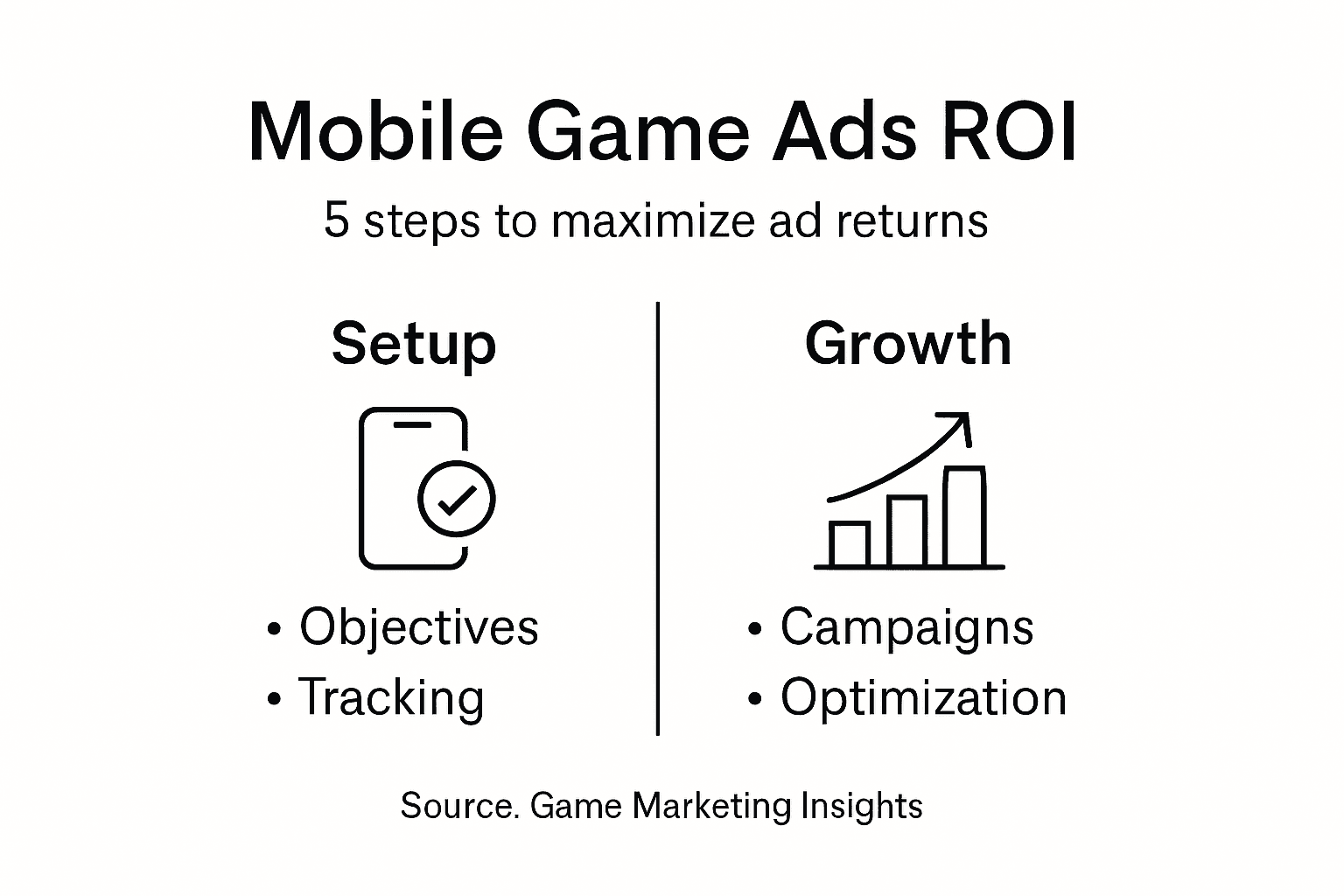
Start by establishing your core metrics dashboard. Track these daily during the first two weeks, then weekly afterward. You need cost per install (CPI), Day 1 retention, Return on Ad Spend (ROAS), average revenue per user (ARPU), and click-through rate (CTR). If any single metric drifts significantly, investigate why immediately.
To help you analyze and improve campaigns effectively, here’s a summary table of key performance metrics and their business significance:
| Metric | What It Measures | Why It Matters |
|---|---|---|
| CPI | Cost per user install | Controls acquisition spend |
| Day 1 Retention | Percentage returning next day | Indicates first impression quality |
| ROAS | Return on ad spend | Tracks advertising profitability |
| ARPU | Average revenue per user | Reveals monetization strength |
| CTR | Click-through rate | Signals creative effectiveness |
Analyze creative performance systematically. A/B testing and cohort analysis reveal which visual elements, messaging hooks, and ad formats drive the best results. Run at least three creative variations simultaneously on each network for the first 30 days.
Focus your analysis on these dimensions:
- Creative elements: Which game footage, character reveals, or gameplay moments drive installs?
- Audience segments: Did your high-LTV cohort perform as expected compared to broad targeting?
- Network performance: Is Meta outperforming Google on ROAS, or vice versa?
- Placement variation: Did feed ads, rewarded video, or interstitials convert differently?
Monthly, conduct a deeper brand lift and creative recall study. Understanding how your ads affect player perception matters beyond install metrics. Strong creative branding generates consideration and word-of-mouth that paid metrics don’t capture. If your ads generate poor brand recall, even cheap installs won’t retain.
Create an improvement roadmap based on findings:
- Identify top performers: Which creatives and segments drove 30% of installs with lowest CPI?
- Pause underperformers: Kill creatives and segments in the bottom 20% by spend efficiency
- Scale winners: Double budget on high-performing creative and audience combos
- Refresh creative: Replace paused creatives with new variations inspired by top performers
Document everything. Track which creative elements appeared in your top-performing ads. What story did they tell? What game moments did they emphasize? Use these patterns to inform your next creative batch.
Data reveals winners; action multiplies them. Stagnant campaigns lose momentum fast.
Pro tip: Set a monthly creative refresh cadence where 20 to 30% of your active creatives rotate out, replaced by new variations based on top-performer patterns—this prevents ad fatigue and keeps your ROAS from declining over time.
Maximize Your Mobile Game Ad Campaign Success Today
Launching mobile game ads that achieve the highest ROI takes more than just setting up a campaign. You need clear objectives, precision in audience targeting, robust tracking, and constant optimization to overcome common challenges like high CPI and low retention. If you find yourself struggling with bid management, creative fatigue, or multi-network deployment, you are not alone. Our proven strategies help studios transform these pain points into winning advantages.
Unlock the full potential of your mobile user acquisition efforts by partnering with expertise tailored for game marketers. Explore Ramiz Trtovac’s consulting and educational resources to access in-depth insights on performance marketing tailored for mobile games. Visit the main website and start refining your campaigns with actionable guidance that turns data into growth. Don’t wait until your budget drains; take control of your ad campaigns now and scale profitably with trusted support.
Frequently Asked Questions
How can I define clear objectives for my mobile game ads?
To define clear objectives, identify what success means for your game—are you aiming for downloads, player retention, or in-app purchases? Use the SMART framework to make your objectives specific, measurable, achievable, relevant, and time-bound.
What metrics should I track for my mobile game advertising campaigns?
You should track key performance indicators (KPIs) such as cost per install (CPI), Day 1 and Day 7 retention rates, return on ad spend (ROAS), and click-through rate (CTR). Establish a dashboard for these metrics to evaluate campaign performance effectively within the first few weeks.
How do I create engaging creative assets for my mobile game ads?
To create engaging ads, focus on a mobile-first design that optimizes visuals for small screens and incorporates sound-off elements like captions. Aim for a length of 15 to 30 seconds for your video ads and produce multiple variations to test different approaches and find what resonates best with your audience.
What steps should I follow to optimize bidding strategies?
Optimize your bidding strategies by aligning your bids with player lifetime value (LTV) and adjusting based on audience segments, geographic targeting, and device types. Test different bids for your high-value audience segments and refine them every 48 to 72 hours based on performance data.
How can I analyze my mobile game ad campaign results effectively?
Analyze your campaign results by setting up a metrics dashboard to monitor CPI, Day 1 retention, ROAS, and average revenue per user (ARPU). Conduct regular assessments, monthly updates, and use data to improve underperforming ads while scaling winners based on solid performance metrics.
Recommended
- Mastering Facebook Ads for Mobile Games by Ramiz Trtovac
- What Is Ad Monetization and Its Impact on Mobile Games
- Master Mobile Game UA Workflow for Profitable Launches
- Top 5 Mobile Game Marketing Strategies for 2024