Acquiring and retaining players is tougher than ever for Mobile game studios in fiercely competitive markets. The stakes are high, with annual worldwide user acquisition spend now exceeding $26 billion, according to Fluentco. Understanding the complete ecosystem of ad channels, tools, and creative strategies is essential, because every investment directly affects your studio’s bottom line. This article clarifies the complexities of the modern gaming UA landscape so you can refine your approach and maximize profitability.
Table of Contents
- What Is The Gaming UA Landscape?
- Major Types And Key Ad Channels
- How AI And Market Changes Reshape UA
- Unique Trends Across Regions And Genres
- Biggest Pitfalls And Profitability Risks Today
Key Takeaways
| Point | Details |
|---|---|
| Understanding the Gaming UA Landscape is Essential | The gaming user acquisition ecosystem directly affects revenue and scaling efforts in mobile game studios. Knowing the right channels and tools can significantly impact profitability. |
| Invest in a Balanced Media Mix | Diversifying acquisition strategies across various ad channels minimizes risk and captures a wider audience, adapting to cost changes effectively. |
| Leverage AI for Optimization | Artificial intelligence can enhance creative strategies and budget allocation, allowing studios to respond quickly to market changes and improve ad performance. |
| Be Aware of Rising Costs and Pitfalls | User acquisition costs continue to rise; studios need to avoid over-reliance on single channels and ensure accurate measurement to maintain profitability. |
What Is the Gaming UA Landscape?
The gaming user acquisition (UA) landscape is the complete ecosystem of channels, tools, and strategies that mobile game studios use to acquire players profitably. This landscape encompasses everything from ad networks and social platforms to measurement infrastructure and performance optimization tactics.
Understanding this landscape matters because it directly shapes how much revenue you’ll generate per player acquired and how quickly you can scale. The complexity here isn’t just theoretical—it affects your bottom line every single day.
The Scale and Scope of Gaming UA
The mobile gaming UA industry operates at massive scale. Annual worldwide spend exceeds $26 billion, making this one of the largest marketing ecosystems in digital advertising today.
This spending reflects the competitive reality: acquiring players has become increasingly expensive, and channels have become more sophisticated. Studios invest heavily because the payoff justifies the spend when executed correctly.
The landscape includes:
- Mainstream ad networks (Google, Meta, TikTok, Apple) where most budget flows
- Alternative channels (smaller networks, programmatic platforms, direct deals) that provide supplementary reach
- Influencer partnerships and creator collaborations that drive quality players
- Rewarded advertising campaigns optimized for engagement and retention
- Contextual advertising that reaches players through relevant content and environments
Infrastructure Supporting Growth
Behind every player acquisition attempt sits integrated infrastructure. Mobile measurement partners (MMPs) track which ads drive which players, providing the attribution data you need to optimize spending. Understanding MMPs shows how this tracking infrastructure became essential to UA success.
Analytics platforms aggregate this data into dashboards that help you see cohort performance, lifetime value trends, and revenue impact. Without proper measurement, you’re essentially guessing which channels actually work.
Balanced Media Mix Strategy
Successful studios don’t rely on a single channel. Instead, they build a balanced media mix across multiple platforms and campaign types.
Why? Different channels reach different player segments:
- Core gamers often respond to targeted campaigns on gaming-focused networks
- Casual players convert better through social ads and influencer recommendations
- Mid-core audiences respond well to rewarded video and contextual placements
A balanced media mix spreads risk while capturing players across your entire addressable market, preventing over-reliance on any single channel or network.
The goal is to maintain flexibility. When one channel’s cost per install rises, you shift budget to another that still delivers returns. This diversification also protects you when platform algorithm changes impact your performance.
The Measurement Foundation
None of this works without accurate tracking. Studios measure success through specific KPIs: cost per install, install-to-session conversion, day-one retention, and ultimately return on ad spend (ROAS).
Mobile game analytics directly influence UA profitability by showing you which players stay engaged and generate revenue.
Pro tip: Build your measurement setup before scaling campaigns—retroactively fixing attribution gaps costs time and money you can’t recover, so establish clean tracking from day one.
Major Types and Key Ad Channels
The channels you choose determine which players you reach and how much you pay to acquire them. Understanding the major types of ad channels helps you build a media mix that aligns with your game’s target audience and monetization model.
Each channel attracts different player profiles and performs differently at various game lifecycle stages. Your job is matching the right channel to the right player segment at the right time.
Social Platform Advertising
Social platforms remain the dominant UA channel because they offer massive reach and sophisticated targeting. Meta (Facebook and Instagram), TikTok, Snapchat, and YouTube each attract different demographics.
Meta gives you access to billions of monthly active users with detailed interest and behavioral targeting. TikTok reaches younger, trend-conscious audiences with short-form content. YouTube reaches viewers at scale through in-stream and discovery ads.
Why studios invest here:
- Massive audience scale and precision targeting
- Ability to test creatives quickly and iterate
- Established best practices and optimization tools
- Direct access to conversion tracking and analytics
The tradeoff: competition drives up costs, especially for casual games competing for the same audience segments.
Programmatic and Ad Networks
Programmatic platforms and traditional ad networks fill the gap between mainstream social channels and direct deals. Google Play Ads, Unity Ads, Mintegral, and AppLovin reach players across thousands of apps and websites.
These networks excel at reaching players mid-session within other apps, a moment when users are already engaged and receptive to new game recommendations.
They offer:
- Access to premium publisher inventory
- Automated bidding and optimization
- Scale beyond what single platforms provide
- Cost-efficient placements for specific user segments
Programmatic works best as a supplementary channel alongside social ads, capturing players you might miss on mainstream platforms.
Influencer and Creator Partnerships
Inflencers drive players through authentic recommendations. A streamer playing your game on Twitch or a content creator posting gameplay clips on YouTube reaches engaged gaming audiences.

Diverse channels including influencer marketing have become increasingly important as traditional ads face fatigue and ad blockers limit reach.
Inflencer partnerships work because:
- Audiences trust creators more than traditional ads
- Content feels organic and entertainment-focused
- Players acquire with higher lifetime value
- Campaigns build community around your game
Rewarded and Playable Ad Formats
Rewarded ads let players opt-in to watch content in exchange for in-game currency or items. This drives conversions because players choose to watch, eliminating friction.
Playable ads boost engagement by letting players try your game before committing to an install, increasing install-to-session conversion rates significantly.
These formats convert well because they reduce uncertainty—players experience the game before downloading.
Contextual Advertising
Contextual placements reach players through relevant content environments. Gaming blogs, YouTube gaming channels, and gaming-focused websites place ads where players already spend time.
This approach avoids algorithm dependence and reaches high-intent audiences naturally interested in games.
Multi-channel strategies adapted to shifting player demographics outperform single-channel approaches, especially as platform dynamics change.
The strongest studios combine social reach, programmatic scale, influencer authenticity, and rewarded engagement into a coordinated strategy.
Pro tip: Start with your highest-converting channel, then layer secondary channels to capture players your primary channel misses—avoid spreading budget thin across too many channels before proving each channel’s economics.
Here is a concise comparison of major gaming UA ad channels and their strategic value:
| UA Channel Type | Best Suited For | Unique Advantage | Typical Challenge |
|---|---|---|---|
| Social Platforms | Casual & broad audiences | Large reach, fast testing | Rising costs, heavy competition |
| Programmatic Networks | Mid-core & diverse segments | Scale, automated buying | Less precise targeting |
| Influencer Partnerships | Engaged & niche communities | Trust & authenticity | Variable ROI, scaling limits |
| Rewarded/Playable Ads | Conversion-focused players | High engagement, opt-in | Limited creative formats |
| Contextual Advertising | High-intent & niche users | Relevant placements | Smaller inventory |
How AI and Market Changes Reshape UA
Artificial intelligence is rewriting the rules of user acquisition. What took human teams weeks to optimize, AI systems now handle in real time. This shift fundamentally changes how you approach creative strategy, audience targeting, and budget allocation.
Market changes—platform policy updates, iOS tracking restrictions, rising costs—force constant adaptation. AI gives you the speed and precision to respond faster than competitors.
AI-Powered Creative Optimization
Dynamic creative optimization powered by AI tests and refines ad variations automatically. Instead of running static creatives across campaigns, AI systems generate personalized versions for different audience segments.
AI-driven real-time dynamic creative optimization tailors ads to user demographics and behaviors, increasing engagement while reducing acquisition costs simultaneously.
This works because AI identifies patterns humans miss:
- Which creative elements resonate with specific demographics
- Optimal messaging for different player segments
- Best timing and placement for maximum conversion
- Color, language, and imagery preferences by audience
The result: higher click-through rates and lower cost per install (CPI) across your campaigns.
Hyper-Personalization at Scale
Player expectations have shifted. Generic ads underperform against personalized experiences. AI enables you to deliver unique messaging to thousands of audience segments without manual effort.
AI-driven systems analyze player behavior and automatically adjust your campaigns accordingly. A casual player sees different creative than a hardcore gamer, even within the same ad network.
This personalization extends to:
- Language and cultural nuances for global markets
- Device-specific messaging and optimization
- Seasonal and trend-based creative adjustments
- User journey stage-specific ad variations
Predictive Analytics and Budget Allocation
AI no longer waits for data—it predicts outcomes. Machine learning models forecast which audiences will generate the highest lifetime value before you spend significant budget.
AI-driven analytics adapt UA strategies to evolving market conditions while optimizing spend efficiency automatically.
This predictive capability allows you to:
- Allocate budget to highest-potential audiences proactively
- Identify emerging player segments before competitors
- Forecast revenue impact of creative changes
- Adjust spending during platform algorithm shifts
Responding to Market Volatility
Platform changes happen constantly. iOS tracking updates, Meta algorithm shifts, and emerging channels create uncertainty. Manual UA teams struggle to adapt quickly enough.
AI systems detect performance drops immediately and recommend strategic adjustments. When one channel deteriorates, AI reallocates budget to high-performing alternatives automatically.
AI transforms UA from reactive problem-solving into proactive optimization, letting you move faster than market changes impact your results.
Studios leveraging AI adapt to platform shifts in days. Studios without AI often take weeks to respond.
Building Your AI-Ready Infrastructure
Implementing AI means ensuring clean data flows through your systems. Measurement accuracy becomes critical because AI learns from historical patterns.
The studios scaling fastest integrate AI into their overall UA workflow from day one, not as an afterthought.
Pro tip: Start with one AI-powered optimization tool in a single channel to understand its behavior before scaling—rushing to implement multiple AI systems without understanding their outputs leads to misallocated budgets and missed opportunities.
Unique Trends Across Regions and Genres
UA strategy isn’t one-size-fits-all. What works in Southeast Asia fails in North America. What converts casual players ignores hardcore audiences. Regional preferences and genre dynamics create vastly different acquisition challenges and opportunities.
Understanding these variations transforms how you allocate budget and design campaigns across markets.
Regional Variations in Player Behavior
North America and Europe dominate spending but show different engagement patterns. American players favor action and competitive games with clear progression. European audiences embrace strategy and puzzle games with longer play sessions.
Cost per install (CPI) runs highest here due to competition, but lifetime value (LTV) justifies the spend. Players expect polished experiences and responsive customer support.
Key characteristics:
- Higher average revenue per user (ARPU)
- Strong preference for premium and hybrid monetization
- Ad fatigue occurs quickly; creative rotation required
- iOS adoption heavily influences channel strategy
Asia-Pacific represents massive scale but requires localization discipline. Southeast Asia players engage with free-to-play mechanics intensely but expect fast progression rewards. China demands native partnership and regulatory compliance. India offers growth at lower CPI but requires patience for monetization.
These markets respond to:
- Social gaming and peer competition features
- Faster progression and instant gratification mechanics
- Character-driven narratives over Western-style storytelling
- Regional payment methods and localized currencies
Latin America shows growing potential with rising smartphone penetration. Players here engage longer with games but convert monetarily slower. WhatsApp-based communities drive organic growth powerfully.
To quickly reference, here are key regional differences impacting user acquisition strategy:
| Region | CPI Level | Monetization Style | Top Success Factor |
|---|---|---|---|
| North America | High | Premium/Hybrid, high ARPU | Quality, creative rotation |
| Europe | Moderately High | Strategy/puzzle, longer sessions | Localization, support |
| Asia-Pacific | Variable | Free-to-play, fast progression | Localization, partnerships |
| Latin America | Lower | Slow monetization ramp | Organic growth, communities |
Genre-Specific UA Strategies
Casual games (puzzles, match-3, hyper-casual) rely on volume and broad targeting. Low CPI compensates for modest LTV. These games succeed through massive scale across diverse demographics.
Casual acquisition works through:
- High creative volume and rapid testing
- Broad audience targeting across age ranges
- Rewarded video emphasis
- Organic and influencer channels
Mid-core games (strategy, RPG, shooting) target engaged players willing to invest time and money. These audiences respond to community-building and progression systems. UA costs run higher but LTV justifies investment.
Mid-core strategies include:
- Detailed audience segmentation by play style
- Content creator partnerships and streaming
- Focused messaging around core gameplay mechanics
- Discord and community platform integration
Hardcore games (competitive multiplayer, complex strategy) demand niche targeting and authentic messaging. These players research games before installing. UA success depends on demonstrating genuine mechanical depth.
Hardcore audiences respond to:
- Esports integration and competitive pathways
- Founder/early adopter positioning
- Technical specification focus
- Community-driven content and updates
Subscription and Hybrid Models
Subscription games (Apple Arcade, cloud gaming) shift UA completely. You’re not acquiring players for a single title—you’re driving Apple or Google platform adoption.
These models emphasize trial conversion rather than install volume. Campaign messaging focuses on catalog breadth and convenience over single-game features.
Hybrid monetization (battle pass + cosmetics + ads) demands balanced messaging. Players need to understand value without overwhelming complexity.
Regional and genre strategies succeed when built on actual player behavior data specific to your market, not assumptions about what “should” work.
Test hypotheses in lower-cost regions before scaling globally. Success in Southeast Asia doesn’t automatically transfer to Europe.
Building Regional Expertise
Effective regional UA requires local knowledge. Language localization extends beyond translation to cultural relevance. Payment preferences, holiday cycles, and streaming platforms vary significantly.
Start by studying top-performing games in your target region. What channels do they emphasize? What messaging resonates? How do their creatives differ from global standards?
Pro tip: Launch new regions with 10-15% of overall budget allocated to testing and learning before scaling—treating regional expansion as a continuous optimization cycle rather than a one-time campaign prevents expensive mistakes and builds sustainable competitive advantages.
Biggest Pitfalls and Profitability Risks Today
The gaming UA landscape contains hidden traps that destroy profitability quietly. You can run perfect campaigns and still lose money if you ignore fundamental risks. Understanding these pitfalls separates studios that scale sustainably from those that burn cash and fold.
The risks aren’t theoretical. They hit your bottom line every quarter.
Rising User Acquisition Costs
Cost per install inflation remains relentless. Competition for players intensifies yearly, pushing CPIs up across every major platform. What cost $0.50 two years ago now costs $1.20.
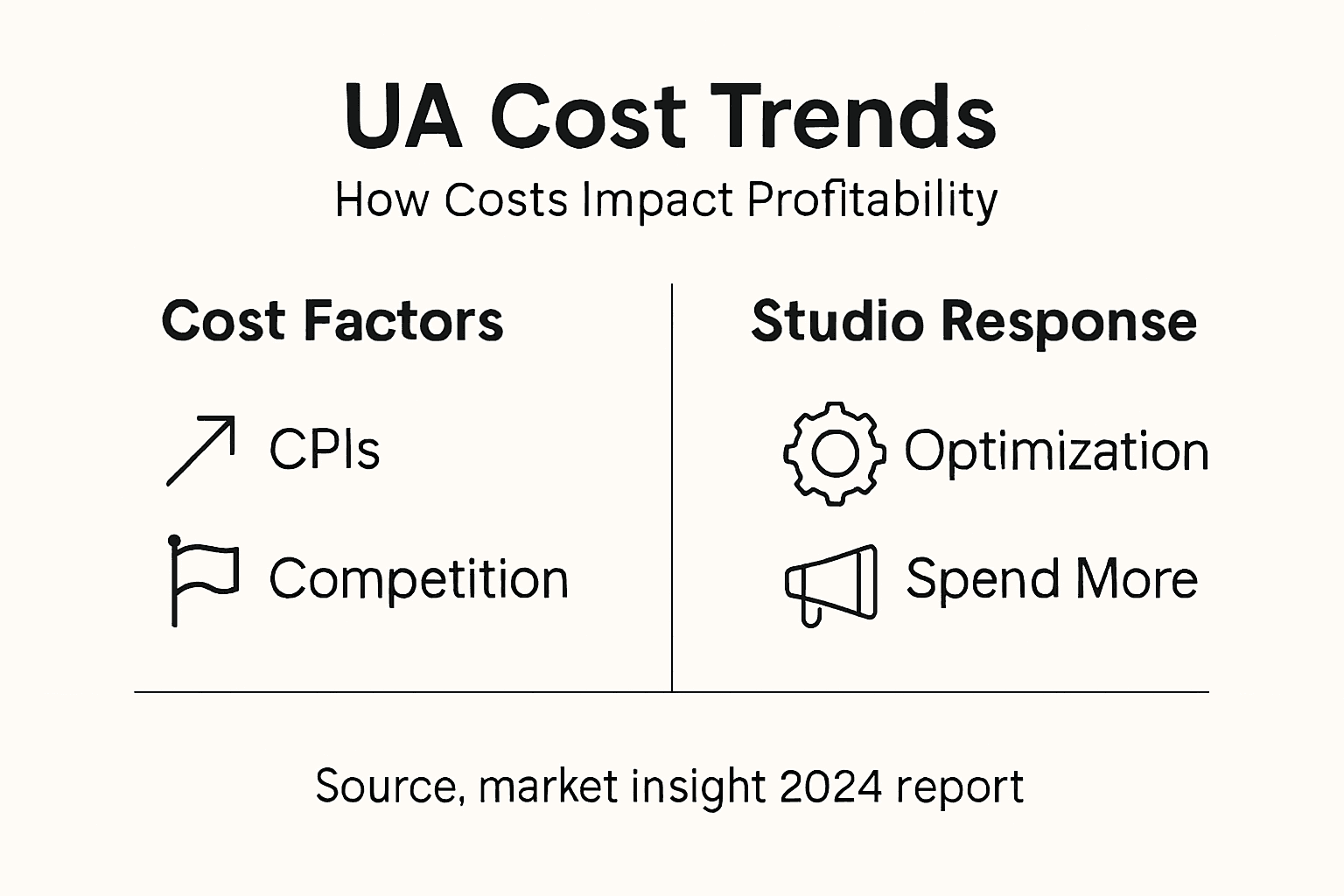
Market saturation leads to user acquisition cost inflation that outpaces revenue growth if you don’t optimize ruthlessly.
The core problem: supply of quality ad inventory shrinks while demand grows. When everyone competes for the same players, prices rise.
This impacts you through:
- Higher minimum budgets needed for meaningful scale
- Longer payback periods for player acquisition
- Pressure to acquire lower-quality users
- Reduced profit margins per install
Studio response varies wildly. Some optimize creatives and targeting ruthlessly. Others simply spend more, diluting returns.
Over-Reliance on Single Channels
Building your entire UA strategy around one network is suicidal. Yet many studios do exactly this. Meta represents 40% of budget. When Meta’s algorithm shifts, everything collapses.
Channel dependency creates fragility. Algorithm changes, policy updates, or unexpected CPI increases hit you with no backup plan.
Risks include:
- Platform policy changes eliminating tracking or targeting capabilities
- Algorithm shifts reducing ad relevance overnight
- Competitive saturation in single channels
- No diversification hedge against platform instability
Measurement and Attribution Gaps
You can’t optimize what you don’t measure. Yet many studios operate with incomplete attribution. They see installs but miss crucial conversion data.
Without accurate measurement, you optimize for wrong metrics. You acquire players that install but never launch. You scale channels that look profitable but aren’t.
Common measurement failures:
- Incomplete MMP implementation across channels
- No day-zero retention tracking
- Missing revenue attribution to source
- Inability to identify true ROAS by channel
Regulatory and Compliance Risk
Gaming industry regulatory complexities across jurisdictions create hidden cost burdens and legal exposure.
Different regions demand different compliance approaches. Privacy regulations (GDPR, CCPA) limit targeting. Gambling classification rules affect monetization. Data residency requirements increase infrastructure costs.
Non-compliance carries real consequences:
- Campaign suspension and account bans
- Substantial fines exceeding campaign spend
- Reputational damage affecting organic growth
- Revenue loss from market access restrictions
Poor Unit Economics Masquerading as Growth
Installs growing while profit shrinks signals a fundamental problem. You’re acquiring players at unsustainable costs relative to lifetime value.
This happens when studios chase vanity metrics. Install volume looks impressive until you calculate actual return on ad spend. Day-one retention drops silently. D7 retention disappears. Revenue per user stagnates.
By the time you notice profitability deterioration, you’ve spent millions on unprofitable players.
Sustainable growth requires ruthless focus on ROAS and unit economics, not just install volume or market share.
Many studios learn this lesson too late, after scaling unprofitable campaigns.
Market Saturation and Player Fatigue
Player expectations rise constantly. What engaged audiences in 2022 bores them in 2025. Successful games face creative fatigue as audiences see variations repeatedly.
Saturation manifests as lower conversion rates despite similar spend. Your creatives stop working not because they’re bad, but because players have seen them thousands of times.
Pro tip: Establish a monthly measurement audit ritual where you compare actual ROAS against projected ROAS by channel—when projections and reality diverge by more than 15%, pause scaling immediately and rebuild unit economics before continuing growth.
Master the Gaming UA Landscape and Boost Your Growth Today
Navigating the fast-changing gaming UA landscape comes with real challenges like rising CPIs, measurement gaps, and platform volatility. If you want to transform these obstacles into opportunities, you need a strategy built on precise measurement, diversified media mix, and AI-driven optimization. Our expertise in mobile game performance marketing has helped studios scale profitably through tailored user acquisition strategies that align perfectly with today’s market dynamics.
Ready to secure your place at the top with proven UA workflows and adaptive strategies? Visit ramiztrtovac.com to explore insightful blog articles, deep-dive talks, and consulting services. Unlock the secrets of sustainable growth by learning from campaigns executed across major ad networks, and start optimizing your campaigns for true long-term profitability now. Discover how clean measurement and AI can reshape your UA results by exploring Mobile Measurement Fundamentals and Profitable Launch Strategies. Don’t let rising costs and platform shifts stall your success. Take control at ramiztrtovac.com today.
Frequently Asked Questions
What is the gaming user acquisition landscape?
The gaming user acquisition (UA) landscape refers to the complete ecosystem of channels, tools, and strategies that mobile game studios use to profitably acquire players. It includes ad networks, social platforms, measurement infrastructure, and performance optimization tactics.
Why is understanding the gaming UA landscape important for mobile game studios?
Understanding the gaming UA landscape is crucial because it directly influences revenue generated per acquired player and the speed at which a studio can scale. It affects financial performance daily as player acquisition costs rise and channels evolve.
What are the main types of user acquisition channels in gaming?
The main types of user acquisition channels in gaming include social platform advertising, programmatic and ad networks, influencer partnerships, rewarded and playable ad formats, and contextual advertising. Each channel attracts different player profiles and performs differently based on the game lifecycle stage.
How does artificial intelligence impact user acquisition strategies in gaming?
Artificial intelligence transforms user acquisition strategies by automating creative optimization, enabling hyper-personalization at scale, providing predictive analytics for budget allocation, and allowing rapid adaptation to market volatility. AI helps studios respond faster than competitors to changes in the market.
Recommended
- Game Marketing Roadmap: Launch and Scale UA Profitably
- What Is MMP in Gaming: Impact on UA Success
- Master Mobile Game UA Workflow for Profitable Launches
- Mobile Game Analytics: Unlocking UA Profitability