Every mobile game marketer knows the pressure of matching acquisition spend to real player value, yet misunderstandings about Lifetime Value send budgets off track every year. In gaming, LTV forecasts future activity rather than just measuring past profits, letting you make informed decisions on spend and segmentation. Clear definitions—and busting common myths—are key to scaling profitably, so this article breaks down what LTV really means for your studio and how it impacts your bottom line.
Table of Contents
- Defining LTV in Gaming and Common Myths
- LTV Calculation Methods and Data Sources
- Player Segmentation and LTV Variations
- LTV’s Role in User Acquisition ROI
- Pitfalls to Avoid in LTV Strategy
Key Takeaways
| Point | Details |
|---|---|
| Understanding LTV is Crucial | Lifetime Value informs user acquisition strategies, guiding budget limits and ensuring profitability. |
| Segmentation is Essential | Player behaviors differ significantly; segmenting users based on predicted LTV maximizes resource allocation efficiency. |
| Use Dynamic Models | Regularly update LTV models to adapt to market changes and ensure accurate predictions for better decision-making. |
| Monitor Uncertainty | Include confidence intervals in LTV estimates to avoid reliance on misleading point predictions that can lead to poor financial decisions. |
Defining LTV in Gaming and Common Myths
LTV (Lifetime Value) in gaming represents the total revenue a player generates for your studio across their entire relationship with your game. This goes beyond a single purchase or session—it’s the cumulative profit from day one until the player stops engaging.
Unlike traditional customer profitability metrics that measure what already happened, LTV forecasts future activity and helps you make smarter acquisition decisions today. When you know a player will generate $15 in revenue over three years, you can confidently spend up to $5 acquiring them and still profit.
The Core Definition
Customer Lifetime Value is calculated as the net profit a specific player contributes during their complete relationship with your game. For mobile studios, this typically spans the initial install through their final monetization event (in-app purchase, ad view, or session engagement).
The metric accounts for:
- Revenue from all monetization sources (premium currency, battle pass, cosmetics, ads)
- Retention rates across cohorts (how long players stick around)
- Engagement frequency and depth (daily active users, session length, features used)
- Operating costs to maintain that player’s experience
Your LTV directly determines your maximum sustainable cost per install (CPI). If players are worth $8, you cannot afford to spend $12 acquiring them at scale.
Common LTV Myths Destroying Budgets
Myth #1: LTV is a fixed number
Your players aren’t homogeneous. A whale spending $200 monthly and a free-to-play user watching ads operate on completely different value curves. Segment your cohorts by traffic source, geography, device, and user behavior—each group has its own LTV trajectory.
Myth #2: You can predict LTV from day one
Early signals help, but true LTV crystallizes over weeks and months. A player who spends $5 on day three might churn by day seven. Another who doesn’t convert until day 14 becomes your top earner. Early identification of customers’ long-term purchasing potential requires patience and historical data patterns.
Myth #3: Higher LTV always means profitability
You can have $20 LTV players that cost $25 to acquire through expensive channels. You can have $5 LTV players that cost $1 from organic sources. Profitability is LTV minus customer acquisition cost (CAC). Always calculate the spread.
Myth #4: LTV stays constant across regions
Players in North America spend differently than players in Southeast Asia. Currency, purchasing power, and monetization preferences vary dramatically. Regional LTV variance can swing 300-400% between markets. Calculate region-specific LTV to avoid catastrophic budget misallocations.
Why This Matters for Your UA Strategy
Knowing your LTV transforms how you run acquisition campaigns. It becomes your upper spending limit for acquiring customers—the north star guiding bid strategy, creative investment, and channel selection. Without clarity on LTV, you’re flying blind, overpaying for users you can’t afford and undershooting opportunities with high-value segments.
Pro tip: Build separate LTV models for each traffic source and geography combination, updating monthly as new cohort data matures. Your day-30 LTV projection today will differ from your day-90 reality, so establish a review cadence that keeps your acquisition budgets aligned with actual player economics.
LTV Calculation Methods and Data Sources
You cannot optimize what you cannot measure. LTV calculation requires a structured approach combining the right data sources with the right methodology. Most studios pick one method and stick with it—often the wrong choice for their maturity level.
There are two primary approaches: statistical methods and machine learning models. Statistical methods work quickly with limited data. ML models scale better as your game matures and you accumulate richer behavioral patterns.
Statistical Methods: RFM Analysis
The Recency, Frequency, and Monetary (RFM) approach is the fastest path to a working LTV model. It requires three data points about each player:
- Recency: How recently did they make their last purchase or engagement?
- Frequency: How often do they spend or interact with monetization?
- Monetary: How much revenue do they generate per transaction?
You score players on each dimension (1-5 scale typically), multiply the scores, and estimate lifetime value from historical patterns. A player with perfect scores (5-5-5) becomes your benchmark for top-tier LTV.
RFM works because it’s simple, fast, and requires only transactional data most studios already track. The drawback? It’s backward-looking and misses predictive signals entirely.
Here’s a concise comparison between statistical and machine learning LTV calculation approaches:
| Aspect | Statistical (RFM) | Machine Learning |
|---|---|---|
| Data Required | Basic transactional history | Deep behavioral data |
| Speed to Deploy | Same week | Several weeks/months |
| Predictive Power | Limited, backward-looking | High, forward-looking |
| Scalability | Best for small studios | Best for mature games |
| Maintenance Need | Minimal updates | Frequent retraining needed |
| Technical Skills Needed | Basic analytics | Advanced data science |
| Typical Use Case | Early-stage or resource-limited teams | Growing studios optimizing for ROI |
Machine Learning: The Advanced Path
Machine learning approaches outperform statistical methods by incorporating behavioral features beyond raw purchase data. Deep learning models analyze:
- Session patterns and engagement sequences
- Feature adoption rates (which game systems players use)
- Content consumption preferences
- Device and network patterns
- Time-to-first-purchase windows
Discrimination—the model’s ability to distinguish between high and low-value customers—improves dramatically with richer feature sets. You’re not just classifying players; you’re predicting their actual revenue trajectory.
The tradeoff? ML requires significantly more historical data and technical expertise to implement correctly.
Critical Data Sources for Accurate LTV
Your LTV calculation is only as good as your data infrastructure. You need:
- Transactional data: Every purchase, timestamp, amount, currency
- Behavioral data: Session logs, feature engagement, retention flags
- Cohort attribution: Traffic source, geography, device, campaign ID
- Operating costs: Server costs per user, support overhead
- Ad revenue data: CPM impressions and payouts by segment
Start with transactional data only if that’s all you have. Add behavioral data as soon as tracking infrastructure allows. Your LTV estimate improves 40-60% when you layer in engagement signals.
Building Your First Model
Don’t overthink this. Start with RFM using 90 days of historical purchase data. Segment by geography and traffic source. Compare your calculated LTV against actual performance from older cohorts to validate accuracy.
Once your game stabilizes, migrate toward a basic ML model incorporating retention curves and engagement metrics. Historical data requirements increase accuracy as your model trains on longer player lifecycles.
Pro tip: Build your LTV model in a spreadsheet first using RFM, validate it against real cohort data, then invest in engineering. Most studios jump to complex ML before understanding their actual player economics, wasting months on infrastructure that doesn’t match business reality.
Player Segmentation and LTV Variations
Not all players are created equal. A casual free-to-play user generates vastly different revenue than a whale. Treating them with identical acquisition budgets wastes resources catastrophically. Segmentation transforms LTV from a single average number into a strategic tool that guides resource allocation.

Player segmentation divides your user base into distinct groups based on predicted or actual LTV. Once segmented, you adjust your UA spending, retention strategies, and monetization approaches for each group independently.
Why Segmentation Changes Everything
An average LTV of $8 masks critical variations. You might have 40% of players worth $15+ and 40% worth under $1. Spending the same acquisition cost on both groups destroys profitability. Segmentation based on predicted LTV enables effective allocation of marketing resources by distinguishing between high-value and low-value player segments.
Segmentation also reveals which traffic sources, regions, and demographics produce high-value cohorts. This intelligence guides future acquisition strategy, letting you double down on profitable channels and exit bad ones.
Common Segmentation Axes
You segment players along multiple dimensions simultaneously:
- Traffic source: Organic players often have different LTV than paid ad installs
- Geography: North America whales behave differently than Southeast Asian free-to-play users
- Device type: iOS users typically spend more than Android equivalents
- Behavioral cohort: Spenders versus free-to-play, hardcore versus casual engagement patterns
- Time-to-monetization: Day-three converters versus day-thirty payers
The most actionable segmentation combines behavior with acquisition source. A user acquired from Facebook who monetizes within 24 hours belongs to a high-value segment worthy of $8 CPI. A Google organic user who never monetizes deserves a $0.50 acquisition spend.
LTV Variation Across Segments
LTV variations across segments are shaped by behavioral patterns and purchasing frequency. Premium segments might show 5-10x LTV spread compared to mass-market audiences.
Consider these real-world ranges:
Here’s an at-a-glance summary of LTV segment types and their business significance:
| Player Segment | Typical LTV Range | Revenue Contribution | Acquisition Focus |
|---|---|---|---|
| High-value Spenders | $20–$150 | 60–80% of total | Maximize UA investment |
| Mid-tier Monetizers | $3–$10 | 15–25% of total | Balanced UA approach |
| Free-to-Play Users | $0.50–$2 | 5–10% of total | Low-cost or ad-driven UA |
- High-value spenders: $20-$150 LTV (5-15% of players, 60-80% of revenue)
- Mid-tier monetizers: $3-$10 LTV (15-25% of players, 15-25% of revenue)
- Free-to-play engagement: $0.50-$2 LTV (60-80% of players, 5-10% of revenue via ads)
The top 10% of your players generate 50-70% of your lifetime revenue. Spending more to acquire and retain them compounds profitability exponentially.
Implementing Segment-Specific Strategies
Once you’ve segmented, tailor your approach:
- Acquisition: Allocate higher CPI budgets to traffic sources producing high-value segments
- Retention: Invest retention marketing dollars in segments with 30+ day LTV potential
- Monetization: Test premium passes and cosmetics with high-value segments; focus on ad monetization for free-to-play cohorts
- Creative messaging: Design ad creative that appeals to the behaviors of profitable segments
Segmentation transforms LTV from a backward-looking metric into forward-looking strategy. You’re not just measuring value—you’re targeting it systematically.
Pro tip: Build your first segmentation using just three variables: traffic source, geography, and day-three monetization status. Calculate LTV for each resulting segment using 90 days of historical data. This simplified model reveals which combinations generate value and where you’re overspending.
LTV’s Role in User Acquisition ROI
LTV isn’t just a number for spreadsheets. It’s the foundation of every rational acquisition decision you make. Without understanding LTV, you’re guessing on spend limits, channel selection, and profitability targets.
Accurate LTV prediction is vital for optimizing revenue strategies and user acquisition return on investment. When you know what players are worth, you can set acquisition budgets that actually generate profit instead of burning cash.
The LTV-to-CAC Equation
The math is brutally simple. LTV minus Customer Acquisition Cost (CAC) equals profit per user. If your LTV is $10 and CAC is $8, you profit $2 per install. If CAC rises to $12, you lose $2 per user.
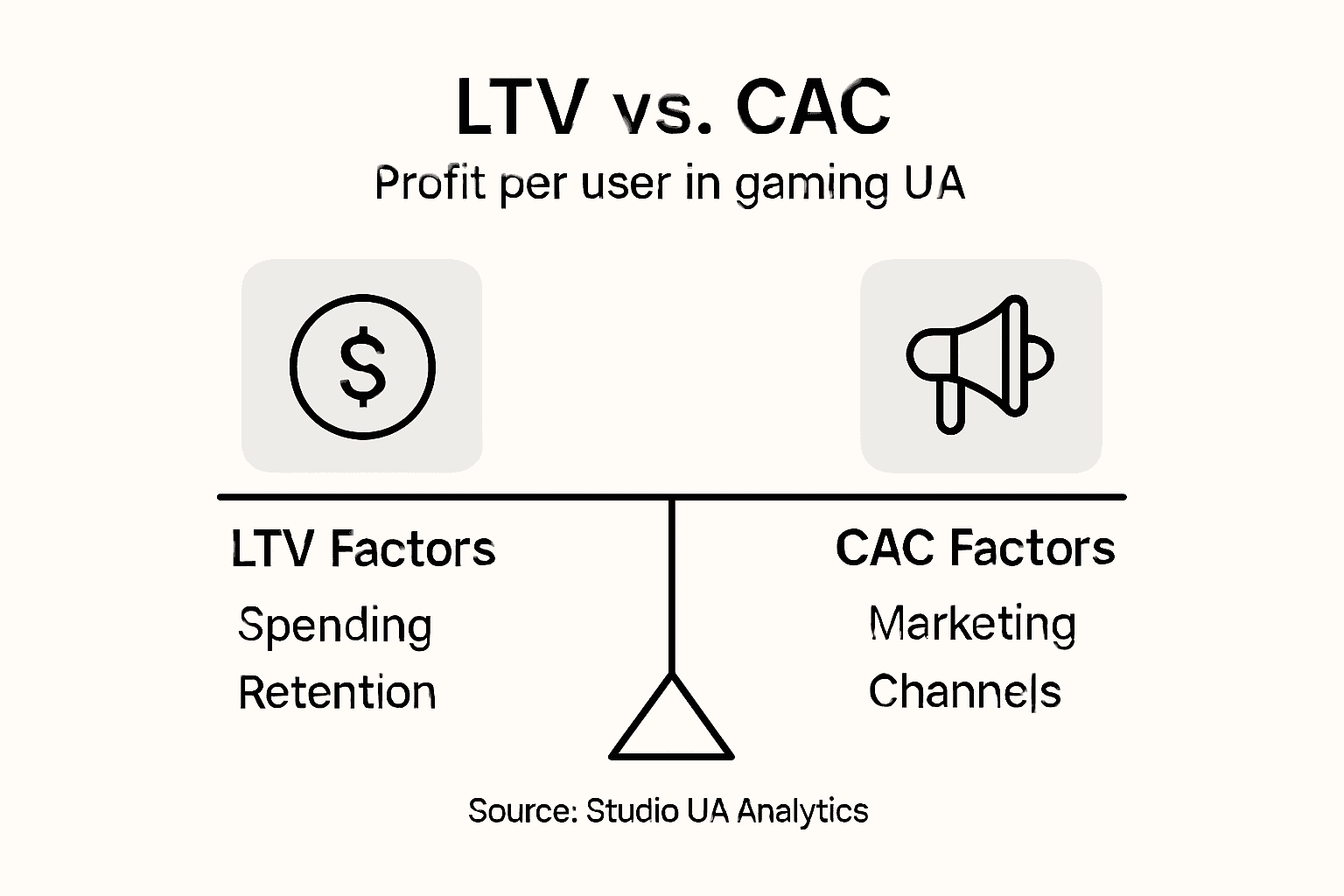
The Lifetime Value to Cost of Acquisition ratio measures theoretical lifetime revenue relative to marketing expenditure required to acquire customers. This LTV/CAC ratio guides whether acquisition spending makes sense.
Healthy studios maintain ratios above 3:1. That means $1 spent acquiring a player generates $3 in revenue over their lifetime. Below 1:1 means every user acquisition loses money.
Setting Your Maximum CPI
LTV directly determines your maximum sustainable cost per install (CPI). This ceiling constrains your entire acquisition strategy.
Calculate it this way:
- Determine your target gross margin (typically 60-70% after servers, support, payment processing)
- Multiply LTV by your gross margin percentage
- The result is your maximum CPI before profitability collapses
Example: $10 LTV × 65% gross margin = $6.50 maximum CPI. Running campaigns at $8 CPI destroys this business model at scale.
Your maximum CPI is never negotiable. It’s a hard ceiling derived from player economics, not a goal to stretch toward.
How LTV Guides Channel Selection
Different channels produce different user quality and acquisition costs. Understanding LTV reveals which channels actually work.
Consider this scenario:
- Facebook ads: $4 CPI, delivers $8 LTV players (2:1 ratio—barely profitable)
- Google Organic: $0 CPI, delivers $3 LTV players (infinite ratio—always profitable)
- Rewarded video: $2 CPI, delivers $12 LTV players (6:1 ratio—highly profitable)
Without LTV visibility, you might scale Facebook because it feels like “growth.” With LTV data, you shift budget to rewarded video where profitability compounds.
Early Prediction Improves Decision Speed
Early prediction of long-term user value enables more precise targeting and customization of marketing efforts, increasing returns substantially. You don’t need to wait 90 days for LTV cohorts to mature.
Predictive models flag high-value players within the first week:
- Players who spend on day three
- Users who engage with premium features before monetization
- Cohorts from specific geographies or traffic sources showing conversion velocity
This intelligence lets you pause low-performing campaigns immediately and double down on winners before losing more budget.
Building Your ROI Dashboard
Track these metrics for every acquisition channel:
- CPI paid across all campaigns
- Day-7, day-30, and day-90 LTV projections
- LTV/CAC ratio by channel and geography
- Profitability threshold (LTV minus acceptable CAC)
Adjust spend allocation monthly based on this data. Channels delivering 5:1 ratios deserve budget increases. Those under 1:1 need immediate review or shutdown.
Pro tip: Calculate your maximum CPI for each channel separately, accounting for traffic quality differences. Then set automated bid caps 10-15% below that threshold. This prevents overspending in profitable channels while avoiding unprofitable expansions.
Pitfalls to Avoid in LTV Strategy
Getting LTV wrong costs studios millions. The metric seems simple until you start applying it to real acquisition decisions. Most teams make predictable mistakes that compound into catastrophic budget misallocations.
Understanding these pitfalls protects your growth strategy before expensive failures happen. And yes, I learned most of these the hard way.
Pitfall #1: Using Point Estimates Without Uncertainty
Your LTV model predicts $8.50 per player. Confident number. But what if actual LTV swings between $6 and $12 depending on market conditions, retention changes, or monetization shifts?
Overemphasis on point predictions without uncertainty measures creates false confidence in strategy. You optimize acquisition spend based on a single prediction while ignoring the range of possible outcomes.
Add confidence intervals to your LTV estimates. A model saying $8.50 LTV with 70% confidence is vastly different from one claiming $8.50 with 95% confidence. The uncertainty margins guide how aggressively you can scale.
Pitfall #2: Trusting Incomplete Historical Data
You’ve been tracking player spending for 30 days. That’s not enough to calculate true LTV. Seasonal spenders, delayed monetization, and churn patterns only reveal themselves over months.
Insufficient historical data for robust modeling leads to inaccurate predictions that misguide resource allocation. Building LTV models on 30 days of data is like predicting annual revenue from January sales.
Wait for 90-180 days of player behavior before locking acquisition budgets to LTV targets. Use early cohort data for direction only, not precision.
Pitfall #3: One-Size-Fits-All Segmentation
Calculating a single LTV number for your entire game ignores heterogeneous player behavior. Whales and free-to-play users operate on completely different economics.
Applying the same acquisition strategy to both groups destroys profitability. A $10 average LTV hides the reality that 10% of players generate 70% of revenue while 60% spend nothing.
Segment aggressively. Traffic source, geography, device, and behavior create distinct LTV profiles. Each segment needs its own acquisition budget ceiling.
Pitfall #4: Ignoring Nonlinear Scaling Effects
Your LTV holds steady at $8 when you’re spending $2,000 monthly on acquisition. What happens when you scale to $20,000 monthly?
Over-reliance on simplistic LTV strategies without understanding nonlinear dynamics causes significant performance declines. Scaling acquisition aggressively can attract lower-quality players, reduce server stability, or trigger competitive market responses that crash your LTV.
Scaling slowly (20-30% monthly increases) lets you monitor whether LTV holds as volume rises. If it doesn’t, pause expansion immediately.
Pitfall #5: Static Models in Dynamic Markets
You built an LTV model six months ago. Market conditions shifted. New competitors launched. Player preferences evolved.
Your static model is now generating wrong predictions. Effective LTV strategies must adapt dynamically to market and behavioral changes or risk costly resource misallocation.
Update your LTV models monthly. Track whether historical LTV predictions match actual cohort performance. If they diverge, rebuild the model immediately.
Common Warning Signs
Watch for these red flags:
- Predicted LTV keeps missing actual performance by 20%+
- Your $8 LTV players actually churn at day 30 instead of day 90
- New traffic sources generate players with 50% lower LTV than historical averages
- Acquisition costs rising while LTV stays flat (profitability compressing)
Any of these signals means your model needs recalibration immediately.
Your LTV strategy is only as good as your willingness to question it monthly. Confident estimates are dangerous. Adaptive estimates keep campaigns profitable.
Pro tip: Build a confidence dashboard showing predicted LTV versus actual cohort LTV over time. When predictions miss by more than 15%, trigger an automatic model review. This prevents you from running unprofitable acquisition for months while chasing false data.
Unlock Profitable User Acquisition with Expert LTV Strategies
Understanding Lifetime Value is key to mastering profitable user acquisition campaigns in gaming. If you are struggling to accurately predict LTV or optimize acquisition costs across diverse player segments and regions the challenges detailed in the article are familiar. Key pain points include avoiding overpaying for low-value players managing acquisition budgets dynamically and applying robust segmentation to maximize return on investment.
At ramiztrtovac.com, Ramiz Trtovac leverages deep mobile game performance marketing expertise to help studios build accurate LTV models connect insights to actionable acquisition strategies and scale profitably across multiple ad networks. Explore proven frameworks and real-world case studies that address LTV myths, data-driven cohort analysis, and tailorable UA execution.

Take control of your UA ROI today by visiting ramiztrtovac.com to access expert consulting and educational resources. Learn how to align your maximum CPI with precise LTV calculations harness segmentation for smarter spend and leverage predictive analytics to beat costly acquisition pitfalls. Don’t leave profitability to chance transform your user acquisition strategy now with tailored support from an industry leader.
Frequently Asked Questions
What does LTV mean in gaming?
LTV, or Lifetime Value, in gaming represents the total revenue a player generates for a game studio over their entire relationship with the game. It takes into account all forms of monetization, including in-app purchases and ad views.
How is LTV calculated in the gaming industry?
LTV is calculated by analyzing various factors, including revenue from all monetization sources, retention rates, engagement frequency, and the operating costs associated with maintaining the player’s experience throughout their interaction with the game.
Why is understanding LTV important for user acquisition strategies?
Understanding LTV is crucial as it helps determine the maximum sustainable cost per install (CPI) when acquiring new players. It informs acquisition budgets, bid strategies, and creative investments to ensure profitable growth.
What are common misconceptions about LTV in gaming?
Common myths include the idea that LTV is a fixed number, that it can be predicted from day one of player engagement, and that higher LTV always indicates profitability. Each player behaves differently, and LTV should be segmented by player types and behaviors.
Recommended
- Master Mobile Game UA Workflow for Profitable Launches
- Playable Ads: Boosting Game UA and Profitability
- Game Marketing Roadmap: Launch and Scale UA Profitably
- Mobile Game Analytics: Unlocking UA Profitability