Mobile game UA teams know that chasing installs is no longer enough. The real challenge is driving valuable actions—installs, purchases, or registrations—while keeping acquisition profitable. As competition for high-quality users surges across North American networks, mastering cost per action bidding for mobile games becomes critical. This guide unpacks the core principles, advanced optimization methods, and real-time machine learning strategies you need to align spend with actual conversions and outperform rivals who still rely on basic bidding models.
Table of Contents
- Core Principles Of CPA Bidding Methods
- How CPA Bidding Differs From Other Models
- The Auction Dynamics Factor
- Setting Your Target CPA Correctly
- Why Accuracy In Conversion Attribution Matters
- Types Of CPA Actions In Mobile Gaming
- Primary CPA Actions You’ll Track
- Why Action Type Matters To Your Bottom Line
- Different CPA Models Beyond Basic Installs
- Matching Actions To Your Monetization Strategy
- Setting Up Multi-Action Tracking
- Advanced Optimization Strategies For Campaigns
- Dynamic Budget Pacing And Bid Adjustment
- Campaign Segmentation And Granular Optimization
- Leveraging Machine Learning For Bid Optimization
- Testing And Iteration
- Risks And Common Pitfalls Of CPA Bidding
- Setting CPA Targets Too Aggressively
- Ignoring Regional And Genre Variations
- Skipping Attribution Verification
- Neglecting Continuous Monitoring
- Assuming Past Performance Predicts Future Results
- Comparing CPA To CPC And Other Models
- How CPA, CPC, And CPM Differ
- When To Use CPA
- When To Use CPC And CPM
- The Cost Efficiency Comparison
- Choosing Your Model Based On Maturity
Key Takeaways
| Point | Details |
|---|---|
| Understanding CPA Bidding | CPA bidding is focused on paying for actual conversions, such as installs or purchases, rather than clicks or impressions. This approach aligns costs directly with user value, making it particularly effective for mobile game user acquisition. |
| Importance of Accurate Attribution | Reliable conversion tracking is essential to ensure that campaigns are optimized correctly. Inaccurate data can lead to misguided bid adjustments and significant budget losses. |
| Adapting to Auction Dynamics | CPA bids operate in competitive real-time auctions where machine learning helps predict conversion likelihood. Adjustments to bids based on user behavior and auction dynamics are crucial for maintaining your target CPA. |
| Multiple CPA Actions | Different actions such as installs, registrations, or in-app purchases can be prioritized based on your monetization strategy. Selecting the right CPA action can significantly influence overall acquisition efficiency and profitability. |
Core Principles of CPA Bidding Methods
Cost per action bidding works differently than traditional click-based models. You’re paying specifically for conversions—installs, registrations, purchases—not just ad impressions or clicks. This alignment between cost and actual user value is what makes CPA bidding so powerful for mobile game UA.
The foundation of effective CPA bidding rests on understanding three core elements:
- Conversion tracking accuracy: Your system must reliably measure when a user completes the target action. Gaps here distort your entire strategy.
- Real-time bid adjustment: Optimization strategies using machine learning allow you to increase or decrease bids based on user behavior patterns and auction dynamics as campaigns run.
- Historical performance data: Past conversion rates, install quality, and user lifetime value inform current bid decisions.
How CPA Bidding Differs from Other Models
Click-based bidding charges you per click regardless of conversions. Impression-based bidding charges per thousand views. CPA flips this—you only pay when the action completes.
This creates a direct relationship between your spend and results. If your target CPA is $2 per install and a user installs after clicking your ad, you pay $2. If they don’t install, you pay nothing.
But this precision demands accuracy. Misattribution or delayed conversion reporting cascades into broken decisions.
The Auction Dynamics Factor
CPA bidding doesn’t happen in isolation. Your bid competes against thousands of others in real-time auctions across ad networks.
The networks use machine learning to predict conversion probability for each user. A user predicted to convert gets weighted higher. Your bid gets adjusted automatically to stay competitive while maintaining your target CPA.
You’re not bidding blindly. Networks balance your CPA goal against their revenue needs, creating a negotiation within each auction.
Setting Your Target CPA Correctly
Your target CPA must reflect your actual economics. Calculate your lifetime value minus distribution costs, and work backward.
Here’s the breakdown:
- Estimate average revenue per user over 12 months
- Subtract platform fees, payouts, and operational costs
- Subtract your required profit margin
- The remaining amount is your maximum sustainable CPA
Set it too high and you acquire unprofitable users. Set it too low and the network can’t find enough qualifying users at scale.
Your target CPA should reflect what a user is actually worth to your business, not what you hope they’re worth.
Why Accuracy in Conversion Attribution Matters
If your conversion tracking attributes installs incorrectly—crediting the wrong campaign, counting duplicates, or missing organic installs—your bids go haywire.
The network optimizes toward whatever conversions it sees. Bad data equals bad optimization. Your CPA can appear excellent while user quality plummets.
Verify your attribution pipeline constantly. Cross-reference network data with your own backend logs. Small discrepancies compound fast.
Pro tip: Test your target CPA 15-20% below your calculated maximum first, then increase gradually as you see user quality and retention metrics stabilize. This conservative approach protects your ROAS while you refine your conversion tracking.
Types of CPA Actions in Mobile Gaming
Not all conversions are created equal in mobile game marketing. Different CPA actions track different user behaviors, and which ones you prioritize directly impacts your acquisition strategy and profitability.
Game installs are the most obvious CPA action. When a user downloads your game from the app store after clicking an ad, that’s a trackable conversion. But installs alone don’t tell you about user quality or monetization potential.
Primary CPA Actions You’ll Track
Most mobile games focus on these core action types:
- Install completion: User downloads and opens the game for the first time
- Registration: User creates an account within your game
- First in-app purchase: Player spends real money on your game
- Level or milestone completion: User reaches a specific progression point
- Daily active user (DAU) retention: Player returns within 24 hours of install
Specific user actions in CPA campaigns like trial sign-ups, survey participation, and in-app purchases allow you to target the behaviors that matter most to your monetization model.
Why Action Type Matters to Your Bottom Line
Paying per install is cheap but risky. You might acquire 10,000 users who never spend a dime. Paying per first purchase is expensive but predictable—you know those users already demonstrated spending intent.

Your choice of CPA action should align with your game’s monetization. A free-to-play game with heavy ad revenue needs volume installs. A premium game needs fewer but higher-quality players ready to pay.
Different CPA Models Beyond Basic Installs
You’re not limited to traditional install tracking. Mobile gaming now uses:
- Cost per play (CPP): Pay when a user launches your game
- Cost per subscription: Pay when a user subscribes to a premium tier or battle pass
- Cost per social action: Pay when a user shares, invites friends, or engages socially
- Cost per retention: Pay based on whether users return after day one
CPA models like cost per play and cost per sale reflect action-driven billing where you pay only for tracked conversions that directly contribute to monetization.
Matching Actions to Your Monetization Strategy
Hyper-casual games generating revenue primarily from ads should prioritize install-level CPA. Each install generates ad impressions, so volume matters.
Mid-core and hardcore games relying on in-app purchases should track first purchase or significant progression milestones as their CPA action. These actions predict spending behavior.
Social games benefit from tracking viral actions—friend invites, profile views, guild joins—because these actions drive organic growth loops.
The table below summarizes efficient CPA action choices for different mobile game types:
| Game Type | Most Effective CPA Action | Why It Works |
|---|---|---|
| Hyper-casual | Install completion | Maximizes install volume for ad monetization |
| Mid-core/Hardcore | First in-app purchase | Targets paying users, boosts LTV |
| Social/Community | Social engagement event | Amplifies organic growth through shares |
| Subscription-based | Premium tier sign-up | Ensures direct monetization alignment |
The most profitable CPA action isn’t the cheapest one—it’s the one that correlates highest with your actual revenue per user.
Setting Up Multi-Action Tracking
Advanced studios don’t rely on a single CPA action. They track multiple events and run different campaigns optimized toward different actions simultaneously.
One campaign might optimize toward installs for awareness. Another optimizes toward first purchase for revenue. A third targets day-seven retention for long-term value.
This requires clean event tracking and clear cost allocation, but the payoff is significant—you acquire users at different price points matched to their predicted value.
Pro tip: Start with install-level CPA tracking, then layer in purchase and retention events as your backend tracking stabilizes. This gives you baseline volume while building toward more sophisticated, revenue-focused optimization.
Advanced Optimization Strategies for Campaigns
Basic CPA bidding gets you started, but advanced optimization is what separates profitable campaigns from mediocre ones. The difference lies in how you adjust bids, allocate budget, and respond to performance signals in real time.
Manual bid adjustments work, but they’re slow and reactive. Advanced studios use automated bid optimization that continuously refines decisions based on incoming performance data. This approach scales far better than human oversight alone.
Dynamic Budget Pacing and Bid Adjustment
You don’t spend your daily budget evenly across 24 hours. Auction quality, user availability, and competitive pressure fluctuate throughout the day. Smart campaigns pace spend dynamically.
Budget pacing algorithms and PID controllers refine bid adjustments to balance spend efficiently across auctions while improving conversion outcomes in CPA campaigns.
Instead of a fixed daily budget, set spend thresholds and let the system increase bids during high-conversion windows. During low-quality periods, reduce spending and preserve budget for peak times.
This requires backend infrastructure to track performance in real time and adjust accordingly. But the payoff is measurable—you hit your target CPA while maximizing volume.
Campaign Segmentation and Granular Optimization
Treating your entire user base identically is leaving money on the table. Different user segments have different value, quality, and conversion likelihood. Segment your campaigns and optimize each separately.
Key segmentation dimensions include:
- Device type: iOS users might convert differently than Android users
- Geographic region: North American players often have different spending patterns than European players
- Traffic source: Users from organic channels behave differently than paid users
- User cohort: New vs. returning players show distinct acquisition costs
Run separate campaigns for high-value segments with higher CPA targets. Run lean campaigns for lower-value segments. This alignment maximizes profitability across your entire acquisition funnel.
Leveraging Machine Learning for Bid Optimization
Automated smart bidding tools use data-driven algorithms to optimize CPA targets, adjusting bids according to campaign performance signals and automatically shifting bids to maximize ROAS.
Modern ad networks train models on your historical performance to predict which users will convert. Your bid gets weighted by conversion probability automatically. Users predicted as low-quality converters get lower bids. High-probability converters get premium bids.
You simply set your target CPA and let the machine learning handle bid adjustments. The system learns from every impression and conversion, getting smarter each day.
Testing and Iteration
Advanced optimization isn’t one-time setup. Winning studios test relentlessly. Run A/B tests on:
- CPA targets (15% above and below your baseline)
- Audience segments (narrow vs. broad targeting)
- Creative variations (messaging, visuals, gameplay hooks)
- Bid strategies (target CPA vs. target ROAS)
Capture learnings from tests and fold winning variants into your core strategy. Kill underperforming approaches quickly.
The campaigns that win aren’t the ones optimized perfectly on day one—they’re the ones that iterate fastest and compound learnings over weeks and months.
Pro tip: Set up separate test campaigns at 10-15% of your primary campaign spend, then rotate new strategies through testing before scaling winners. This limits downside risk while building a pipeline of improvements to implement.
Risks and Common Pitfalls of CPA Bidding
CPA bidding is powerful, but it punishes mistakes harder than other bidding models. When you set the wrong targets or ignore critical variables, your campaign doesn’t just underperform—it hemorrhages money fast.
Understanding these pitfalls protects your budget and keeps your acquisition strategy on track. Many studios learn these lessons the expensive way. You don’t have to.
Setting CPA Targets Too Aggressively
The biggest mistake is setting a target CPA that looks good on spreadsheets but doesn’t match market reality. You see competitors acquiring users cheaply and decide to match their CPA without understanding their player lifetime value.
Overly stringent CPA targets restrict impression share and campaign delivery, leaving volume on the table when you need it most.
When your CPA target is unrealistic, the network struggles to find qualifying users. Impressions drop. Your campaigns starve for traffic. You end up with fewer installs at a higher actual cost per acquisition.
Start with a target CPA that’s 20-30% above your calculated maximum. Tighten gradually as you see consistent performance data. Patience here saves thousands.
Ignoring Regional and Genre Variations
North American players don’t cost the same to acquire as players in Southeast Asia. Casual puzzle games don’t acquire at the same CPA as mid-core RPGs. Yet many studios apply a single CPA target globally.
Ignoring variations in user value across regions, genres, and platforms causes cost overruns and inefficiency.
A realistic approach requires segmented CPA targets:
- United States: Higher CPA, higher LTV
- Europe: Moderate CPA, moderate LTV
- Asia-Pacific: Lower CPA, variable LTV
- Casual games: Lower CPA, higher volume
- Hardcore games: Higher CPA, lower volume
Run campaigns by segment with region and genre-appropriate targets. This prevents overspending in low-value segments while underbidding in high-value ones.
Skipping Attribution Verification
You assume your attribution system is accurate. Then mid-campaign, you discover a 15% discrepancy between network data and your own logs.
Your optimization was based on false data. Bids got adjusted against phantom conversions. Budget flowed toward campaigns the network thought were working but actually weren’t.
Verify attribution weekly. Cross-reference network conversion reports with your backend data. Flag discrepancies immediately. Don’t adjust campaign strategy until attribution aligns.
Neglecting Continuous Monitoring
You launch a campaign, set your CPA target, and check in weekly. Meanwhile, market conditions shift, competition tightens, and your campaign drifts from target.
Continuous monitoring and adjustment are critical to avoid inefficiencies such as overspending on low-value users or under-delivery of impressions.
High-performing studios monitor campaigns daily. They track:
- Actual CPA vs. target CPA
- Impression volume trends
- Conversion rate changes
- User quality signals (retention, day-one ROAS)
Campaigns don’t maintain themselves. Small drift becomes catastrophic overspend if ignored for two weeks.
Assuming Past Performance Predicts Future Results
Last month’s CPA metrics don’t guarantee this month’s performance. Seasonal shifts, competitive pressure changes, and audience saturation creep happen gradually.
Don’t lock your strategy into yesterday’s numbers. Review performance weekly and adjust assumptions quarterly. What worked in January might need tweaking by March.
Pro tip: Create a weekly performance dashboard tracking CPA, impression volume, conversion rates, and user quality metrics side by side. Set alert thresholds (CPA +15% from target, conversion rate drops 20%, impression volume down 25%) so you catch drift early before waste compounds.
Comparing CPA to CPC and Other Models
You have choices in how you pay for user acquisition. Each model aligns with different campaign goals and comes with distinct tradeoffs. Understanding when to use CPA versus alternatives shapes your entire acquisition strategy.
The three dominant bidding models—CPM, CPC, and CPA—solve different problems. Choosing the right one depends on your funnel stage and what you’re trying to optimize.
How CPA, CPC, and CPM Differ
CPA charges only upon user conversion, CPC on clicks, and CPM on impressions. Each model reflects payment timing and what you’re actually paying for.
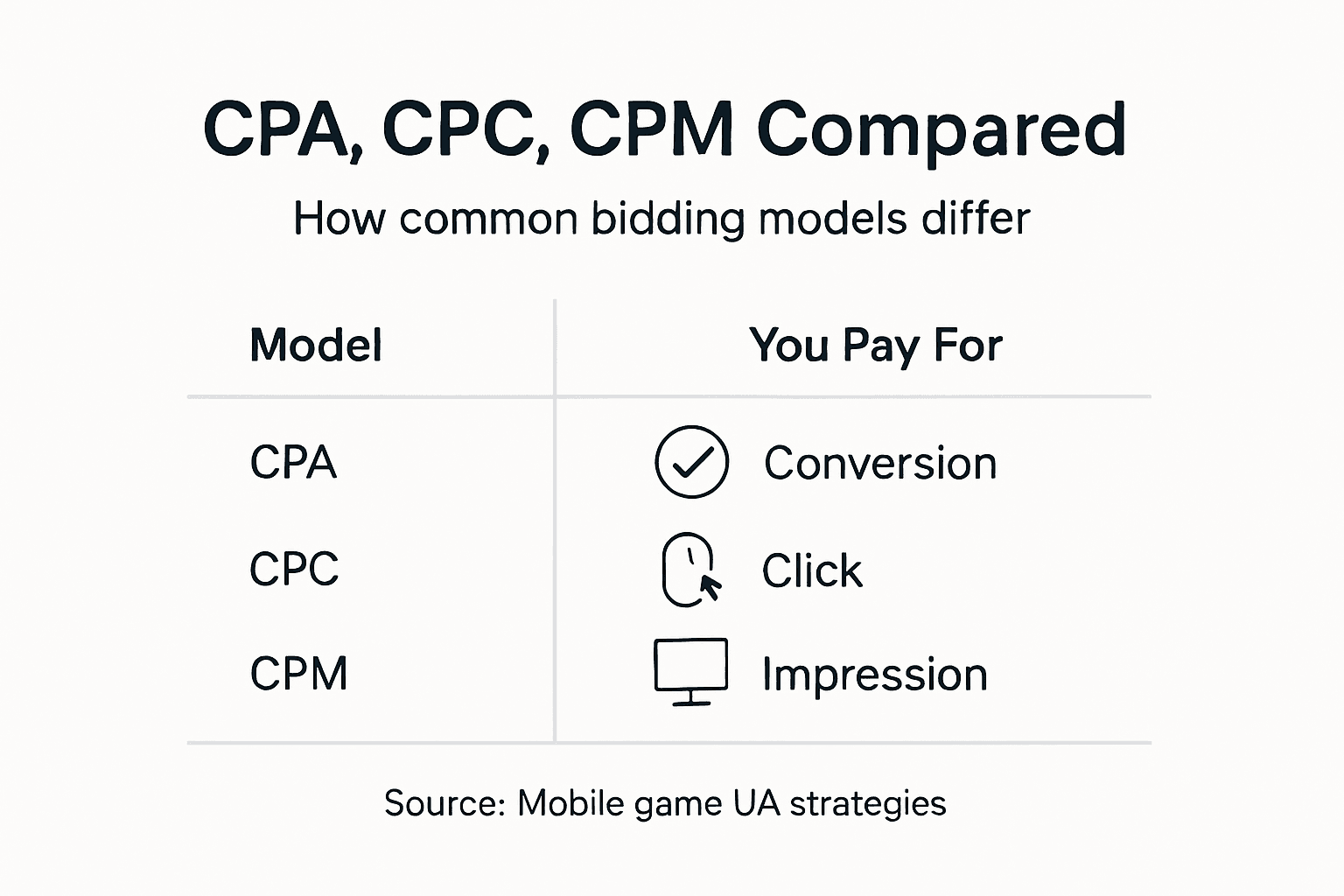
With CPM (cost per thousand impressions), you pay regardless of whether anyone clicks or converts. Your cost is purely based on ad visibility. You could show your ad to a million people and get zero installs—and still pay the full bill.
CPC (cost per click) charges when someone clicks your ad, but not if they install. They might click, visit your game’s store page, then leave. You still pay for that click even though nothing converted.
CPA charges only when the target action completes. Install? You pay. Registration? You pay. No conversion? Zero cost.
Here’s how key bidding models compare for mobile game user acquisition:
| Model | What You Pay For | Best Use Case | Typical Business Impact |
|---|---|---|---|
| CPM | Each 1,000 ad views | Brand awareness, early funnel | Broad reach, less control over results |
| CPC | Each ad click | Driving store traffic, early testing | May get non-converting users, moderate spend predictability |
| CPA | Completed user conversion | Monetization, ROAS-focused campaigns | Direct link between spend and results, higher control |
When to Use CPA
CPA works best when you have a clear conversion goal and robust tracking infrastructure. You’re optimizing for revenue-generating actions, not just clicks or impressions.
CPA is ideal for:
- Mid-core and hardcore games focused on monetization
- Campaigns targeting high-value user segments
- When you’ve proven your monetization model works
- Scaling campaigns that already show positive ROAS
When to Use CPC and CPM
CPC makes sense for early funnel stages when you’re building awareness and driving traffic. You care about clicks, not conversions yet.
CPM works for brand awareness campaigns where you want maximum visibility. Your goal is to get your game in front of as many people as possible, not drive immediate installs.
CPC is easier to manage but less targeted, while CPM focuses on awareness rather than direct performance.
Many studios use a hybrid approach: CPM or CPC in early campaigns to build awareness at scale, then CPA in later campaigns to optimize conversions from warmed audiences.
The Cost Efficiency Comparison
CPA looks more expensive per user upfront, but it protects you from paying for worthless clicks. Your actual cost per install with CPA is guaranteed because you only pay for installs.
With CPC, you might drive 100 clicks at $0.50 each and get only five installs. Your effective cost per install is $10, even though your CPC target was $0.50.
This is why CPA is superior for conversion-centric campaigns. You know exactly what you’re paying per actual user.
CPA forces alignment between what you pay and what you actually get—no hidden costs hidden in unmeasured clicks.
Choosing Your Model Based on Maturity
Early-stage games often start with CPM or CPC because conversion tracking isn’t yet bulletproof. Once you’ve proven your funnel and have reliable tracking, shift to CPA for better margin control.
Established games with multiple active campaigns often run all three models simultaneously, each optimized for different purposes.
Pro tip: Run a small CPA test campaign (5-10% of your total spend) alongside your existing CPC campaigns. Compare the actual cost per install and user quality metrics after 30 days. This direct comparison shows whether CPA’s overhead is worth it for your specific game.
Unlock the Full Potential of CPA Bidding for Your Mobile Game User Acquisition
Struggling with setting the right target CPA or verifying accurate conversion tracking for your mobile game campaigns Understanding auction dynamics and optimizing bids in real time can feel overwhelming but mastering these elements is crucial for scaling profitably. If you want to elevate your user acquisition strategy with proven techniques like real-time bid adjustment and multi-action tracking visit ramiztrtovac.com where Ramiz Trtovac shares deep expertise from leading large-scale UA initiatives.
Discover practical consulting and educational resources that help studios avoid common pitfalls such as aggressive CPA targets and attribution errors. Whether you are targeting installs or in-app purchases Ramiz’s insights will guide you toward smarter CPA campaign structures and dynamic budget pacing. Don’t waste another dollar on inefficient campaigns improve your ROAS today by exploring trusted strategies at ramiztrtovac.com and start scaling sustainably with expert support.
Frequently Asked Questions
What is CPA bidding in mobile games?
CPA bidding, or Cost Per Action bidding, is a model where advertisers pay only for specific user actions such as installs, registrations, or purchases, rather than for clicks or impressions. This approach aligns costs directly with the value of user conversions.
How does CPA bidding differ from CPC and CPM models?
While CPA charges only for completed conversions, CPC (Cost Per Click) charges for each click regardless of conversion, and CPM (Cost Per Thousand Impressions) charges for ad visibility without considering user actions. CPA is more focused on actual performance and offers better ROI for conversion-driven campaigns.
Why is accurate conversion tracking important in CPA bidding?
Accurate conversion tracking is essential because it directly affects bid adjustments and overall campaign performance. If conversions are misattributed or inaccurately reported, the campaign may optimize based on faulty data, leading to poor acquisition outcomes and wasted budget.
What are some common pitfalls of CPA bidding?
Common pitfalls include setting CPA targets too aggressively, neglecting regional variations in user behavior, skipping attribution verification, and failing to continuously monitor campaign performance. These mistakes can lead to overspending and inefficient user acquisition strategies.
Recommended
- Master Mobile User Acquisition Workflow for Growth
- 7 Key Types of User Acquisition Strategies for Mobile Games
- The Importance of User Acquisition in Mobile Gaming: A Simplified Guide – Ramiz Trtovac
- Effective User Acquisition Strategies – Blog posts