Many mobile game studios still rely on CPI as their main UA metric, which can mislead your strategy and harm profitability. ROAS measures the actual revenue each advertising dollar generates, revealing true campaign performance beyond install volume. Mastering ROAS transforms how you measure campaigns and enables you to optimize user acquisition for sustainable profits. This guide explains ROAS calculation, tracking methods, benchmark targets by genre, and actionable strategies to improve your returns.
Table of Contents
- Introduction To ROAS In Mobile Games
- How ROAS Is Calculated And Tracked In Mobile Gaming
- Common Misconceptions About ROAS In User Acquisition
- Factors That Influence ROAS In Mobile Games
- ROAS Benchmarks And Genre Specific Insights
- Practical Strategies To Improve ROAS In Mobile Game UA
- Conclusion: Bridging ROAS Understanding To Profitable UA Growth
- Optimize Your Mobile Game UA With Expert Guidance
- What Is ROAS In Games? Frequently Asked Questions
Key Takeaways
| Point | Details |
|---|---|
| ROAS measures revenue per ad dollar | Unlike CPI which only tracks cost per install, ROAS reveals actual revenue generated from your UA spend. |
| Cohort tracking is essential | Day 7 and Day 30 ROAS windows capture delayed monetization patterns typical in mobile games. |
| Genre determines measurement window | Strategy games need 60 to 180 day tracking while hypercasual games monetize within days. |
| Creative quality drives post ATT ROAS | iOS privacy changes elevated creative testing and iteration as critical levers for maintaining healthy returns. |
| Target 1.5x Day 30 ROAS minimum | This benchmark indicates profitable UA campaigns that can scale sustainably. |
Introduction to ROAS in Mobile Games
ROAS stands for Return on Ad Spend, calculated as revenue attributed to a user acquisition campaign divided by the cost of that campaign. The ROAS formula is simple: ROAS = Revenue from campaign / Cost of campaign. If you spend $10,000 on ads and generate $15,000 in attributed revenue, your ROAS is 1.5x or 150%.
ROAS isolates advertising effectiveness by focusing exclusively on ad spend versus the revenue those ads produce. According to industry analysis, ROAS focuses exclusively on revenue relative to ad spend, isolating UA campaign profitability distinct from broader ROI. ROI includes all operational costs like development, salaries, and overhead, making it less actionable for optimizing specific campaigns. CPI only measures what you paid per install without any revenue context, missing the quality and monetization potential of acquired users.
The mobile gaming industry shifted from install volume obsession to profitability focus because downloads mean nothing if users don’t generate revenue. ROAS became the preferred metric because it directly answers whether your UA spending makes money. Key distinctions include:
- ROAS measures revenue efficiency of ad campaigns specifically
- ROI encompasses total business profitability including non marketing costs
- CPI tracks acquisition cost but ignores user value and monetization
- ROAS enables data driven budget allocation across campaigns and channels
Understanding ROAS helps you allocate budgets to campaigns that actually drive profits rather than just installs. For mobile game user acquisition, this distinction determines whether you scale profitably or burn cash on low quality users.
How ROAS is Calculated and Tracked in Mobile Gaming
Calculating ROAS requires accurate revenue attribution to specific UA campaigns through proper tracking infrastructure. You must tag every campaign with unique identifiers and use mobile measurement partners to connect installs to revenue events. The challenge lies in mobile games monetizing over extended periods through in app purchases or ad impressions that occur days or weeks after install.
Cohort analysis solves this by tracking ROAS at defined intervals like Day 7, Day 30, Day 60, or Day 180. Research shows that using cohort analysis like Day 7 and Day 30 ROAS ensures accurate tracking of revenue from installs that monetize over time. Each cohort represents users acquired on the same date, and you measure their cumulative revenue at each milestone.
Common tracking windows include:
- Day 7 ROAS captures early monetization and engagement signals
- Day 30 ROAS provides standard profitability assessment across genres
- Day 60 ROAS reveals mid lifecycle value for moderate depth games
- Day 180 ROAS measures long term returns for strategy and RPG titles
Revenue tracking challenges include delayed IAP events where users purchase weeks after install, ad revenue accruing gradually through daily sessions, and attribution gaps from privacy restrictions. Accurate campaign tagging through UTM parameters and deep linking ensures every revenue event connects to its source campaign.
Pro tip: Integrate cohort based ROAS dashboards with your MMP to monitor real time performance and identify underperforming segments before burning significant budget. This enables rapid optimization.
Choosing the right timeframe depends on your game genre and monetization cycle. Hypercasual games monetize primarily through ads within the first few sessions, making Day 7 ROAS sufficient. Strategy games rely on mid to late game IAP from invested players, requiring 60+ day windows. The mobile user acquisition workflow should align measurement periods with when your game actually generates revenue to avoid premature optimization decisions.
Common Misconceptions About ROAS in User Acquisition
Three major misconceptions undermine effective UA measurement and waste advertising budgets. Clarifying these helps you avoid strategy mistakes that harm profitability.
-
CPI alone determines UA success
Many teams optimize purely for lowest CPI, assuming cheaper installs equal better outcomes. This ignores user quality entirely. A $2 CPI user who spends $10 outperforms a $0.50 CPI user who never monetizes. CPI measures acquisition cost but provides zero insight into revenue generation or lifetime value. -
ROAS and ROI are interchangeable metrics
While related, these measure different things. ROAS isolates ad campaign efficiency by comparing only ad spend to attributed revenue. ROI includes all business costs like development, operations, and salaries against total revenue. For campaign optimization, ROAS provides the actionable signal because it directly reflects your advertising decisions. -
More installs automatically improve business outcomes
Volume focused strategies often acquire low quality users who churn quickly or never monetize. Quality trumps quantity in profitable UA. Acquiring 1,000 high LTV users beats 10,000 users with poor retention and zero spend. User quality and monetization behavior matter far more than raw install counts.
Industry research confirms that ROAS has become more important than CPI because CPI does not reflect revenue generation or user quality.
Focusing on install volume over revenue metrics leads to misallocated budgets and unsustainable growth. You scale campaigns that deliver cheap installs but negative lifetime value, burning cash while metrics look superficially positive. Understanding these distinctions helps you prioritize effective UA strategies that actually drive profits. Misunderstanding ROAS versus simpler metrics causes teams to optimize for the wrong goals, and improving ROAS requires shifting focus from vanity metrics to revenue driven performance.
Factors That Influence ROAS in Mobile Games
Several key drivers determine ROAS performance and provide optimization levers for UA teams. Understanding these factors helps you systematically improve returns.
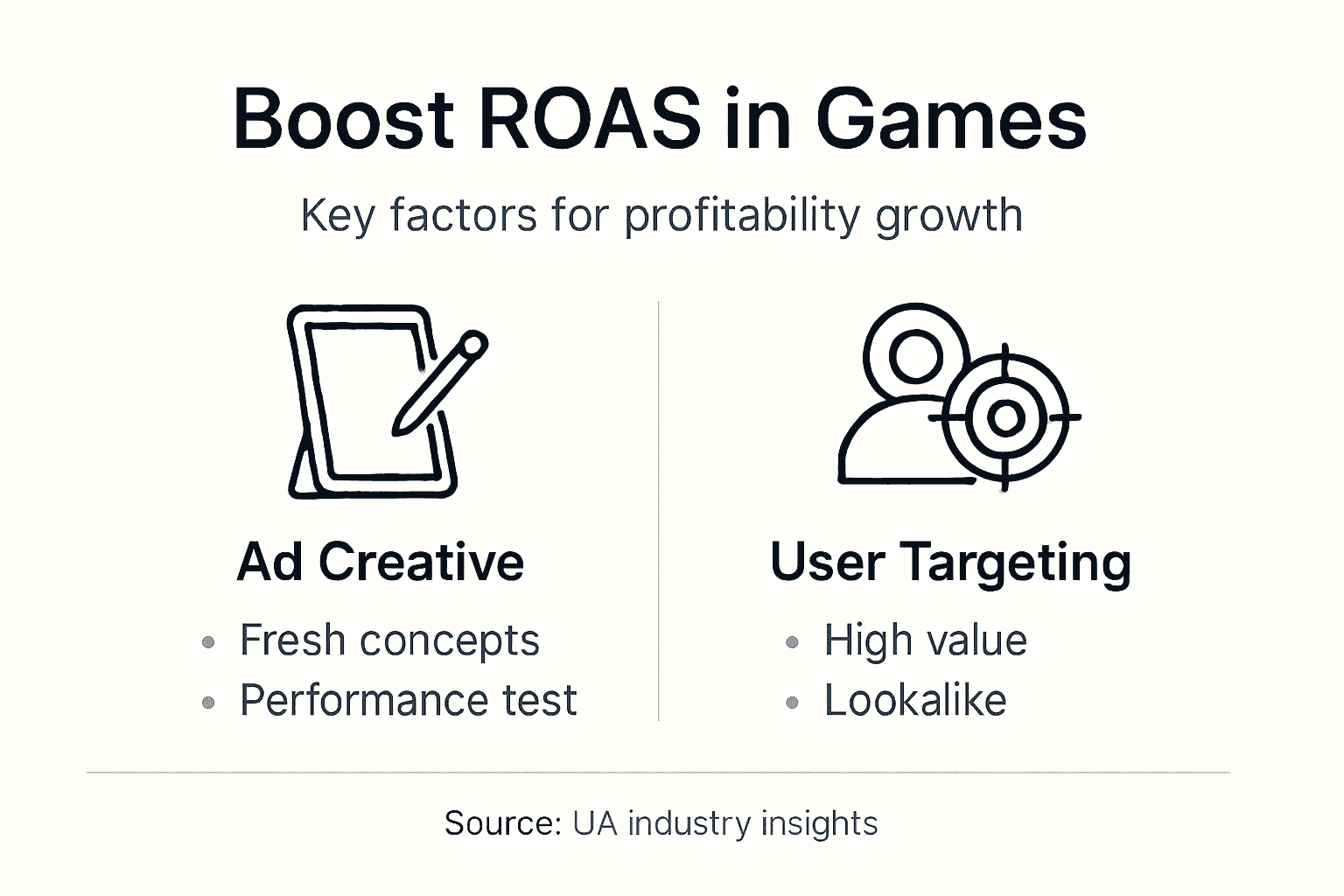
Ad creative quality became the dominant factor post iOS ATT privacy changes. Industry analysis shows that changes in iOS ATT have increased importance of creative quality and precise platform attribution to maintain healthy ROAS. With limited tracking data, compelling creatives that accurately represent gameplay drive better user quality and engagement, directly impacting monetization.
Monetization model fundamentally shapes ROAS expectations and measurement. IAP heavy games concentrate revenue among small whale segments, creating high variance but potentially massive returns. Ad revenue games monetize broadly across users through impressions, generating steadier but lower per user returns. Your monetization workflow must align with UA strategy.
Key ROAS drivers include:
- Creative quality and accurate gameplay representation in ads
- User targeting precision to acquire high LTV segments
- Monetization design matching user acquisition and retention mechanics
- Platform attribution technology revealing performance by source
- Campaign budget allocation based on real time ROAS signals
Pro tip: Implement fail rescue creative testing where you systematically test new ad concepts, kill underperformers within 48 hours, and scale winners to sustain ROAS improvements as fatigue sets in.
Precise user targeting maximizes value by focusing spend on segments likely to monetize. Lookalike audiences based on high spenders, interest targeting aligned with game themes, and geographic focus on regions with strong payment rates all improve ROAS efficiency. Attribution technology helps you understand which platforms, creatives, and audiences actually drive revenue versus just installs.
The relationship between ad monetization strategy and ROAS targets means hybrid models balancing IAP and ads often achieve more consistent returns than relying on either alone. Optimization strategies should test both revenue streams and adjust targeting based on which user segments prefer each monetization path.
ROAS Benchmarks and Genre Specific Insights
ROAS performance standards vary significantly by game genre and monetization cycle. Setting realistic targets aligned with your game type prevents misinterpreting results and guides optimization priorities.

A common profitability threshold is 1.5x Day 30 ROAS, meaning $1.50 revenue per $1.00 ad spend at 30 days post install. This indicates positive unit economics that can scale. However, genres monetizing over longer periods need extended measurement windows. Research indicates that strategy games require 60 to 180 day ROAS tracking due to longer monetization cycles and delayed revenue recognition.
| Genre | Day 7 ROAS | Day 30 ROAS | Day 180 ROAS | Notes |
|---|---|---|---|---|
| Hypercasual | 0.8x to 1.2x | 1.0x to 1.5x | N/A | Fast monetization through ads, short lifecycle |
| Casual Puzzle | 0.4x to 0.8x | 1.2x to 1.8x | 2.0x+ | Mix of ads and IAP, moderate retention |
| Midcore Action | 0.3x to 0.6x | 1.0x to 1.5x | 2.5x to 4.0x | IAP focused, builds over weeks |
| Strategy | 0.2x to 0.4x | 0.8x to 1.2x | 2.0x to 5.0x+ | Slow burn, whale dependent, extended LTV |
| RPG | 0.3x to 0.5x | 0.9x to 1.4x | 2.5x to 4.5x | Deep progression, delayed high value purchases |
Hypercasual games monetize primarily through ad impressions within early sessions, achieving break even or slight profit by Day 30. Their short user lifecycles mean 60+ day tracking adds little value. Strategy and RPG titles rely on players reaching mid to late game content before making significant IAP, requiring patience and longer windows to see true returns.
Ad revenue dominant genres show different patterns than IAP focused games. Ad monetization spreads revenue across more users but at lower per user values, while IAP concentrates returns among small spender segments with high variance. Aligning your ROAS goals with these genre specific benchmarks prevents unrealistic expectations. If your strategy game shows 0.5x at Day 30, that may be on track for strong Day 180 performance rather than a failure signal requiring panic optimization.
Monitor genre trends within your specific game category and geography. Premium markets like North America and Western Europe typically show higher ROAS due to stronger payment rates, while high volume markets like Southeast Asia may show lower returns per user but greater scale opportunities.
Practical Strategies to Improve ROAS in Mobile Game UA
Improving ROAS requires systematic optimization across creatives, targeting, and budget allocation. These actionable tactics help UA managers increase returns and scale campaigns profitably.
Industry best practices show that creative iteration, whale targeting, and cross platform ad mediation are proven strategies to sustainably boost ROAS. Start with creative testing because ad fatigue constantly erodes performance. Implement these steps:
- Run A/B tests comparing 3 to 5 creative concepts per campaign weekly
- Track ROAS and retention metrics for each creative variant
- Kill underperformers within 48 to 72 hours to prevent wasted spend
- Scale winning creatives with increased budgets until performance declines
- Refresh top performers with iterative variations to combat fatigue
Targeting high value users dramatically improves ROAS by focusing spend on segments likely to monetize. Build lookalike audiences from your top 10% spenders, not all users. Use interest targeting matching your game themes and test geographic segments to identify regions with best payment rates. Retargeting engaged users who installed but haven’t purchased yet often yields strong returns at lower cost than cold acquisition.
| Traditional UA Approach | ROAS Focused Strategy | Impact |
|---|---|---|
| Optimize for lowest CPI | Optimize for highest Day 30 ROAS | Acquires monetizing users vs cheap installs |
| Broad audience targeting | Lookalike audiences from top spenders | Concentrates spend on high LTV potential |
| Set and forget campaigns | Daily monitoring with rapid optimization | Prevents budget waste on declining performance |
| Single creative per campaign | Continuous A/B testing and iteration | Combats fatigue and sustains performance |
| Equal budget across platforms | Dynamic allocation based on ROAS | Shifts spend to best performing channels |
Pro tip: Use advanced cohort analysis to identify your best performing user acquisition segments by creative, geography, and platform, then concentrate 70% of budget on proven winners while testing new approaches with 30%.
Ad mediation and cross promotion help maximize revenue from acquired users, improving the revenue side of ROAS calculations. Optimizing waterfall configurations and testing multiple ad networks often increases ad revenue 15% to 25% without changing user acquisition. Budget shifting based on real time ROAS signals ensures you scale what works and cut what doesn’t before burning significant cash.
Apply these UA strategies for mobile games systematically rather than making one time adjustments. Sustainable ROAS improvement requires ongoing data driven iteration. When launching mobile game ads, build optimization into your workflow from day one rather than treating it as an afterthought.
Conclusion: Bridging ROAS Understanding to Profitable UA Growth
ROAS stands as the most crucial metric for user acquisition profitability in mobile games because it directly connects advertising spend to revenue generation. Unlike CPI which measures only acquisition cost or ROI which blends all business expenses, ROAS isolates campaign effectiveness and enables precise optimization.
Cohort based measurement at Day 7, Day 30, and beyond captures the delayed monetization patterns typical in mobile games. Genre aware benchmarks help you set realistic targets, whether you need 1.5x at Day 30 for casual games or patience for 2.5x+ at Day 180 for strategy titles. Continuous optimization through creative testing, whale targeting, and data driven budget allocation transforms ROAS from a measurement tool into a growth engine.
Founders and UA managers who shift focus from install volume to revenue driven metrics like ROAS build sustainable acquisition strategies that scale profitably. Your competitors burning cash on cheap installs will struggle while you acquire users who actually generate returns. Master ROAS tracking and optimization to transform user acquisition from a cost center into a profit driver.
Optimize Your Mobile Game UA with Expert Guidance
Applying these ROAS strategies requires deep expertise in mobile game user acquisition and performance marketing. Ramiz Trtovac brings proven experience leading UA initiatives and running large scale campaigns across multiple ad networks to help studios launch and scale profitably.
Whether you’re struggling to improve campaign returns or ready to scale successful user acquisition, expert guidance accelerates your path to profitability. Explore proven approaches for mobile game marketing growth and leverage mobile game analytics for UA profitability to make better data driven decisions. Ready to launch mobile game ads that actually drive returns? Let’s transform your user acquisition strategy together.
What Is ROAS in Games? Frequently Asked Questions
How soon should I track ROAS after install for different game genres?
Hypercasual games monetize primarily through ads within the first few sessions, so Day 7 ROAS provides meaningful signals. Casual puzzle games benefit from Day 30 tracking to capture IAP conversion cycles. Strategy and RPG titles require 60 to 180 day windows because players must progress deep into content before making significant purchases that drive returns.
Does ROAS include all operational costs like ROI does?
No, ROAS isolates only advertising spend versus attributed revenue from those ads. It excludes development costs, salaries, server expenses, and other operational overhead. This narrow focus makes ROAS more actionable for optimizing specific campaigns. ROI measures total business profitability including all costs, providing a broader but less granular view of marketing effectiveness.
How do ad creatives specifically impact ROAS on iOS after ATT changes?
iOS privacy restrictions limit user level tracking data, making aggregate creative performance the primary optimization signal. High quality creatives that accurately represent gameplay attract users genuinely interested in your game, improving engagement and monetization rates. Misleading or low quality ads may drive installs but result in immediate churn and zero revenue, destroying ROAS. Creative testing and iteration became essential post ATT.
What benchmarks indicate good ROAS beyond Day 30 for slow monetizing games?
Strategy games should target 2.0x to 3.0x ROAS by Day 90 and 3.0x to 5.0x+ by Day 180. RPG titles typically aim for 2.5x to 4.0x at Day 90. These extended timeframes account for the progression systems and content depth required before players make large IAP. Any game with subscription models or seasonal content should track 180+ day ROAS to capture renewal cycles.
What are best practices to avoid common ROAS measurement errors?
Ensure accurate campaign tagging with unique identifiers for every ad source. Use mobile measurement partners with proven attribution technology rather than relying on self reported platform data. Set cohort windows matching your monetization cycle instead of using arbitrary timeframes. Exclude organic installs from paid ROAS calculations to avoid inflating performance. Review attribution windows regularly because platform changes can shift where revenue gets credited.
Recommended
- Playable Ads: Boosting Game UA and Profitability
- Master Mobile Game UA Workflow for Profitable Launches
- Effective User Acquisition Strategies – Blog posts
- Game Marketing Roadmap: Launch and Scale UA Profitably